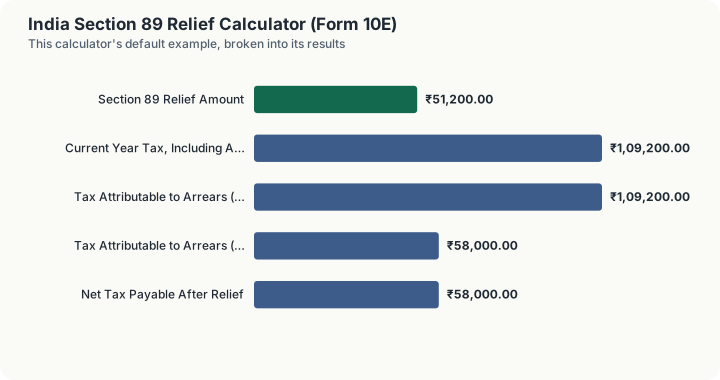
Quick Answer: A taxpayer receiving ₹5,00,000 in salary arrears this year -- on top of ₹10,00,000 of regular income (new regime, below 60) -- sees current-year tax rise by ₹1,09,200 because of the arrears, but only ₹58,000 of that increase would have applied had the arrears been received in the earlier year they relate to. Section 89 relief of ₹51,200 removes the extra tax caused purely by receiving the money late, bringing net tax on the arrears down to ₹58,000.
Overview
When salary arrears, advance salary, or certain other payments cover income that legally "belongs" to an earlier year but land in your bank account this year, they get added to this year's total income -- which can shove you into a higher tax bracket you would never have hit if the money had arrived on time. Section 89(1), computed under Rule 21A of the Income Tax Rules, exists specifically to neutralize that timing penalty: it compares how much extra tax the arrears actually cost you this year against how much extra tax they would have cost in the year(s) they relate to, and refunds the difference as "relief," claimed via Form 10E.
This calculator performs the multi-year Rule 21A(2) arithmetic precisely: it computes your current year's tax with and without the arrears using this platform's verified FY2025-26 slabs, and combines that with the earlier year's own tax figures (which you supply, exactly as Form 10E's own Annexure I requires) to compute your exact relief and the resulting net tax on the arrears.
How This Is Calculated
Rule 21A(2) prescribes a four-step comparison:
- Tax on current-year income, including the arrears, at current-year rates.
- Tax on current-year income, excluding the arrears, at current-year rates. Step 3 is the difference -- the tax genuinely attributable to receiving the arrears this year.
- For each earlier year the arrears relate to: the tax that year's own income plus its allocated share of the arrears would have generated at that year's own rates, minus the tax actually paid that year (excluding arrears). Summed across every earlier year involved, this is Step 5.
- Relief is the excess of Step 3 over Step 5, floored at zero -- you can never receive negative relief (i.e., arrears can never increase your liability beyond what Step 3 alone would produce).
On Step 5's inputs: exactly like Form 10E's own Annexure I, this calculator asks you to supply each earlier year's tax figures (with and without its allocated arrears) directly, since Step 5 requires that year's own historical slab rates rather than the current year's -- the Form itself does not compute this for you either, and neither does this calculator attempt to reconstruct historical-year rate tables that have not been independently verified for this build.
Worked Example
Using the calculator's default inputs:
- Current Year Income (Excluding Arrears): ₹10,00,000, new regime, below 60
- Arrears Received This Year: ₹5,00,000
- Prior Year 1 -- Tax Excluding Arrears: ₹2,000; Tax Including Allocated Arrears: ₹60,000
Step by step:
- Tax on ₹10,00,000 (current year, excluding arrears): within the ₹12,00,000 rebate threshold → ₹0 net tax.
- Tax on ₹15,00,000 (current year, including arrears): 0% to ₹4L, 5% to ₹8L (₹20,000), 10% to ₹12L (₹40,000), 15% on the remaining ₹3L (₹45,000) = ₹1,05,000; exceeds the rebate threshold by more than the tax itself, so no rebate; cess 4% = ₹4,200 → ₹1,09,200.
- Step 3: ₹1,09,200 − ₹0 = ₹1,09,200.
- Step 5: ₹60,000 − ₹2,000 = ₹58,000 (the extra tax the arrears would have caused in the year they relate to, at that year's own rates).
- Relief: max(0, ₹1,09,200 − ₹58,000) = ₹51,200.
- Net tax payable on the arrears after relief: ₹1,09,200 − ₹51,200 = ₹58,000 -- exactly matching what the tax impact would have been had the arrears arrived on time.
What This Does Not Account For
- Historical-year tax slabs. This calculator does not recompute each earlier year's tax from a historical rate table; you supply those two figures per year directly, as Form 10E's Annexure I itself requires.
- More than two prior years. This calculator supports arrears spanning up to two earlier years; genuine multi-year arrears spanning three or more years follow the identical Step 5 summation logic, just extended further.
- Gratuity, compensation on termination, or commuted pension relief, which Rule 21A computes under separate sub-rules (3, 4, and 5) using an "average rate of tax" method rather than the incremental arrears method modeled here.
- The mandatory electronic filing of Form 10E before the relief can actually be claimed in your ITR -- this calculator computes the relief math only, not the filing procedure.
- State-level tax or surcharge/cess interactions beyond what is already built into the current-year tax computation.
Common Pitfalls
- Claiming Section 89 relief in the ITR without filing Form 10E first. The Income Tax Department's return-processing system (CPC) systematically denies the relief if Form 10E was not filed electronically before the ITR, even if the relief amount itself is correctly claimed.
- Assuming the current year's higher slab automatically means you're owed relief. If the arrears wouldn't have caused meaningfully more tax in the year they relate to either (Step 5 close to Step 3), the relief can be small or zero -- relief exists to offset a timing penalty, not to reduce tax below what would have applied either way.
- Mixing up which year's rates apply where. Step 3 always uses current-year rates for both "with" and "without" arrears; Step 5 always uses each prior year's own rates -- using the wrong year's rates in either step produces an incorrect relief figure.
- Forgetting relief can never be negative. If Step 5 exceeds Step 3 (the arrears would have cost more tax in the earlier year than they cost this year), relief is simply zero -- you are never required to pay more because of Section 89.
- Applying this calculator to gratuity, leave encashment, or pension commutation instead of salary arrears. Those use a different average-rate mechanism under separate Rule 21A sub-rules, not the incremental method shown here.
Frequently Asked Questions
What is Form 10E and why do I need it for Section 89 relief?
How do I know how much of my arrears relates to each earlier year?
Can Section 89 relief make my tax on the arrears negative or create a refund larger than the arrears themselves?
Is gratuity or leave encashment received in arrears eligible for this same calculator?
Does my employer already account for Section 89 relief when deducting TDS on my arrears payment?
Sources
- Section 89(1), Income-tax Act, 1961. incometax.gov.in/iec/foportal
Also consulted: Rule 21A, Income-tax Rules, 1962 (the four-step relief computation for salary arrears/advance salary under sub-rule (2); separate sub-rules (3)-(5) cover gratuity, termination compensation, and commuted pension); Form 10E, Income Tax Department (mandatory e-filing prerequisite for claiming Section 89 relief).