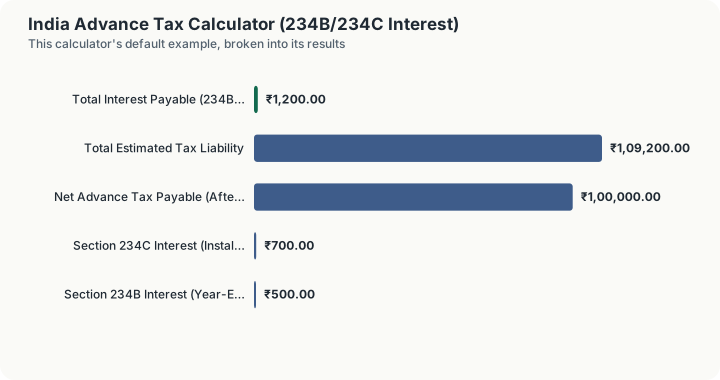
Quick Answer: A taxpayer with ₹15,00,000 estimated taxable income (new regime, FY2025-26), ₹9,200 already withheld as TDS, who missed the first installment and never reached 90% of the ₹1,00,000 net advance tax payable by year-end, owes ₹1,200 in combined Section 234B and 234C interest -- ₹700 from installment shortfalls and ₹500 from the year-end 90% shortfall.
Overview
India requires most taxpayers with a net tax liability above ₹10,000 in a year to pay that tax in advance, in four installments across the financial year, rather than as a single lump sum at filing time. Miss an installment, and Section 234C charges interest on the shortfall against that specific due date; fall short of 90% of your total liability by the final 15 March deadline, and Section 234B adds interest on top, running from the start of the assessment year until you actually settle the balance. Both are simple 1%-per-month charges, but they compound in a way that surprises freelancers, consultants, and anyone with significant non-salary income who assumes "I'll just pay it all at filing time."
This calculator walks through the exact cumulative percentage due at each of the four statutory dates, checks your actual payments against the built-in statutory tolerance at each one, and computes both 234C and 234B interest precisely -- so you can see not just whether you owe interest, but exactly which installment caused it and how much delay is costing you per month.
How This Is Calculated
- Determine net advance tax payable. Total estimated tax liability for the year, minus TDS/TCS already collected.
- Check each installment against its cumulative percentage and statutory tolerance, per Section 211(1)(a) and Section 234C:
| Due Date | Cumulative % Required | Tolerance (no interest if met) |
|---|---|---|
| 15 June | 15% | 12% |
| 15 September | 45% | 36% |
| 15 December | 75% | 75% |
| 15 March | 100% | 100% |
If cumulative payment by a due date falls short of that installment's tolerance, interest accrues at 1%/month on the shortfall -- 3 months for each of the first three installments, 1 month for the final one.
- Check the 90% year-end threshold under Section 234B. If total advance tax paid by year-end is less than 90% of the final assessed tax, interest accrues at 1%/month on the remaining shortfall, from 1 April of the assessment year until the balance is actually paid.
Worked Example
Using the calculator's default inputs:
- Estimated Annual Taxable Income: ₹15,00,000 (new regime)
- TDS Already Deducted: ₹9,200
- Cumulative Paid: ₹0 (15 June) → ₹45,000 (15 September) → ₹75,000 (15 December) → ₹75,000 (15 March)
- Months Until Balance Paid: 2
Step by step:
- Total estimated tax on ₹15,00,000: ₹1,09,200. Net advance tax payable: ₹1,09,200 − ₹9,200 = ₹1,00,000.
- Required cumulative amounts: ₹15,000 / ₹45,000 / ₹75,000 / ₹1,00,000.
- 15 June: paid ₹0, below the ₹12,000 tolerance → shortfall ₹15,000, 3 months' interest = ₹450.
- 15 September: paid ₹45,000, meets the ₹36,000 tolerance → no interest.
- 15 December: paid ₹75,000, meets the ₹75,000 tolerance exactly → no interest.
- 15 March: paid ₹75,000, short of the full ₹1,00,000 required → shortfall ₹25,000, 1 month's interest = ₹250.
- Total Section 234C interest: ₹450 + ₹250 = ₹700.
- Section 234B: final payment (₹75,000) is below 90% of ₹1,00,000 (₹90,000) → shortfall ₹25,000, 2 months' delay = ₹500.
- Total interest payable: ₹700 + ₹500 = ₹1,200.
What This Does Not Account For
- Section 44AD/44ADA presumptive-scheme taxpayers, who are required to pay their entire advance tax liability in a single installment by 15 March (100%), not across the four-installment schedule modeled here -- see the Presumptive Taxation Calculator for that scheme.
- Revisions to estimated income mid-year. If your income estimate changes significantly between installments (a bonus, a large capital gain, a new client), each installment's "required" cumulative amount should technically be reassessed against your updated full-year estimate -- this calculator uses a single estimate for the whole year.
- Section 234A interest (for late filing of the return itself), which is separate from both 234B and 234C and not computed here.
- Interest waivers or rebates the Assessing Officer may grant in specific circumstances (Section 234C proviso for certain capital gains/dividend income received late in the year, for instance) -- this calculator applies the standard rule uniformly.
- Rounding conventions used by the actual e-filing portal, which may round each interest component slightly differently than the exact arithmetic shown here.
Common Pitfalls
- Assuming a small net liability escapes advance tax entirely. The obligation to pay advance tax applies once net tax liability (after TDS) exceeds ₹10,000 for the year -- many salaried taxpayers with meaningful side income cross this threshold without realizing it.
- Believing you can "catch up" penalty-free by paying everything on 15 March. Sections 234C's per-installment tolerance means missing the June/September/December dates generates interest on those specific shortfalls even if the year-end total is eventually correct.
- Confusing the December and March tolerances (both effectively 75%/100%, with no grace band) with the more forgiving 12%/36% tolerances on the first two installments. The grace shrinks to zero for the final two due dates.
- Not distinguishing 234B from 234C. 234C penalizes missing the specific quarterly schedule; 234B separately penalizes an overall shortfall against 90% of final liability by year-end, and continues accruing until the balance is actually paid -- these can and do stack.
- Forgetting freelancers/consultants with irregular income still owe advance tax on a normal quarterly schedule (unless they qualify for and elect the 44AD/44ADA single-installment presumptive scheme), not just at filing time.
Frequently Asked Questions
Who is required to pay advance tax in India?
What happens if I pay all my tax on 15 March instead of spreading it across the year?
Is the interest rate always 1% per month?
Does presumptive taxation (44AD/44ADA) follow the same four-installment schedule?
If my income estimate turns out to be wrong, do I still owe interest based on the final actual tax?
Can I revise an earlier advance tax installment if my income estimate changes mid-year?
Does paying advance tax early, ahead of a due date, earn any interest or benefit?
Sources
- Section 211(1)(a), Income-tax Act, 1961 (advance tax installment schedule and percentages). incometax.gov.in/iec/foportal
Also consulted: Section 234B, Income-tax Act, 1961 (interest for shortfall in advance tax payment); Section 234C, Income-tax Act, 1961 (interest for deferment of advance tax installments).