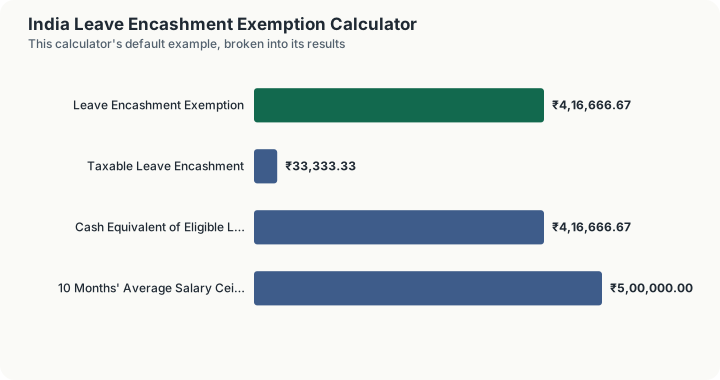
Quick Answer: A private-sector employee retiring after 20 years of service, with a 10-month average salary of ₹50,000/month, 250 days of unused earned leave, and ₹4,50,000 actually received as leave encashment, can exempt ₹4,16,666.67 of that under Section 10(10AA) -- leaving just ₹33,333.33 taxable as salary income.
Overview
Leave encashment -- the lump sum paid out for unused earned leave, typically at retirement or resignation -- gets very different tax treatment depending on who you work for. Government employees (Central and State) get their leave encashment fully tax-free with no monetary ceiling at all. Everyone else falls under Section 10(10AA)(ii), which exempts only the smallest of four separately computed limits: the actual amount received, a statutory ceiling, a 10-month average-salary figure, and -- the one most people never check -- the cash value of leave capped at a maximum of 30 days for every year of actual service, regardless of how much leave your employer's policy actually let you accumulate.
This calculator applies all four limbs correctly, including the notified ceiling (raised from ₹3,00,000 to ₹25,00,000 by a May 2023 government notification, a change many people still don't know about) and the 30-day-per-year leave cap, so you know precisely how much of your payout is exempt and how much adds to your taxable salary income.
How This Is Calculated
For non-government employees, the exemption under Section 10(10AA)(ii) is the least of:
Limb (c) uses the average of Basic Pay + DA (where DA forms part of retirement benefits) over the 10 months immediately preceding retirement, multiplied by 10.
Limb (d) is the more subtle one: the Act's own Explanation caps eligible leave at a maximum of 30 days for every year of actual service rendered -- so if your employer's policy let you accumulate more than that (a common outcome with generous leave-carry-forward policies), only the 30-days/year portion counts toward this limb, valued at your average daily salary (average monthly salary ÷ 30).
Government employees skip this entire calculation: Section 10(10AA)(i) exempts their leave encashment in full, with no ceiling. This exemption is available under both the old and new tax regimes, since Section 115BAC(2)'s list of exemptions blocked under the new regime does not include clause (10AA).
Worked Example
Using the calculator's default inputs:
- Average Monthly Salary, Last 10 Months: ₹50,000
- Earned Leave Days Standing to Credit: 250
- Years of Actual Service: 20
- Actual Leave Encashment Received: ₹4,50,000
- Employee Type: Private sector (not government)
Step by step:
- Maximum eligible leave: 20 years × 30 days/year = 600 days. Actual leave standing (250) is below this cap, so all 250 days count.
- (d) Cash equivalent of eligible leave: ₹50,000 ÷ 30 × 250 = ₹4,16,666.67
- (c) 10 months' average salary: ₹50,000 × 10 = ₹5,00,000
- (b) Notified ceiling: ₹25,00,000
- (a) Actual amount received: ₹4,50,000
- Least of the four: ₹4,16,666.67 -- limb (d) is binding.
- Exempt: ₹4,16,666.67. Taxable: ₹4,50,000 − ₹4,16,666.67 = ₹33,333.33, added to salary income for the year.
If the same employee had only 5 years of service instead of 20, the eligible-leave cap would drop to just 150 days (5 × 30), regardless of how many days actually stood to their credit -- a scenario worth checking explicitly if your service period is shorter than your accumulated leave would suggest.
What This Does Not Account For
- Aggregation across multiple employers in the same year. If you received leave encashment from more than one employer in the same previous year, the ₹25,00,000 ceiling applies in aggregate across all of them, not separately per employer -- this calculator computes a single-employer scenario.
- Leave encashment received while still in service (not at retirement/resignation), which is fully taxable as salary with no Section 10(10AA) exemption at all -- this calculator assumes a retirement/resignation payout.
- The specific definition of "earned leave" under your employer's leave policy versus other leave types (sick leave, casual leave) that may not qualify as "earned leave" for this computation at all.
- State government or PSU-specific leave encashment rules that may differ from the standard Central Government treatment for "government employee" purposes.
- Any prior leave encashment exemption already claimed with a previous employer, which would reduce the remaining ₹25,00,000 ceiling available for a subsequent employer's payout in a later year -- this calculator assumes no prior claims.
Common Pitfalls
- Assuming leave encashment is exempt just because it's paid at retirement. For non-government employees, exemption is capped by all four limbs simultaneously -- high earners with substantial accumulated leave often find the exemption capped well below what they actually received.
- Forgetting the 30-days-per-year-of-service cap on eligible leave. An employee with 20 years of service and 400 days of accumulated leave can only count 600 days as eligible under the 30-day cap in the first place -- but if the accumulated balance is even higher (say, 700 days), only 600 count, not the full balance.
- Using total years worked across multiple employers instead of years of service with the employer paying the encashment. The 30-day-per-year cap uses actual service with that employer, not a taxpayer's total career length.
- Not knowing the ceiling increased in 2023. Many taxpayers and even some employers still apply the outdated ₹3,00,000 ceiling from before the May 2023 notification -- always confirm you're using the current ₹25,00,000 limit for FY2025-26.
- Confusing "government employee" eligibility. Only Central and State Government employees qualify for the fully-exempt treatment under 10(10AA)(i) -- public sector undertaking (PSU) employees, even those of government-owned companies, are generally treated as non-government employees for this specific exemption.
Frequently Asked Questions
Is leave encashment taxable in India?
What is the current tax-free limit on leave encashment?
Does the 30-day-per-year cap use my total leave balance or something else?
Is leave encashment exemption available if I choose the new tax regime?
What if I receive leave encashment from two different employers in the same year?
Is leave encashment received while I'm still employed (not retiring) tax-free too?
Sources
- Section 10(10AA), Income-tax Act, 1961 (both sub-clauses (i) government and (ii) non-government, including the Explanation's 30-day-per-year leave cap). incometax.gov.in/iec/foportal
Also consulted: Press Information Bureau (Government of India) release, 25 May 2023, confirming the increased ₹25,00,000 exemption limit under Notification No. 31/2023, dated 24 May 2023, effective 1 April 2023; Section 115BAC(2)(i), Income-tax Act, 1961 (confirms Section 10(10AA) is not excluded under the new tax regime).