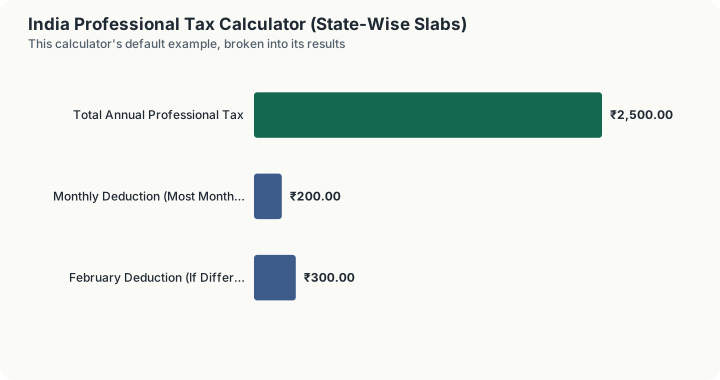
Quick Answer: A salaried employee earning ₹30,000/month in Maharashtra pays ₹2,500/year in professional tax (₹200/month, ₹300 in February), while the same salary in Delhi, Uttar Pradesh, or Haryana attracts ₹0 -- those states don't levy professional tax at all. This calculator is built for Indian employers and employees, with every figure shown in ₹ (INR).
Overview
Professional Tax (PT) is a small, state-levied direct tax on salaries, wages, and professional/trade income in India -- not to be confused with income tax, which is a central-government tax. It's authorized under Article 276 of the Constitution, which caps the annual amount any state can charge a single individual at ₹2,500, regardless of how high that person's income actually is. Because Article 276 sets a ceiling rather than a single national rate, each state that chooses to levy PT sets its own slab structure below that cap -- which is why the same ₹30,000 monthly salary can mean a real annual deduction in one state and exactly ₹0 in a neighboring one.
This calculator is built for Indian employers running payroll, and for employees who want to check their own PT deduction. It covers five states with verified, currently-in-force slabs -- Maharashtra, Karnataka, West Bengal, Andhra Pradesh, and Telangana -- plus three states that are explicitly confirmed to levy no professional tax at all: Delhi, Uttar Pradesh, and Haryana. This is not an exhaustive list of every Indian state; several other states (Tamil Nadu, Gujarat, Kerala, Madhya Pradesh, Odisha, Assam, Bihar, and others) also levy their own professional tax under separate state legislation not modeled in this tool, and this calculator intentionally does not guess at their figures.
Professional tax is deducted by the employer directly from an employee's salary each month (for salaried employees) and remitted to the state government; self-employed professionals and traders register and pay it directly themselves. Because employer liability to deduct is automatic under each state's Act, getting the slab wrong is not a paperwork inconvenience -- it's a compliance failure with penalty exposure for the employer.
How This Is Calculated
Professional tax in the states this calculator covers depends on the employee's gross monthly salary or wages compared against that state's slab thresholds:
Two of the covered states (Maharashtra and Karnataka) use a structure that charges a flat monthly amount for eleven months and a slightly higher amount in February, so the exact annual total lands precisely on the ₹2,500 constitutional cap:
The other three covered states (West Bengal, Andhra Pradesh, Telangana) charge the same flat monthly amount in every month, including February:
Verified current slabs (as sourced below):
- Maharashtra (Profession Tax Act, 1975, Schedule I, rate in force since 1 April 2023): Men -- Nil up to ₹7,500/month; ₹175/month from ₹7,501-10,000; ₹2,500/year (₹200/month, ₹300 in February) above ₹10,000. Women -- Nil up to ₹25,000/month; ₹2,500/year (same ₹200/₹300 structure) above ₹25,000.
- Karnataka (Karnataka Tax on Professions Amendment Act, 2025, effective 1 April 2025): Nil up to ₹25,000/month (raised from the previous ₹15,000 threshold); ₹2,500/year (₹200/month, ₹300 in February) above ₹25,000.
- West Bengal (Schedule I rates in force since 1 April 2013): Nil up to ₹7,000/month, then rising through ₹50, ₹90, ₹110, ₹130, and ₹150 bands, up to ₹200/month (₹2,400/year) above ₹40,000.
- Andhra Pradesh & Telangana (Andhra Pradesh Tax on Professions, Trades, Callings and Employments Act, 1987, continued in both states post-2014 bifurcation): Nil up to ₹15,000/month; ₹150/month from ₹15,001-20,000; ₹200/month (₹2,400/year) above ₹20,000.
- Delhi, Uttar Pradesh, Haryana: ₹0 -- these states do not levy professional tax under any state legislation.
Worked Example
Scenario 1: A male employee earning ₹12,000/month in Maharashtra. ₹12,000 exceeds Maharashtra's ₹10,000 top threshold for men.
Step 1: Determine the monthly rate. Above ₹10,000/month → ₹200/month (₹300 in February).
Step 2: Calculate the annual total.
This hits Maharashtra's -- and the constitutional -- ₹2,500 annual cap exactly.
Scenario 2: The same ₹12,000/month salary, but the employee works in Karnataka instead. Karnataka's threshold, revised in 2025, exempts everyone earning up to ₹25,000/month.
Under the pre-2025 Karnataka rules (₹15,000 threshold), this same salary would have triggered PT; the April 2025 amendment specifically moved this income band out of scope.
Scenario 3: A West Bengal employee earning ₹28,000/month. This falls in West Bengal's ₹25,001-40,000 band.
Unlike Maharashtra and Karnataka, West Bengal charges the same ₹150 in every month, including February -- there is no higher February payment to true up to a round annual figure.
Scenario 4: The same ₹28,000/month salary, but in Delhi. Delhi does not levy professional tax under any statute.
What This Does Not Account For
- States outside the eight covered here. Tamil Nadu, Gujarat, Kerala, Madhya Pradesh, Odisha, Assam, Bihar, Jharkhand, Chhattisgarh, and several smaller states/UTs also levy professional tax under their own separate schedules, which are not modeled in this calculator. Do not assume a state not listed here has no PT -- check that state's specific Act.
- Non-salary professional tax categories. Most states' PT Acts also separately tax self-employed professionals, traders, partnership firms, companies, and specific licensed occupations (often at flat annual amounts independent of salary slabs). This calculator only models the salary/wage-earner slab, not those separate categories.
- Multi-state employment or mid-year transfers. If an employee is transferred between states covered by different PT regimes partway through the year, the actual annual liability is a proration across both states' rules, which this single-state calculator does not compute.
- Registration and enrolment compliance mechanics. This tool calculates the tax amount only; it does not address employer registration certificates, employee enrolment certificates, monthly/annual return filing deadlines, or state-specific penalty structures for late payment.
- Future rate changes. State PT slabs are revised periodically by state legislatures (Karnataka's April 2025 amendment being a recent example). Always verify the current notified slab against the specific state's commercial/tax department before finalizing payroll.
Common Pitfalls
- Assuming professional tax applies uniformly nationwide. PT is a state subject; roughly half of India's states and union territories don't levy it at all, and among those that do, thresholds and rates vary widely -- there is no single "India professional tax rate."
- Mapping PT to the employer's registered office instead of the employee's actual work location. Professional tax is owed to the state where the employee is actually working, not necessarily where the company is headquartered or registered.
- Missing the February step-up in Maharashtra and Karnataka. Payroll systems that apply a flat monthly PT rate all twelve months, without the higher February deduction, under-collect by the exact amount needed to reach the ₹2,500 annual cap.
- Using stale slab thresholds. Karnataka's exemption threshold moved from ₹15,000 to ₹25,000/month effective 1 April 2025 -- a payroll calculation still using the old ₹15,000 cutoff will incorrectly deduct PT from employees who are now exempt.
- Assuming Andhra Pradesh and Telangana still share identical administration. The two states have used the same rate schedule since their 2014 bifurcation, but they are administered by separate state commercial tax departments with separate registration and filing portals.
Frequently Asked Questions
What is the professional tax slab in Maharashtra for 2026?
Does Karnataka still charge professional tax on a ₹20,000 salary?
Which Indian states have no professional tax at all?
What is the maximum professional tax anyone can be charged in India?
Is professional tax the same as income tax?
Who is responsible for deducting and paying professional tax?
Sources
- Income Tax Department, Government of India, the official authority for the national tax authority this calculator relates to. incometax.gov.in/iec/foportal
Also consulted: Constitution of India, Article 276 (Taxes on professions, trades, callings and employments) -- the ₹2,500/year statutory ceiling; Maharashtra Profession Tax Act, 1975, Schedule I rate schedule, "as on 31.03.2025" (Maharashtra Goods and Services Tax Department, mahagst.gov.in); Karnataka Tax on Professions, Trades, Callings and Employments (Amendment) Act, 2025 (Karnataka Act No. 33 of 2025), effective 1 April 2025; West Bengal State Tax on Professions, Trades, Callings and Employments Act, 1979, Schedule I; Andhra Pradesh Tax on Professions, Trades, Callings and Employments Act, 1987, as administered by the Telangana and Andhra Pradesh Commercial Taxes Departments.