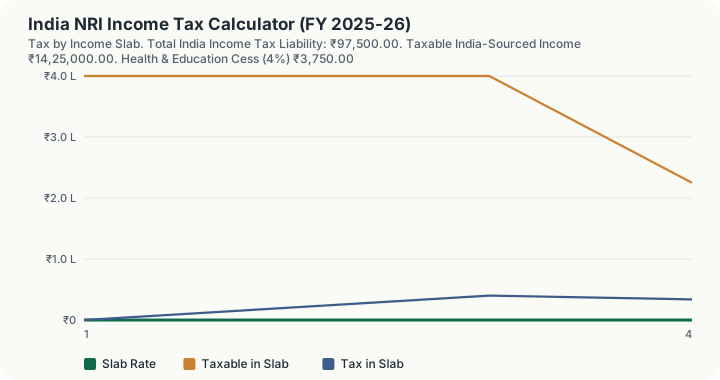
Quick Answer: For a Non-Resident Indian (NRI) with ₹15,00,000 (₹15 lakh) of India-sourced income and no other deductions, the new-regime FY 2025-26 tax works out to a taxable income of ₹14,25,000 after the ₹75,000 standard deduction, a base tax of ₹93,750, plus 4% cess of ₹3,750, for a total India tax liability of ₹97,500 -- with no Section 87A rebate available, unlike a resident Indian at the same income level.
Overview
This calculator is built specifically for Non-Resident Indians (NRIs) -- Indian citizens or Persons of Indian Origin (PIOs) who do not meet the Section 6 residency thresholds for a given tax year. It is not for resident Indians, and it does not compute tax on income earned outside India.
The single most consequential rule an NRI needs to understand: an NRI is taxed in India only on income earned, accrued, or received in India -- salary for Indian services, rent from Indian property, interest from Indian accounts, capital gains on Indian assets. A Resident and Ordinarily Resident (ROR) Indian, by contrast, is taxed on global income, wherever earned. Misjudging your residential status is the costliest NRI tax mistake in either direction -- under-reporting India-taxable income if you're actually resident, or failing to disclose global income and foreign assets if you wrongly assume NRI status.
This calculator walks through the Section 6 residential-status test (the 182-day / 60-day-plus-prior-years test, its NRI-specific carve-outs, and the Resident-but-Not-Ordinarily-Resident (RNOR) sub-status), and computes India income-tax liability on India-sourced income using current FY 2025-26 slab rates -- explicitly modeling that NRIs are never eligible for the Section 87A rebate that zeroes out tax for residents with income up to ₹12 lakh (new regime) or ₹5 lakh (old regime).
How This Is Calculated
1. Residential status (Section 6). The calculator applies these tests in order:
- Basic test: present in India 182 days or more in the tax year -> Resident.
- Employment-abroad / ship-crew carve-out: an Indian citizen who left for employment abroad, or as a crew member, is tested ONLY on the 182-day rule -- the 60-day alternate test never applies to this group.
- Visiting citizen/PIO carve-out: the ordinary 60-day alternate test is replaced. Above ₹15 lakh India income, it tightens to 120 days present this year and 365+ days across the preceding 4 years. At or below ₹15 lakh, no alternate test applies at all -- only 182 days matters.
- General alternate test: for everyone else, 60+ days this year plus 365+ days across the preceding 4 years also triggers residency (Section 6(1)(b)).
- Section 6(1A) "deemed resident": a citizen with India income over ₹15 lakh not liable to tax in any other country by domicile or residence is deemed resident even without meeting a day-count test -- but automatically RNOR, not full ROR. Targets individuals structured to be tax-resident nowhere.
- RNOR sub-test: even if resident, the individual is only RNOR -- taxed like an NRI, India-sourced income only -- if non-resident in 9 of the preceding 10 years, or present ≤729 days across the preceding 7 years. Otherwise, full ROR, taxed on global income.
2. Taxable income. India-sourced income, less the standard deduction against salary income (₹75,000 under the new regime, ₹50,000 under the old regime -- available to NRIs on the same terms as residents) and any other eligible deductions you enter.
3. Base tax. Computed progressively against the FY 2025-26 slab schedule for the selected regime:
| New Regime Slab | Rate |
|---|---|
| ₹0 - ₹4,00,000 | 0% |
| ₹4,00,000 - ₹8,00,000 | 5% |
| ₹8,00,000 - ₹12,00,000 | 10% |
| ₹12,00,000 - ₹16,00,000 | 15% |
| ₹16,00,000 - ₹20,00,000 | 20% |
| ₹20,00,000 - ₹24,00,000 | 25% |
| Above ₹24,00,000 | 30% |
The old regime uses the long-standing 0% / 5% / 20% / 30% slabs at ₹2.5L / ₹5L / ₹10L breakpoints, with a ₹50,000 standard deduction instead.
4. No Section 87A rebate, ever. A resident individual with taxable income up to ₹12 lakh (new regime) or ₹5 lakh (old regime) pays effectively zero tax after the Section 87A rebate. This rebate is available to resident individuals only. An NRI at the identical income level pays full slab-rate tax with no rebate offset -- this calculator never applies one.
5. Surcharge. Applies only above ₹50 lakh in taxable income, on a rising ladder (10% / 15% / 25%, capped at 25% above ₹5 crore under the new regime, or 37% above ₹5 crore under the old regime):
6. Cess. A flat 4% Health & Education Cess on (base tax + surcharge), with no exemption threshold.
Worked Example
Two separate discontinuities decide an NRI's Indian tax bill: the residency day count, and the ₹50 lakh surcharge floor. The base case comes first, then each threshold is walked from just under to just over.
The base case
Take a visiting Indian citizen with ₹15,00,000 of India-sourced salary, 90 days in India this year, 400 days across the preceding four, filing under the new regime.
Step 1 -- Residency test. India income is ₹15 lakh or less, so for a visiting citizen only the 182-day test applies. At 90 days it is not met, and the status is Non-Resident
Step 2 -- Taxable income after the standard deduction. ₹15,00,000 - ₹75,000 = ₹14,25,000
Step 3 -- Tax slab by slab. ₹0 to ₹4,00,000 at 0% = ₹0 ₹4,00,000 to ₹8,00,000 at 5% = ₹20,000 ₹8,00,000 to ₹12,00,000 at 10% = ₹40,000 ₹12,00,000 to ₹14,25,000 at 15% = ₹33,750
Step 4 -- Base tax. ₹20,000 + ₹40,000 + ₹33,750 = ₹93,750
Step 5 -- Section 87A rebate. Not available to a non-resident at any income level, so the rebate is ₹0
Step 6 -- Surcharge. Taxable income is below ₹50,00,000, so the surcharge is ₹0
Step 7 -- Cess and total. ₹93,750 × 4% = ₹3,750 ₹93,750 + ₹3,750 = ₹97,500 Effective rate: 6.50%. Marginal bracket: 15%
Threshold one: the ₹15 lakh residency switch
Step 8 -- The same person at 120 days in India, income exactly ₹15,00,000. Status: Non-Resident, because at or below ₹15 lakh the day-count alternate test does not exist for a visiting citizen
Step 9 -- One rupee more of India income, ₹15,00,001, still 120 days. The 120-day plus 365-day alternate test now applies and is met, so the status becomes Resident but Not Ordinarily Resident
That rupee changes the label but not the bill: RNOR is taxed on India-sourced income only, exactly like an NRI, so the liability moves from ₹97,500 to ₹97,500.16. The consequence sits outside this calculator, in reporting and in what happens when the RNOR window closes and full ROR status begins taxing global income.
Threshold two: the ₹50 lakh surcharge floor
Step 10 -- Salary of ₹50,00,000. Taxable income: ₹49,25,000 Base tax: ₹10,57,500. Surcharge rate: 0%. Cess: ₹42,300 Total: ₹10,99,800, an effective rate of 22.00%
Step 11 -- Salary of ₹51,00,000. Taxable income: ₹50,25,000, now above the ₹50 lakh line Base tax: ₹10,87,500. Surcharge at 10%: ₹1,08,750. Cess: ₹47,850 Total: ₹12,44,100, an effective rate of 24.39%
Step 12 -- What the extra ₹1,00,000 of salary cost. ₹12,44,100 - ₹10,99,800 = ₹1,44,300
The last ₹1,00,000 of salary generates ₹1,44,300 of additional tax as modelled here, because the surcharge lands on the whole base tax at once rather than on the excess. The statute answers this with marginal relief, which this calculator does not implement, so figures within a lakh or two of ₹50L, ₹1Cr, ₹2Cr and ₹5Cr overstate the real liability. That limitation is listed below rather than papered over.
Step 13 -- Well past the boundary, at ₹75,00,000. Taxable income: ₹74,25,000. Base tax: ₹18,07,500. Surcharge: ₹1,80,750. Cess: ₹79,530 Total: ₹20,67,780, effective rate 27.57%
Away from the boundary the surcharge behaves normally again, and marginal relief has no work to do.
What This Does Not Account For
- Global income for ROR individuals. If the residency test resolves to "Resident and Ordinarily Resident," this calculator still only taxes the India-sourced income you entered -- it does not add foreign income, foreign tax credits, or Schedule FA reporting that a true ROR return requires.
- Marginal relief on surcharge, which caps the tax increase from crossing a threshold to the amount of income over it. Not modeled -- results near the ₹50L/₹1Cr/₹2Cr/₹5Cr boundaries may slightly overstate liability.
- DTAA relief, capital gains (Sections 111A/112/112A rates, not slab rates), and TDS already withheld during the year -- see the companion DTAA Relief, Property TDS, and Capital Gains Repatriation calculators.
- Age-based exemption for NRI seniors. Resident seniors get a higher old-regime exemption (₹3L/₹5L); NRIs do NOT, regardless of actual age -- this calculator always uses the standard ₹2.5L threshold.
Common Pitfalls
- Assuming NRIs get the Section 87A rebate. They never do, in either regime, at any income level -- the most common source of a mismatched expectation versus a resident sibling comparing notes.
- Misjudging residential status by only counting the current year's days. The prior-4-years test, the visiting-citizen carve-outs, and the RNOR sub-test all require looking beyond the current year alone.
- Assuming "NRI" and "RNOR" are taxed differently. They aren't, for India-sourced income -- RNOR is a sub-status of "resident," relevant mainly to recently-returned NRIs, but the tax outcome matches a straightforward NRI's.
- Forgetting the senior-citizen exemption doesn't travel with NRI status. A 65-year-old NRI still uses the ordinary ₹2.5 lakh old-regime threshold, not the ₹3L/₹5L thresholds available to resident seniors.
- Ignoring the 120-day trap for high earners. A citizen/PIO spending 130 days in India with income over ₹15 lakh can become resident, even though 150 days at lower income would have stayed safely non-resident -- the threshold tightens specifically because income is high.
Frequently Asked Questions
Does an NRI get the Section 87A tax rebate?
Is an NRI's foreign salary or foreign investment income taxed in India?
How many days can I spend in India each year and stay an NRI?
What's the difference between NRI, RNOR, and Resident status for tax purposes?
Do I need to file an Indian tax return as an NRI?
Sources
- Income Tax Department (incometax.gov.in): Non-Resident FAQs and residential-status guidance under Section 6 of the Income-tax Act, 1961. incometax.gov.in/iec/foportal
Also consulted: Finance Act, 2025: revised new-regime slab rates and thresholds for FY 2025-26 / AY 2026-27; Section 87A, Income-tax Act, 1961 (rebate provision, resident individuals only); Section 6(1A), Income-tax Act, 1961 (deemed-residency provision for high-income Indian citizens, inserted by the Finance Act, 2020).
Verification note: the Section 6(1A) "deemed resident" and RNOR day-count rules, and the ₹15 lakh / 120-day visiting-citizen thresholds, were cross-checked across the official Income Tax Department FAQ page and multiple professional tax-portal summaries; the FY 2025-26 new-regime slab breakpoints were corroborated across several independent secondary sources (ClearTax, Bajaj Finserv, Axis Max Life) rather than fetched directly from a Gazette notification PDF within this session. Marginal relief on surcharge is explicitly not modeled -- see "What This Does Not Account For."