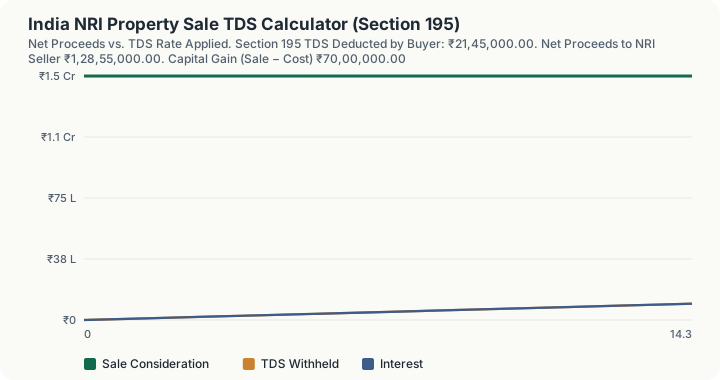
Quick Answer: On a ₹1,50,00,000 (₹1.5 crore) property sale by an NRI with a ₹80,00,000 cost basis (a ₹70,00,000 long-term gain, held over 24 months), the buyer must withhold Section 195 TDS at an effective 14.30% -- but because no Lower Deduction Certificate was obtained, that rate applies to the entire ₹1.5 crore sale price, not just the gain, producing a TDS deduction of ₹21,45,000 and net proceeds to the NRI seller of just ₹1,28,55,000 at closing.
Overview
When a Non-Resident Indian sells property in India, the tax mechanics are meaningfully different from a resident-to-resident sale, in a way that catches many NRI sellers by surprise:
- The buyer, not the seller, deducts and deposits the tax, under Section 195 of the Income-tax Act, 1961 -- and is personally liable for interest and penalties if they fail to do so correctly, which makes buyers of NRI-owned property conservative.
- There is no ₹50 lakh threshold below which TDS doesn't apply (unlike Section 194-IA's flat 1% TDS on resident-to-resident property sales above ₹50 lakh). Every rupee of an NRI's property sale is subject to Section 195 TDS, at whatever rate the seller's actual capital gain would be taxed.
- Absent a certificate, TDS is deducted on the full sale consideration, not the gain. Since the buyer usually cannot independently verify the seller's original cost basis, standard practice is to withhold tax as if the entire sale price were taxable, which can lock up a large share of the sale proceeds until the NRI files a return and claims a refund -- often months later.
- The Form 13 Lower/Nil Deduction Certificate exists specifically to fix problem #3. An NRI seller can apply to the Income Tax Department (Section 197, Rule 28AA) before the sale closes, for a certificate specifying that TDS be deducted only on the actual net capital gain, at the correct rate -- dramatically improving cash flow at closing instead of waiting for a refund.
This calculator models both scenarios so you can see exactly how much of your sale proceeds a Form 13 certificate keeps in your hands at closing instead of with the Income Tax Department.
How This Is Calculated
1. Capital gain and classification.
Property held more than 24 months is long-term (LTCG); 24 months or less is short-term (STCG).
2. Statutory rate. - LTCG: a flat 12.5%, with no indexation benefit for transfers on or after 23 July 2024 (Finance (No. 2) Act, 2024 removed the indexation option for this class of gain). NRIs do not have the choice residents sometimes retain between an indexed and non-indexed computation -- 12.5% flat, unindexed, is the only rate. - STCG: added to ordinary slab income; since the buyer cannot verify the seller's full income picture, a conservative flat 30% is used for TDS-deduction purposes.
3. Surcharge. LTCG on property falls under Section 112, so surcharge is capped at 15% regardless of income level (the same cap that applies to dividend income and Sections 111A/112A gains) -- a meaningfully better outcome at high income levels than uncapped slab-rate surcharge. STCG on property, since it's taxed at slab rates rather than under 112, uses the ordinary uncapped surcharge ladder (10% / 15% / 25%, and 25% or 37% above ₹5 crore depending on regime) based on your total income.
4. Cess. A flat 4% Health & Education Cess on (statutory tax + surcharge), same as elsewhere.
5. TDS base -- the critical fork. - Without a Form 13 certificate: TDS = Effective Rate × full sale consideration. - With a Form 13 certificate: TDS = Certified Rate (as determined by the Assessing Officer, based on your actual computed gain) × net capital gain only.
Worked Example
Using the calculator's defaults: ₹1,50,00,000 sale consideration, ₹80,00,000 cost basis, 36-month holding period (long-term), no certificate.
- Capital gain: ₹1,50,00,000 − ₹80,00,000 = ₹70,00,000.
- Held over 24 months -> long-term, statutory rate 12.5%.
- ₹70,00,000 falls in the "over ₹50L, up to ₹1Cr" surcharge tier -> 10% surcharge (Sec. 112 cap; would be capped at 15% even at much higher gain levels).
- Effective TDS rate: 12.5% × 1.10 × 1.04 = 14.30%.
- No certificate -> TDS applies to the full ₹1,50,00,000 consideration, not just the ₹70,00,000 gain: ₹1,50,00,000 × 14.30% = ₹21,45,000 withheld.
- Net proceeds at closing: ₹1,50,00,000 − ₹21,45,000 = ₹1,28,55,000.
Now compare: with a Form 13 certificate specifying, say, a 5% certified rate applied to the actual ₹70,00,000 gain (a realistic outcome once the Assessing Officer verifies your cost basis and computes the true tax due), TDS drops to ₹70,00,000 × 5% = ₹3,50,000, and net proceeds rise to ₹1,46,50,000 -- nearly ₹18 lakh more in hand at closing, with the difference no longer stuck in a refund queue.
What This Does Not Account For
- Marginal relief on surcharge. Not modeled; results very close to the ₹50L/₹1Cr/₹2Cr/₹5Cr surcharge boundaries may slightly overstate the surcharge component.
- The actual Form 13 processing timeline. Obtaining a certificate typically takes about 30 days from application, and should be filed well before the transaction closes -- this calculator assumes the certificate is already in hand.
- State stamp duty and registration charges, or any brokerage/legal fees -- this calculator only computes the income-tax TDS piece of the transaction.
- Exemptions under Sections 54 / 54EC / 54F (reinvestment in another residential property, or in specified capital-gains bonds) that can reduce or eliminate the underlying capital-gains liability -- these are grounds an NRI would cite in a Form 13 application, but this calculator does not model the exemption computation itself.
- DTAA relief. If the NRI's country of residence has a favorable capital-gains treaty article with India, that is a separate analysis -- see the companion DTAA Relief Calculator, though note capital gains on Indian immovable property are frequently NOT covered by treaty relief (most DTAAs reserve immovable-property gains taxation to the country where the property is located).
- FEMA repatriation of the net proceeds. See the companion NRI Capital Gains Repatriation Calculator for the USD 1 million per-financial-year ceiling and Form 15CA/15CB requirements on moving this money abroad.
Common Pitfalls
- Not applying for Form 13 early enough. Because it can take about a month for the Assessing Officer to process, applying after signing a sale agreement with a tight closing timeline often means missing the window entirely, forcing full-consideration TDS regardless of the seller's actual gain.
- Assuming the resident-seller 1% TDS rule (Section 194-IA) applies. It does not -- there is no ₹50 lakh minimum threshold and no flat 1% rate for NRI sellers; the full capital-gains-rate TDS mechanism under Section 195 applies from the first rupee.
- Forgetting that NRIs get no indexation on property LTCG since July 2024. Older cost-basis assumptions that relied on indexed cost benchmarks will overstate the seller's actual after-tax proceeds under current law.
- Confusing the buyer's TDS obligation with the seller's final tax liability. TDS is a withholding mechanism; the NRI seller must still file an Indian tax return to reconcile the TDS withheld against the actual computed tax (claiming a refund if TDS exceeded the true liability, which is common without a Form 13 certificate).
- The buyer skipping TDS deduction entirely because "the seller says they'll handle their own taxes." The buyer, not the seller, is personally liable for the TDS shortfall, interest, and penalty if they fail to deduct correctly -- this is why buyers are conservative and often over-withhold absent a certificate.
Frequently Asked Questions
Why does the buyer deduct tax at 12.5%+ instead of the resident 1% TDS rate?
What is Form 13 and how does it help?
Can I get a refund if too much TDS was deducted without a certificate?
Does the 12.5% LTCG rate apply to all property, or just for sales after a certain date?
Is the surcharge on my property gain capped, or does it keep rising with income?
Sources
- Section 195, Income-tax Act, 1961 (TDS on payments to non-residents). incometax.gov.in/iec/foportal
Also consulted: Section 197 and Rule 28AA, Income-tax Rules, 1962 (lower/nil deduction certificate, Form 13); Section 112, Income-tax Act, 1961, as amended by the Finance (No. 2) Act, 2024 (12.5% flat LTCG rate without indexation, effective 23 July 2024; 15%-capped surcharge for Section 112/111A/112A gains); CBDT FAQs on the Budget 2024 capital-gains changes (Press Information Bureau release).
Verification note: the 12.5%/no-indexation LTCG rate and the 15% surcharge cap for Section 112 gains were corroborated across the CBDT FAQ press release and multiple professional tax-portal summaries. The "TDS on full consideration absent a certificate" convention reflects standard market practice as described by multiple NRI tax-advisory sources, rather than an explicit numeric figure fixed in the bare statutory text of Section 195 itself -- if your specific transaction's buyer proposes a different withholding base, confirm with a chartered accountant before closing.