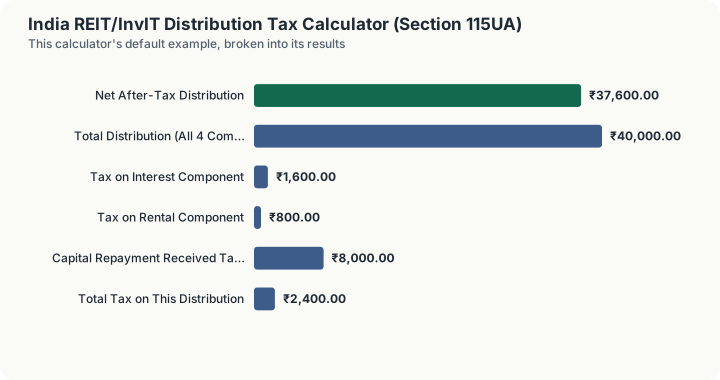
Quick Answer: An Indian investor receiving a ₹40,000 REIT/InvIT distribution split as ₹16,000 interest, ₹8,000 dividend, ₹8,000 rental and ₹8,000 capital repayment (₹40,000 already returned against a ₹1,00,000 investment) pays ₹2,400 of tax at a 10% marginal slab, for net after-tax income of ₹37,600. Interest and rental are taxed, the dividend leg is exempt under current law, and the repayment falls within remaining cost basis.
Overview
This calculator is built for Indian investors holding units of a listed Real Estate Investment Trust (REIT) or Infrastructure Investment Trust (InvIT), collectively called "business trusts" under Indian tax law. All figures are in Indian Rupees (₹); this is specific to the Indian REIT/InvIT framework under Section 115UA of the Income-tax Act and does not describe how REITs are taxed in other countries.
Unlike a simple dividend-paying stock, a single REIT/InvIT distribution to a unit holder is not one uniform income stream -- it is a blend of up to four components, each carrying its own tax treatment under Section 115UA's "pass-through" regime (the trust itself is largely tax-exempt; each component retains its character and is taxed in the unit holder's hands according to what it actually is):
- Interest -- the trust's interest income from lending to its underlying Special Purpose Vehicles (SPVs), passed through and always taxable in your hands at your slab rate (with 10% TDS deducted under Section 194LBA).
- Dividend -- profit distributed by the SPVs to the trust and passed through to you. Effective 1 April 2026, the Taxation and Other Laws (Amendment) Act 2026 made this always exempt in your hands, regardless of whether the underlying SPV elected the concessional Section 115BAA corporate tax regime. Before that date, the rule was more complicated: dividend was exempt only if the SPV had not opted into Section 115BAA, and taxable at your slab rate if it had. This calculator models current law -- dividend is always shown as exempt.
- Rental income -- for a REIT that owns real estate directly (rather than only through an SPV), rent collected is passed through to you and is taxable at your slab rate; the trust itself is exempt on this leg under Section 10(23FCA), but that exemption does not extend to you as the unit holder.
- Capital repayment -- some distributions represent SPV debt principal being repaid, treated as a tax-free return of your capital rather than income. This is tax-free only up to the cumulative amount of your original investment (the unit's issue price); once cumulative capital-repayment distributions since you acquired the units exceed that amount, the excess becomes taxable as "Income from Other Sources" under Section 56(2)(xii) (old Act) / Section 92(2)(k) (Income-tax Act 2025), a rule inserted by the Finance Act 2023 effective for distributions on or after 1 April 2024.
How This Is Calculated
Interest: $\text{Interest Tax} = \text{Interest Component} \times \text{Marginal Slab Rate}$
Dividend: $\text{Dividend Tax} = 0$ (unconditionally exempt for distributions on/after 1 April 2026)
Rental: $\text{Rental Tax} = \text{Rental Component} \times \text{Marginal Slab Rate}$
Capital repayment:
Total: $\text{Total Tax} = \text{Interest Tax} + \text{Dividend Tax} + \text{Rental Tax} + \text{Capital Repayment Tax}$
Worked Example
An investor originally invested ₹1,00,000 in REIT units and has already received ₹40,000 of capital-repayment distributions in prior years. This year's distribution totals ₹40,000, split as ₹16,000 interest, ₹8,000 dividend, ₹8,000 rental income, and ₹8,000 capital repayment. Their other income puts them in the 10% new-regime marginal slab.
- Interest tax = ₹16,000 × 10% = ₹1,600.
- Dividend tax = ₹0 (exempt under current law).
- Rental tax = ₹8,000 × 10% = ₹800.
- Capital repayment: headroom = ₹1,00,000 − ₹40,000 = ₹60,000, which comfortably covers the ₹8,000 capital-repayment leg, so it is entirely tax-free; cumulative capital repaid rises to ₹48,000.
- Total tax = ₹1,600 + ₹0 + ₹800 + ₹0 = ₹2,400, leaving net after-tax income of ₹37,600 on the ₹40,000 distribution.
If, instead, ₹97,000 had already been repaid as capital in prior years, only ₹3,000 of headroom would remain before the ₹1,00,000 issue price is exceeded. Of this year's ₹8,000 capital-repayment leg, ₹3,000 would be tax-free and the remaining ₹5,000 would be taxed as Income from Other Sources at the 10% slab (₹500), pushing total tax to ₹2,900 -- a reminder that the "tax-free return of capital" framing has a firm ceiling.
What This Does Not Account For
This calculator excludes the 4% Health and Education Cess and any applicable surcharge on top of the figures shown. It does not model TDS timing (10% TDS is deducted at source on interest and dividend components under Section 194LBA, which affects cash-flow timing but not your final annual tax liability, which this calculator computes on a gross basis). It does not model capital gains on selling the REIT/InvIT units themselves (a separate transaction from receiving distributions) -- note that the Finance Act 2025 amended Section 115UA(2) to bring long-term gains on unit sales under the same Section 112A framework used for equity shares (12.5% above the ₹1,25,000 annual exemption) effective Tax Year 2026-27, which this distribution-focused calculator does not compute. It assumes a single, static set of component percentages for the year; in practice a trust's quarterly distributions can vary in composition from quarter to quarter, and a fully precise annual calculation would sum each quarter's components separately rather than using one blended annual figure as this calculator does for simplicity. It does not model non-resident unit holder taxation, which uses different flat withholding rates (10% on dividend, 5% on interest for non-residents) rather than slab-rate taxation.
Common Pitfalls
- Assuming the whole distribution is "dividend" and tax-free. Only the dividend component is exempt; interest and rental income in the same distribution are fully taxable, and this is easy to miss when a broker statement simply labels the whole payout as a "distribution."
- Using the pre-2026 dividend rule. Older material describing dividend as taxable "if the SPV opted for Section 115BAA" reflects the rule before 1 April 2026; under current law the dividend leg is exempt unconditionally.
- Treating capital repayment as permanently tax-free. It is tax-free only up to your cumulative original investment; long-held REIT/InvIT units with years of capital-repayment distributions can and do eventually cross that threshold, at which point further such distributions become taxable.
- Forgetting TDS already withheld. The 10% TDS deducted on interest and dividend components under Section 194LBA is a prepayment, not the final tax; you must still reconcile the full slab-rate liability (for interest) when filing your return.
- Confusing distribution income with capital gains on selling the units. These are two entirely separate tax events under different provisions; this calculator handles only the distribution-income side.
Frequently Asked Questions
Is REIT/InvIT dividend income really tax-free now in India?
Why is the interest component taxed but not the dividend component?
How do I know how much of my distribution is "capital repayment" versus income?
What happens once I've received capital-repayment distributions exceeding what I originally invested?
Does selling my REIT/InvIT units trigger the same taxes as receiving a distribution?
Sources
- Income-tax Act, Section 115UA (taxation of business trusts and their unit holders). incometax.gov.in/iec/foportal
Also consulted: Section 56(2)(xii) (Income-tax Act 1961, inserted by the Finance Act 2023, effective 1 April 2024) / Section 92(2)(k) (Income-tax Act 2025) -- taxation of "other distributions" exceeding the unit's cost of acquisition; Taxation and Other Laws (Amendment) Act 2026, effective 1 April 2026 -- removal of the SPV-tax-regime carve-out on the dividend exemption; Finance Act 2025 -- amendment bringing long-term capital gains on business-trust units within Section 112A.