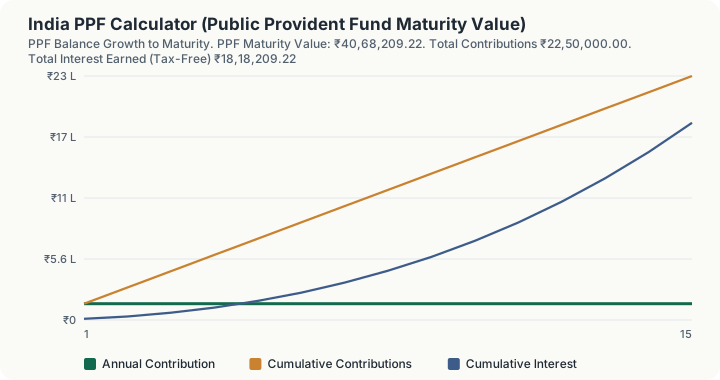
Quick Answer: Contributing the maximum ₹1,50,000 every financial year into a Public Provident Fund (PPF) account at the current 7.1% p.a. rate, deposited early enough each year to earn a full year's interest, grows to approximately ₹40,68,209 at the end of the standard 15-year lock-in -- all of it tax-free under India's EEE (Exempt-Exempt-Exempt) rules.
Overview
This calculator is built specifically for India's Public Provident Fund (PPF), a government-backed long-term savings scheme, and every number here is in Indian Rupees (₹). It is not a US retirement account. PPF is one of the few investment options in India offering the full EEE tax treatment: your contribution is deductible under Section 80C, the interest that accrues is entirely exempt from tax, and the maturity proceeds are tax-free on withdrawal too. In exchange, PPF carries a firm 15-year lock-in and a hard annual contribution ceiling of ₹1,50,000 per person, per financial year.
The interest rate is not fixed for the life of the account -- it is notified quarterly by the Ministry of Finance's Department of Economic Affairs, and it has actually been remarkably stable: 7.1% per annum has now held for ten consecutive quarters, including the current Q2 FY 2026-27 (1 July - 30 September 2026) quarter, with the last actual rate change dating back to the January-March 2024 quarter. This calculator defaults to that current rate but lets you adjust it if a newer rate is notified.
How This Is Calculated
PPF compounds annually, but the timing convention matters more than it does for most accounts: interest is computed monthly on the lowest balance between the close of the fifth day and the last day of each month, and credited to the account once a year. In practice, this means a deposit made by the 5th of any month earns interest for that entire month -- which is why the standard advice is "deposit your full year's contribution by April 5" to maximize interest. This calculator models that behavior directly: each year's contribution is treated as earning a full year's interest, exactly like the widely-published PPF maturity tables you'll find from India Post and most banks.
The formula, year by year: New Balance = (Previous Balance + This Year's Contribution) × (1 + Annual Rate), capped so that no more than ₹1,50,000 is credited toward the compounding balance in any financial year even if you request more (excess deposits are simply rejected by the scheme and earn no interest).
After the initial 15-year lock-in, you can extend the account indefinitely in blocks of exactly 5 years, either continuing to contribute (subject to the same ₹1,50,000/year cap) or leaving the balance untouched to keep earning interest with no further deposits -- the "extension without contribution" option. This calculator lets you model both.
Worked Example
Take the most common case people actually model: a salaried saver who opens a PPF account with nothing in it and commits to depositing the full statutory ₹1,50,000 before 5 April every year, at the current 7.1% p.a. notified rate.
Step 1 -- The contribution after the statutory cap. ₹1,50,000 requested, ₹1,50,000 annual ceiling, so the credited deposit is ₹1,50,000
Step 2 -- The annual growth factor. 1 + (7.1 / 100) = 1.071
Step 3 -- Year 1 closing balance. (₹0 + ₹1,50,000) × 1.071 = ₹1,60,650.00
Step 4 -- Year 1 interest credited. ₹1,60,650.00 - ₹1,50,000 = ₹10,650.00
Step 5 -- Year 2 closing balance. (₹1,60,650.00 + ₹1,50,000) × 1.071 = ₹3,32,706.15
Step 6 -- Cumulative interest after year 2. ₹3,32,706.15 - ₹3,00,000 = ₹32,706.15
The second year is where the scheme starts to separate from a plain savings account: year 2 alone credits ₹22,056.15 of interest against year 1's ₹10,650, because the first year's interest is itself now earning interest.
Step 7 -- The halfway milestone, end of year 10. Running the same recurrence through year 10 gives a balance of ₹22,30,123.98, of which ₹15,00,000 is your own money and ₹7,30,123.98 is accumulated interest.
Step 8 -- Maturity, end of year 15. The balance at the end of the 15-year lock-in is ₹40,68,209.22
Step 9 -- Split the maturity value. Total contributed: 15 × ₹1,50,000 = ₹22,50,000 Total interest: ₹40,68,209.22 - ₹22,50,000 = ₹18,18,209.22
By maturity the interest component is larger than half of what you put in, and none of it is taxable on withdrawal. Notice the shape of the growth: it took ten years to accumulate ₹7,30,123.98 of interest and only five more to add another ₹10,88,085 -- the back half of a PPF term does most of the work, which is the practical argument against closing the account early even when the lock-in technically permits a partial withdrawal.
Step 10 -- Extending one 5-year block, still contributing. Twenty years of ₹1,50,000 at 7.1% reaches ₹66,58,288.17 (₹30,00,000 contributed, ₹36,58,288.17 interest)
Step 11 -- Extending the same block without further deposits. Letting the year-15 balance compound alone for 5 years reaches ₹57,32,586.73
The gap between steps 10 and 11 is ₹9,25,701.44 for ₹7,50,000 of extra deposits -- so the extension-with-contribution election is worth making, but the larger share of the extension's growth comes from the balance you already had rather than the new money.
What This Does Not Account For
- Partial withdrawals from year 7 onward. PPF permits limited withdrawals starting the 7th financial year of the account; this calculator projects a single continuous balance to maturity and does not model interim withdrawals.
- Loans against the balance (years 3-6). A loan facility is available in a specific early window; not modeled here.
- Deposit timing within the year. This calculator assumes every year's contribution earns a full year's interest, matching the "deposit by April 5" convention; a deposit made later in the financial year would earn proportionally less interest that year in reality, which this annual model does not distinguish.
- Multiple accounts or NRI restrictions. An individual may hold only one PPF account (plus one on behalf of a minor); NRIs cannot open new PPF accounts, though existing accounts opened before NRI status can generally continue to maturity. Neither nuance is modeled.
- Rate changes mid-projection. This calculator holds the entered rate constant across the whole projection; PPF's actual rate is revised quarterly and can move up or down in the real world.
Common Pitfalls
- Assuming interest compounds like a US bond or CD. PPF's "deposit by the 5th" rule is not cosmetic -- depositing on, say, the 20th of the month instead of the 4th can cost you a full month's interest on that deposit, year after year.
- Contributing more than ₹1,50,000/year. Any amount above the cap does not earn interest and is not eligible for the 80C deduction; it typically has to be refunded, which is a friction most people would rather avoid.
- Forgetting to formally elect extension-with-contribution. If you want to keep contributing after the 15-year lock-in, you generally must submit the extension form within one year of maturity -- miss that window and you can only extend without further deposits.
- Treating the maturity value as fully liquid before 15 years. Beyond the specific years-7-onward partial withdrawal allowance, the bulk of a PPF balance is genuinely locked for the full 15 years; it is not a substitute for an emergency fund.
- Double-counting the tax benefit. The ₹1,50,000 PPF contribution and the ₹1,50,000 Section 80C ceiling are the same cap if PPF is your only 80C instrument -- but 80C is a combined ceiling covering PPF, ELSS, life insurance premiums, and more, so maxing out PPF alone can crowd out the tax benefit of other 80C investments.
Frequently Asked Questions
What is the PPF maturity value for ₹1,50,000/year over 15 years at the current interest rate?
Can I extend my PPF account after 15 years?
Is PPF interest and maturity amount really tax-free?
What is the current PPF interest rate, and how often does it change?
What happens if I miss a year's contribution?
Sources
- Income Tax Department, Government of India, the official authority for the national tax authority this calculator relates to. incometax.gov.in/iec/foportal
Also consulted: National Savings Institute, nsiindia.gov.in, PPF scheme page -- interest rate, contribution limits, lock-in period, extension rules, loan/withdrawal windows, tax treatment; Dept. of Economic Affairs, Ministry of Finance, Office Memorandum F.No.1/4/2019-NS (dated 2026-06-30) -- Q2 FY 2026-27 (1 July - 30 September 2026) small savings interest rate notification, confirming 7.1% unchanged; Income Tax Act, 1961, Section 80C (contribution deduction) and Section 10 (interest exemption) -- PPF's EEE tax treatment.