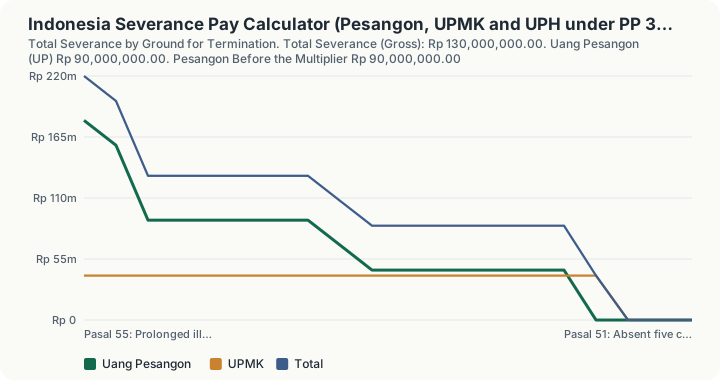
Quick Answer: An employee on Rp 10,000,000 a month with ten completed years of service, dismissed for efficiency reasons where the company is not making losses, receives Rp 130,000,000 gross. That is nine months of pesangon plus four months of long-service pay, or thirteen months of wage in total. Change only the reason for termination and the same employee could receive Rp 85,000,000, Rp 220,000,000, or nothing at all.
What does this calculator do?
Indonesian severance has three components and one multiplier, and the multiplier does most of the work.
The three components are uang pesangon, the severance payment proper; uang penghargaan masa kerja or UPMK, a long-service award; and uang penggantian hak or UPH, compensation for accrued rights such as untaken leave. The first two come from statutory tables keyed to years of service. The third depends on individual circumstances and cannot be derived from a wage and a tenure.
The multiplier is what PP 35/2021 attaches to the ground for termination. A dismissal for efficiency reasons pays full pesangon if the company is merely protecting itself against future losses, but half if it is already making losses. Retirement pays 1.75 times. Termination after prolonged illness or a work accident disability pays double. Resignation pays no pesangon at all. On identical facts the spread between the best and worst outcome is fourfold, before you even reach the grounds that pay nothing.
One structural detail is worth knowing before you read the result. The multiplier applies to pesangon only. UPMK is paid at its full table amount wherever it is payable, and UPH is paid in full whatever the reason. A model that scales all three by the same factor understates long-service dismissals substantially, because for anyone past about twelve years UPMK is a large share of the total.
This calculator implements the tables and all twenty grounds, and shows what every alternative ground would have paid on the same facts.
How is this calculated?
Step one, the pesangon entitlement from the Article 40(2) table, in months of wage. It runs from one month for less than a year of service, rising by one month per completed year, and stops at nine months from eight years onward. Further service adds nothing to pesangon.
Step two, the UPMK entitlement from the Article 40(3) table. Nothing below three years, then two months for three to five years, three months for six to eight, four months for nine to eleven, five for twelve to fourteen, six for fifteen to seventeen, seven for eighteen to twenty, eight for twenty-one to twenty-three, and ten from twenty-four years. Note the jump from eight straight to ten. There is no nine-month tier.
Step three, the multiplier attached to the ground for termination by Articles 41 to 56.
Uang Pesangon = Wage × Pesangon Months × Multiplier
UPMK = Wage × UPMK Months
Total = Uang Pesangon + UPMK + UPH
The multiplier appears in the first line only. That is the point most often got wrong.
Worked Example
An employee earning Rp 10,000,000 a month for severance purposes, with ten completed years of service, dismissed under Article 43(2) for efficiency measures taken to prevent losses.
Step 1: Read the pesangon entitlement for ten years. Service of eight years or more gives the maximum.
Pesangon entitlement = 9 months of wage
Step 2: Convert that to money.
Rp 10,000,000 × 9 = Rp 90,000,000
Pesangon before the multiplier = Rp 90,000,000
Step 3: Apply the multiplier for Article 43(2). Efficiency to prevent losses carries the full rate.
Rp 90,000,000 × 1 = Rp 90,000,000
Uang pesangon = Rp 90,000,000
Step 4: Read the UPMK entitlement for ten years. Ten years falls in the nine to eleven band.
UPMK entitlement = 4 months of wage
Step 5: Convert that to money. The multiplier does not apply here.
Rp 10,000,000 × 4 = Rp 40,000,000
UPMK = Rp 40,000,000
Step 6: Add the components.
Rp 90,000,000 + Rp 40,000,000 = Rp 130,000,000
Total severance = Rp 130,000,000, or thirteen months of wage.
Now change only the ground. Suppose the employer is dismissing for efficiency because it is already making losses, under Article 43(1). The multiplier becomes 0.5:
Rp 90,000,000 × 0.5 = Rp 45,000,000
Uang pesangon = Rp 45,000,000
But UPMK is untouched at Rp 40,000,000, so the total is Rp 85,000,000. The halving cost the employee Rp 45,000,000, not half of Rp 130,000,000. Had the multiplier applied to UPMK as well, the total would have been Rp 65,000,000, and that is precisely the error to avoid.
At the other end, termination after prolonged illness under Article 55 doubles the pesangon to Rp 180,000,000, giving a total of Rp 220,000,000. That is more than four times the pesangon payable in the loss-driven efficiency case on identical facts.
What does this calculator not account for?
- Income tax on the payment. Lump-sum severance is taxed under a separate final-rate PPh 21 schedule, not the ordinary Article 17 ladder. We could not confirm that schedule from a government-hosted copy of the regulation, so all figures here are GROSS and no tax is deducted.
- Uang penggantian hak. UPH covers untaken non-lapsed annual leave, repatriation costs for the worker and family, and whatever a contract or collective agreement adds. None of that follows from a wage and a tenure, so it is not estimated. Enter your own figure.
- Uang pisah. Where no pesangon is payable, some grounds still attract a separation payment whose amount is set by contract, company regulation or collective agreement rather than by statute.
- What counts as the wage. The calculator uses whatever figure you enter. In law the base is basic wage plus fixed allowances, and disputes about whether a particular allowance is fixed or variable are common.
- More generous contractual terms. A contract or collective agreement may improve on the statutory entitlement, and where it does, the better terms apply.
- Fixed-term contract workers. Employees on a PKWT receive compensation on expiry under a different rule, not the pesangon tables.
- Whether your ground is legally correct. The calculator applies the multiplier for the ground you select. Whether that ground is properly available on your facts, and whether the required procedure was followed, is a legal question.
- Disputes and tribunal outcomes. Several grounds depend on a finding by an industrial relations court, and the amount ultimately paid may follow a settlement rather than the table.
- Family support during detention under Article 53, which provides 25% to 50% of wage for up to six months depending on the number of dependents.
What mistakes do people make with this?
- Applying the multiplier to UPMK. It applies to pesangon only. UPMK is paid at its full table amount wherever it is payable at all.
- Assuming long service keeps increasing pesangon. It stops at nine months from year eight. After that, additional service is rewarded through UPMK instead, which is why the two tables must be read together.
- Missing the jump at twenty-four years. UPMK goes from eight months to ten with no nine-month step in between. On a Rp 10,000,000 wage, the twenty-fourth year alone is worth Rp 20,000,000.
- Rounding partial years up. The pesangon table keys off completed years. Seven years and eleven months gives eight months of pesangon, not nine.
- Choosing the closest-sounding ground. Efficiency to prevent losses and efficiency because of losses sound similar and differ by a factor of two on the pesangon.
- Forgetting UPH on a resignation. Resignation carries no pesangon and no UPMK, but accrued rights are still payable.
- Using total take-home pay as the wage. The severance base is basic wage plus fixed allowances, which is usually lower than what actually reaches the bank each month.
- Treating these figures as net. They are gross. Severance carries its own final-rate tax that this page does not compute.
Frequently Asked Questions
How much severance am I entitled to in Indonesia?
What is the difference between pesangon and UPMK?
Do I get severance if I resign?
Why does the reason for termination matter so much?
Is severance taxed?
What wage figure should I enter?
Sources
- Peraturan Pemerintah Nomor 35 Tahun 2021 tentang Perjanjian Kerja Waktu Tertentu, Alih Daya, Waktu Kerja dan Waktu Istirahat, dan Pemutusan Hubungan Kerja. llg-bwi.org/file_publish/Peraturan%20Pemerintah%20(PP)%20Nomor%2035%20Tahun%202021.pdf (read 31 August 2026). Note on provenance: that address is a third-party mirror hosted by a labour organisation, not a government legal database. We could not open a government-hosted copy, so the article numbers cited here were read from this mirror. They are internally consistent, but treat them as unconfirmed against the official text.
- Directorate General of Taxes (Indonesia), the official authority for the national tax authority this calculator relates to. pajak.go.id
Also consulted: Article 40(2) for the uang pesangon table, running from one month below one year of service to nine months from eight years; Article 40(3) for the UPMK table, beginning at two months for three years of service and reaching ten months at twenty-four years; Article 40(4) for uang penggantian hak: untaken non-lapsed annual leave, repatriation costs, and further items provided by contract, company regulation or collective agreement; Articles 41 to 56 for the termination multipliers applied here, including Article 42(2) and 43(1) at 0.5 times, Article 45(2) at 0.75 times, Article 56 retirement at 1.75 times, and Article 55 prolonged illness or disability at 2 times, together with Articles 49 to 52 and 54 for the grounds carrying no pesangon; The regulation implements Undang-Undang Nomor 13 Tahun 2003 as amended by Undang-Undang Nomor 11 Tahun 2020, carried forward into Undang-Undang Nomor 6 Tahun 2023.