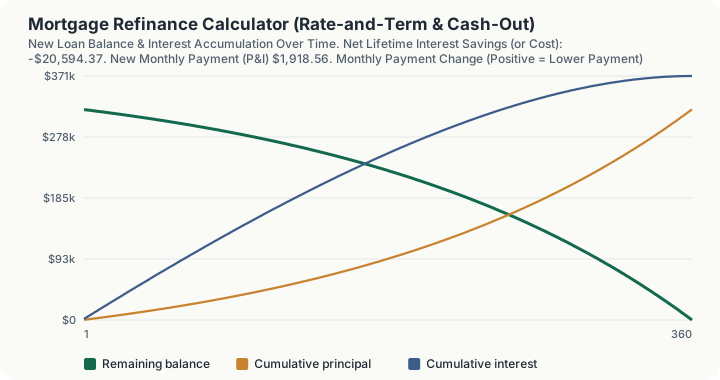
Quick Answer: Refinancing a $320,000 balance with 288 months (24 years) remaining at 7.25% into a fresh 30-year loan at 6.0% drops the monthly payment by $428.98, but because the amortization clock resets to a full 30 years, it actually costs $20,594.37 more in lifetime interest than keeping the current loan, a tradeoff a monthly-payment-only comparison would completely miss.
Overview
Refinancing decisions get reduced, constantly, to a single question: did the rate go down? That question misses two structural factors that can matter more than the rate itself: whether the new loan's term resets the amortization clock, and whether you are pulling cash out and adding it to the new balance. This calculator handles the full decision, not just one slice of it: it computes the new monthly payment, the total interest over the new term, the month the closing costs break even, and the net lifetime interest savings or cost once the reset term (and any cash-out) is factored in.
This is intentionally broader than this platform's refinance-breakeven-calculator, which isolates only the break-even timing question and assumes the new loan simply replaces the old balance dollar for dollar. This calculator adds cash-out refinancing, where additional equity is withdrawn and added directly to the new loan's principal, which changes both the new payment and the lifetime interest math in ways a pure break-even calculation does not capture. Use the breakeven-focused calculator when your only question is "how fast do I recover the closing costs." Use this calculator when you also want to know the full lifetime cost picture, or when cash-out is part of the plan.
How This Is Calculated
- Current loan payment. The existing balance amortized at the current rate over the remaining months:
currentPayment = amortize(balance, currentRate, remainingMonths). - New loan principal. The existing balance plus any cash-out amount withdrawn:
newPrincipal = balance + cashOut. Closing costs are treated as a separate cash outlay at closing, not added to the financed balance, matching the convention used elsewhere on this platform. - New loan payment. The new principal amortized at the new rate over the new term:
newPayment = amortize(newPrincipal, newRate, newTermMonths). - Monthly payment change.
currentPayment − newPayment. Positive means the payment goes down; a large enough cash-out or a shorter new term can make this negative, meaning the payment goes up even at a lower rate. - Break-even month. Only calculated when the payment decreases: closing costs divided by the monthly payment decrease, rounded up to the next whole month. If the payment does not decrease, there is no break-even, since there is no ongoing monthly savings to recover the upfront cost.
- Net lifetime interest savings. Total cost of keeping the current loan (
currentPayment × remainingMonths) compared against total cost of the new loan plus closing costs (newPayment × newTermMonths + closingCosts). This is the number that captures the term-reset effect: a lower payment achieved mainly by stretching the term back out to 30 years can still lose to the current loan on a lifetime-cost basis.
Worked Example
Scenario 1: Standard rate-and-term refinance, no cash-out. A $320,000 balance with 288 months (24 years) remaining at 7.25%, refinanced into a fresh 30-year loan at 6.0%, with $6,000 in closing costs.
- Current monthly payment: $2,347.54
- New monthly payment: $1,918.56
- Monthly payment decrease: $428.98
- Break-even on closing costs: 14 months
- Net lifetime result: −$20,594.37 (a net lifetime cost, not a savings)
Even though the payment drops by nearly $429 a month and the closing costs break even in just over a year, this refinance costs more over its full life than keeping the current loan, because resetting from 24 remaining years to a fresh 30-year term adds six years of payments back onto the clock. The monthly savings are real; the lifetime cost is also real. Both numbers are true at once, which is exactly why this calculator reports both instead of just one.
Scenario 2: Same refinance, plus a $40,000 cash-out. Same rates and balance, but $40,000 in equity is withdrawn and added to the new loan.
- New monthly payment: $2,158.38 (a smaller decrease of $189.16 from the current $2,347.54, since the larger balance offsets some of the rate improvement)
- Break-even on closing costs: 32 months
- Net lifetime result: −$106,929.86
Cash-out refinancing borrows more today at the new rate over the new term, so it compounds the term-reset effect from Scenario 1 with the interest cost of financing an additional $40,000 over 30 years. The monthly payment still goes down, but by much less, and the lifetime cost more than quintuples.
Scenario 3: Refinance into a shorter 15-year term instead. Same $320,000 balance and 288 months remaining at 7.25%, refinanced into a 15-year (180-month) term at 6.0%, no cash-out.
- New monthly payment: $2,700.34, an increase of $352.80 over the current payment
- Break-even: none, since the payment does not decrease
- Net lifetime result: +$184,027.30
This is the mirror image of Scenario 1: the monthly payment goes up, so there is no break-even math to run at all, but shortening the term instead of resetting it produces a large net lifetime savings, because far less time is available for interest to accrue. A monthly-payment-only view would call Scenario 1 "good" (lower payment) and Scenario 3 "bad" (higher payment); the lifetime interest numbers say the opposite.
What This Does Not Account For
- Points and rate buydowns. Paying discount points changes the closing cost input and the effective new rate at the same time; this calculator treats closing costs and the new rate as independent inputs you supply.
- Rolling closing costs into the new loan balance. Some refinances add closing costs to the financed amount instead of collecting them in cash; this calculator assumes a separate cash outlay, consistent with this platform's refinance-breakeven-calculator.
- Tax treatment of cash-out proceeds and mortgage interest deductibility. Cash-out proceeds are generally not taxable income, but interest deductibility on the cash-out portion depends on how the funds are used under current federal tax law; this calculator does not model tax effects.
- PMI, appraisal contingencies, and rate locks. This calculator assumes a clean refinance at the quoted new rate; it does not model private mortgage insurance that may apply if cash-out pushes loan-to-value above 80%, or the possibility of a rate change between application and closing.
- The possibility of moving or selling before the break-even month. If the home is sold before the closing costs are recovered, they are never fully offset by the monthly savings, regardless of how the lifetime numbers look on paper.
Common Pitfalls
- Judging a refinance by the monthly payment alone. Scenario 1 above is the textbook version of this mistake: a genuinely lower payment and a fast break-even, paired with a net lifetime cost, because the term reset outweighs the rate improvement.
- Not distinguishing a cash-out refinance from a pure rate-and-term refinance. Adding cash-out proceeds to the new balance changes both the payment and lifetime interest math; treating a cash-out refinance like a simple rate improvement will understate its true cost.
- Assuming a higher new payment always means a worse deal. Scenario 3 shows the opposite: a higher payment from a shorter term can produce the largest lifetime savings of any scenario, because the loan is paid off faster with far less total interest.
- Ignoring how many years are actually remaining on the current loan. The term-reset effect only shows up when you compare the new term against the current loan's remaining months, not its original term; a loan with 5 years left resets much more dramatically into a new 30-year term than one with 25 years left.
- Treating the break-even month as the whole story when the payment doesn't decrease. If cash-out or a shorter term pushes the new payment above the current payment, there is no break-even to calculate, and the decision should be evaluated purely on the lifetime interest and cash-out need, not a monthly recovery timeline.
Frequently Asked Questions
Why did my monthly payment go down but my lifetime cost go up?
Should I take cash out during a refinance, or get a separate home equity loan?
What does "Payment Does Not Decrease - No Break-Even" mean?
Is a bigger rate drop always better?
How is the break-even month rounded?
Sources
- Consumer Financial Protection Bureau: "Should I refinance my mortgage?" guidance and closing cost disclosure standards under Regulation Z and the TILA-RESPA Integrated Disclosure rule. ecfr.gov/current/title-12/chapter-X/part-1026
- Federal Housing Finance Agency: mortgage rate and refinance volume data. fhfa.gov
Also consulted: Freddie Mac: refinance analysis methodology, cash-out refinance guidance, and Primary Mortgage Market Survey rate history; Urban Institute Housing Finance Policy Center: research on mortgage refinance incentive and amortization term-reset effects.