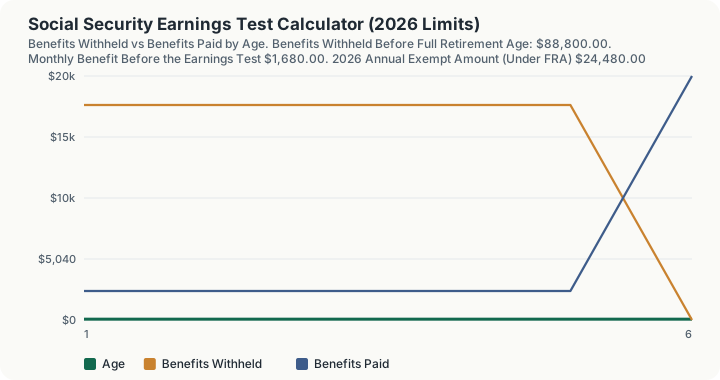
Quick Answer: Claiming at 62 on a $2,400 full-retirement-age benefit while still earning $60,000 a year withholds $88,800.00 of benefits before Full Retirement Age. None of it is lost. At FRA the 55 withheld months are removed from the early-claiming reduction, raising the monthly benefit permanently from $1,680.00 to $2,333.33, an increase of $653.33 a month, and the cumulative increase repays everything withheld after about 11.3 years.
What does this calculator do?
The retirement earnings test withholds Social Security benefits from people who claim before Full Retirement Age and keep working. In 2026, earnings above $24,480 cost $1 of benefits for every $2 of excess, at every age below FRA except the year you attain it. In the year you attain FRA the exempt amount jumps to $65,160 and the ratio softens to $1 withheld per $3 of excess. From the month you reach FRA the test stops entirely.
Almost every popular description of this rule calls it a penalty or a clawback. That is wrong, and the error changes real claiming decisions.
Under 20 CFR 404.412, the months in which benefits were withheld as an earnings-test deduction are removed from the count of months used to reduce your benefit for claiming early. The reduction is recomputed with fewer early months, and the higher benefit is payable from the month you attain Full Retirement Age, for life. The withheld money comes back as a permanently larger cheque.
It is a deferral with a recoupment period, not a forfeiture. Whether it is a good deferral depends on how long you live, which is what the recoupment figure on this page is for.
How is this calculated?
Excess = max(0, annual earnings − exempt amount)
Withheld = min(Excess/d, 12 × monthly benefit)
Months withheld = ⌈Withheld/(monthly benefit)⌉
Adjusted benefit = PIA × f(FRA months − adjusted months early)
Step by step:
Step 1: Find Full Retirement Age from the birth year, and convert it to months.
Step 2: Reduce the PIA for claiming early. The standard worker reduction is 5/9 of 1% per month for the first 36 months before FRA and 5/12 of 1% per month beyond that.
Step 3: For each year from the claiming age to FRA, pick the exempt amount and divisor. The lower annual exempt amount of $24,480 with a divisor of 2 in every year before the FRA-attainment year; the higher amount of $65,160 with a divisor of 3 in the FRA year itself.
Step 4: Compute excess earnings and the amount withheld, capped at the year's whole benefit. You cannot lose more than you are owed.
Step 5: Convert the withheld amount to whole months. SSA withholds benefits a whole month at a time, so a partial month rounds up. This month count, not the dollar amount, is what drives the restoration.
Step 6: Accumulate across the years to FRA.
Step 7: Apply the adjustment of the reduction factor. Credit back the withheld months, capped at the number of early-claiming reduction months that existed in the first place, and re-derive the benefit with the reduced count.
Step 8: Compute the permanent monthly increase.
Step 9: Compute the recoupment period. Total withheld divided by the monthly increase, rounded up to whole months.
Worked Example
Using the defaults: PIA $2,400 a month, born 1963, claiming at 62, earning $60,000 a year.
Step 1: Establish Full Retirement Age. For a 1963 birth year, FRA is 67 years 0 months, which is 804 months.
Step 2: Count the months of early claiming. Claiming at 62 is 744 months, so 804 − 744 = 60 months early.
Step 3: Apply the reduction to the PIA. 36 months × 5/9 of 1% = 20.00%, plus 24 months × 5/12 of 1% = 10.00%, for a 30.00% total reduction. $2,400 × 0.70 = $1,680.00 a month, or $20,160.00 a year.
Step 4: Compute excess earnings in a pre-FRA year. $60,000 − $24,480 = $35,520.00
Step 5: Compute the amount withheld in that year. $35,520 ÷ 2 = $17,760.00, which is below the $20,160 annual benefit, so nothing is capped.
Step 6: Convert that to whole months. $17,760 ÷ $1,680 = 10.57, rounded up to 11 months withheld.
Step 7: Repeat for ages 62 through 66. That is five identical years. 5 × $17,760 = $88,800.00 withheld in total, and 5 × 11 = 55 months withheld.
Step 8: Handle the FRA-attainment year at 67. The higher exempt amount of $65,160 applies, and $60,000 is below it, so nothing is withheld and the full $20,160 is paid.
Step 9: Total the benefits actually received before FRA. Five years at $20,160 − $17,760 = $2,400 each, plus the full $20,160 in the FRA year. (5 × $2,400) + $20,160 = $32,160.00
Step 10: Apply the adjustment of the reduction factor at FRA. 55 withheld months are credited back against 60 reduction months. 60 − 55 = 5 months of reduction remaining
Step 11: Recompute the benefit. 5 months × 5/9 of 1% = 2.7778% reduction. $2,400 × 0.972222 = $2,333.33 a month
Step 12: Compute the permanent increase. $2,333.33 − $1,680.00 = $653.33 a month, or $7,839.96 a year
Step 13: Compute the recoupment period. $88,800.00 ÷ $653.33 = 135.9, rounded up to 136 months, which is 11.3 years.
So the withheld $88,800 is returned in full through a benefit that is $653.33 a month larger for life, and the break-even lands at about age 78 years 4 months. Live past that and the earnings test made you money.
Carrying the Test Year by Year to Full Retirement Age
Step 14: Age 62, the first row. Benefits withheld $17,760.00, benefits paid $2,400.00
Step 15: Age 63. Identical. Withheld $17,760.00, paid $2,400.00. Two years in, $35,520.00 has been withheld and $4,800.00 collected.
Step 16: Age 66, the last pre-FRA row. Still $17,760.00 withheld and $2,400.00 paid. Five consecutive rows are the same, because neither the earnings nor the lower exempt amount changes across them.
Step 17: Age 67, where the cliff falls. Withheld $0.00, paid $20,160.00
The whole schedule turns on one row. For five years the test takes 88% of the benefit and hands back $2,400.00 a year, and then in the year Full Retirement Age is reached the higher $65,160 exempt amount applies, $60,000 of earnings falls below it, and the withholding stops outright. Nothing about the job changed. What changed is which exempt amount the year is tested against, which is the single most misunderstood feature of the earnings test and the reason so many people claim early, see almost nothing arrive, and conclude the benefit was taken from them permanently.
What does this calculator not account for?
- The monthly test in the FRA-attainment year. The statute counts only earnings in the months before the month FRA is attained. This calculator applies the higher annual exempt amount against the full year's earnings instead. For someone earning evenly through the year that overstates countable earnings in the FRA year.
- The monthly grace-year test under 20 CFR 404.435, which can pay benefits for months of low earnings in the first year of entitlement. It is not modelled; only the annual test is applied.
- Cost-of-living adjustments. The benefit is held constant in nominal terms and the recoupment period is a nominal figure, not a present value.
- Constant earnings. Earnings are assumed identical in every pre-FRA year.
- Income tax on benefits under section 86, and the interaction between working, higher AGI, and how much of the benefit is taxable.
- Recomputation of the PIA from additional earnings years. Continuing to work can raise the PIA itself if the new year replaces a low year in the top 35; that is a separate benefit and is not included.
- Spousal, survivor and dependent benefits, which are also subject to the test on the worker's earnings.
- Self-employment special rules on the substantial-services test.
- Delayed retirement credits, which do not apply below FRA.
What mistakes do people make with this?
- Believing the withheld money is gone. It is credited back through a permanently higher benefit under 20 CFR 404.412. Every popular article calling it a penalty is describing the wrong mechanism.
- Counting the wrong income. Only wages and net self-employment income count. Pensions, annuities, interest, dividends, capital gains, rental income and IRA or 401(k) withdrawals do not.
- Using the wrong exempt amount in the FRA year. The $65,160 amount and the 1-for-3 ratio apply only in the calendar year you attain FRA, and on $60,000 of earnings they withhold nothing at all.
- Assuming benefits are withheld pro rata. SSA withholds whole months, which is why the month count and the dollar amount are not proportional.
- Claiming early while earning well above the exempt amount. On these defaults, five years of claiming produced $32,160 of actual cash. The permanent reduction was largely undone at FRA, but the intervening years delivered very little.
- Forgetting that the credit is capped. Withheld months are credited back only up to the number of early-claiming reduction months that existed. Withhold 72 months against 60 months of reduction and the reduction is simply erased; the excess buys nothing.
Frequently Asked Questions
How much can I earn in 2026 before Social Security withholds benefits?
Do I get the withheld money back?
How long does it take to get it back?
What income counts toward the earnings test?
Should I just wait to claim if I am still working?
Does the earnings test apply after Full Retirement Age?
Sources
- SSA, "Cost-of-Living Increase and Other Determinations for 2026", 90 FR (doc. 2025-19763), published 3 November 2025, govinfo.gov/content/pkg/FR-2025-11-03/html/2025-19763.htm: "the lower retirement earnings test monthly exempt amount is $2,040 for 2026. The lower annual exempt amount is $24,480"; "the higher retirement earnings test monthly exempt amount is $5,430 for 2026. The higher annual exempt amount is $65,160"; the $1-for-$3 ratio in the year of attaining normal retirement age and the $1-for-$2 ratio at all other ages below it. Verified 2026-08-30.
- 20 CFR 404.412, "After my benefits are reduced for age when and how will adjustments to that reduction be made?", ecfr.gov/current/title-20/part-404/section-404.412: the adjustment of the reduction factor that credits withheld months back, effective with the month full retirement age is attained. Verified 2026-08-30.
Also consulted: 20 CFR 404.415, the earnings-test deduction itself; 20 CFR 404.435, the monthly grace-year test, noted here as not modelled.