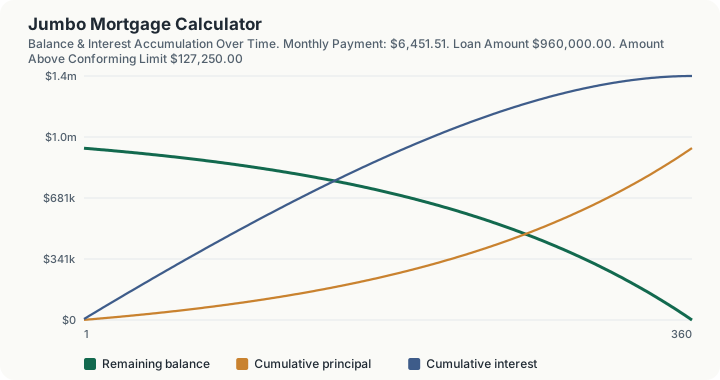
Quick Answer: A $960,000 jumbo loan at 7.1% over 30 years costs $6,451.51 a month and exceeds the 2026 FHFA conforming limit of $832,750 by $127,250.
Overview
A jumbo mortgage is any home loan that exceeds the conforming loan limit set each year by the Federal Housing Finance Agency (FHFA). That limit is the maximum loan size Fannie Mae and Freddie Mac are allowed to purchase or guarantee. Loans under the limit are called conforming loans; loans over it are jumbo loans, and they play by different rules.
The math behind a jumbo loan payment is identical to any other fixed-rate mortgage: a standard amortization schedule applied to the loan amount, rate, and term. What actually differentiates a jumbo loan is everything around that math. Because jumbo loans cannot be sold to Fannie Mae or Freddie Mac, lenders hold more of the risk themselves, which typically means larger down payment requirements (often 10-20%, versus 3-5% for many conforming loans), stricter credit and reserve requirements, and a modest interest rate premium compared to a conforming loan of the same term.
This calculator does two things: it runs the standard amortization math to give you a real monthly payment and interest total, and it checks your loan amount against the current FHFA conforming limit so you know whether you are actually looking at a jumbo loan in the first place, or a conforming loan that happens to be large.
How This Is Calculated
The financed amount is the home price minus the down payment:
`
Loan Amount = Home Price − Down Payment
`
The monthly payment uses the standard fixed-rate amortization formula:
`
PMT = P × i / (1 − (1 + i)^−n)
`
where P is the loan amount, i is the monthly interest rate (annual rate divided by 12), and n is the total number of monthly payments (loan term in years times 12).
Separately, the loan amount is compared against the FHFA conforming loan limit for 2026. The baseline limit for most of the United States is $832,750 for a one-unit property. In designated high-cost areas, where local home values run well above the national average, FHFA sets a higher ceiling equal to 150% of the baseline, or $1,249,125 for 2026. A loan is jumbo if it exceeds whichever limit applies to the property's location.
The full amortization schedule is then generated month by month, tracking principal, interest, and remaining balance, and reconciling exactly to the original loan amount by the final payment.
Worked Example
Consider a $1,200,000 home purchased with $240,000 down, financed at 7.1% over 30 years, in a standard (non-high-cost) area:
- Loan amount: $1,200,000 − $240,000 = $960,000
- Conforming limit check: the 2026 baseline conforming limit is $832,750. Since $960,000 > $832,750, this loan is jumbo by $127,250 ($960,000 − $832,750)
- Monthly interest rate: 7.1% ÷ 12 = 0.0059167
- Monthly payment: solving the amortization formula for $960,000 over 360 months at that rate gives $6,451.51
- Total interest over 30 years: $6,451.51 × 360 − $960,000 ≈ $1,362,542.45
Now suppose the same property is located in a designated high-cost county. The applicable conforming ceiling jumps to $1,249,125, which is above the $960,000 loan amount. The exact same loan, on the exact same property price, down payment, and rate, is no longer classified as jumbo purely because of where the property sits. The monthly payment math does not change, but the loan's regulatory category, and often its pricing, does.
What This Does Not Account For
- The actual rate premium a specific lender will charge. Jumbo rate spreads over conforming rates move with credit markets and vary by lender, loan-to-value ratio, and borrower credit profile. This calculator lets you enter whatever rate you have been quoted; it does not forecast or apply a premium automatically.
- Minimum down payment and reserve requirements. Jumbo lenders commonly require larger down payments and months of cash reserves on hand. This tool does not check your inputs against any lender's specific underwriting overlay.
- Property taxes, homeowners insurance, or mortgage insurance. All figures here are principal-and-interest only. Jumbo loans generally do not carry private mortgage insurance the way low-down-payment conforming loans do, but escrowed taxes and insurance still apply and are not included.
- County-by-county high-cost designation. Whether a specific county qualifies for the higher conforming ceiling is determined by FHFA on a per-county basis each year. This calculator offers a toggle between the national baseline and the high-cost ceiling; it does not look up your specific county.
- Multi-unit property limits. FHFA sets separate, higher conforming limits for two-, three-, and four-unit properties. This calculator uses the one-unit limit throughout.
Common Pitfalls
- Assuming "expensive home" automatically means "jumbo loan." It's the loan amount, not the home price, that determines jumbo status. A $2 million home purchased with a $1.5 million down payment and a $500,000 loan is a conforming loan, not a jumbo one.
- Comparing jumbo and conforming rates without checking loan-to-value. Jumbo pricing is sensitive to down payment size in a way that can outweigh the underlying rate premium; a jumbo loan with 25% down can sometimes price better than one with 10% down.
- Forgetting the high-cost-area ceiling exists. Buyers near, but technically inside, an expensive metro area sometimes assume they need a jumbo loan when their county actually carries a higher conforming limit that covers their loan amount.
- Overlooking reserve requirements when budgeting. Jumbo lenders frequently require six to twelve months of mortgage payments in liquid reserves at closing, on top of the down payment and closing costs, which materially changes how much cash a buyer actually needs.
- Ignoring how the conforming limit changes every year. FHFA adjusts the limit annually based on national home price growth. A loan that was comfortably jumbo two years ago may now sit close to, or even under, the current conforming limit.
Frequently Asked Questions
What is the 2026 conforming loan limit?
Why do jumbo loans usually have a slightly different interest rate than conforming loans?
Do jumbo loans require a bigger down payment?
Is the conforming loan limit the same in every state?
Can a loan be jumbo in one county and conforming in another with identical terms?
Sources
- Federal Housing Finance Agency (FHFA): "FHFA Announces Conforming Loan Limit Values for 2026," news release, fhfa.gov, November 2025. fhfa.gov
- Consumer Financial Protection Bureau (CFPB): Jumbo loan disclosures and Qualified Mortgage standards under Regulation Z. ecfr.gov/current/title-12/chapter-X/part-1026
Also consulted: Federal Housing Finance Agency (FHFA): Conforming Loan Limit Values dataset and county-level high-cost area determinations, fhfa.gov/data/conforming-loan-limit.