Quick Answer: Levered beta measures how much a company's debt load amplifies its equity risk, calculated with the Hamada Equation as Levered Beta = Unlevered Beta times [1 plus (1 minus Tax Rate) times Debt-to-Equity].
Overview
Beta measures how sensitive a stock's returns are to movements in the broader market. But a company's observed, or "levered," beta reflects two things mixed together: the underlying business risk of its operations and the financial risk added by its debt. Two companies in the same industry with identical operating businesses will show different betas if one carries far more debt than the other, because debt magnifies the volatility of returns to equity holders. Interest payments are fixed regardless of how revenue performs, so in a downturn, equity holders absorb a disproportionate share of the damage, and in an upturn they capture a disproportionate share of the gains.
The Hamada Equation, developed by Robert Hamada in 1972, isolates these two effects. It lets analysts strip financing effects out of an observed beta to get the "unlevered" or "asset" beta, which reflects pure business risk, and then re-apply a different capital structure to see what beta a company would have under that structure instead. This is the backbone technique behind comparable-company analysis in valuation work: analysts unlever the betas of several peer companies with different debt loads, average the resulting asset betas to get a cleaner estimate of industry business risk, and then relever that average beta at the target company's own capital structure before plugging it into the Capital Asset Pricing Model to estimate a cost of equity.
This calculator performs the relevering half of that process. Given an unlevered beta, a target debt-to-equity ratio, and a marginal tax rate, it computes the levered beta that capital structure implies.
How This Is Calculated
The Hamada Equation is:
Where $\beta_L$ is levered (equity) beta, $\beta_U$ is unlevered (asset) beta, $T$ is the marginal corporate tax rate, and $D/E$ is the debt-to-equity ratio, ideally measured using market values of debt and equity rather than book values.
The $(1 - T)$ term reflects the tax deductibility of interest expense. Because interest payments reduce a company's taxable income, part of the financial risk debt would otherwise add is offset by the tax shield those interest deductions generate. A higher tax rate therefore dampens, slightly, how much a given debt load raises beta, since more of the interest cost is effectively subsidized by lower taxes.
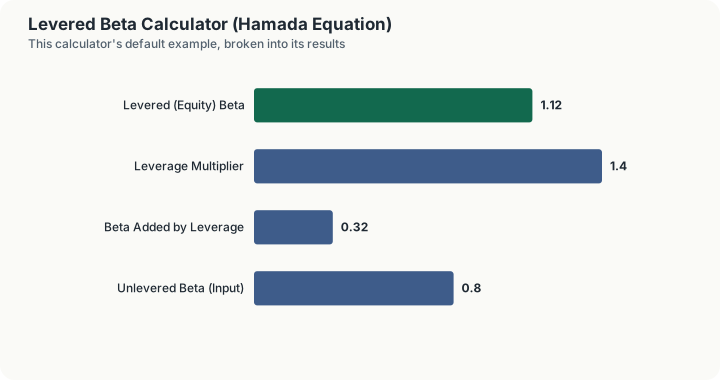
The calculator computes this in two steps. First it builds the leverage multiplier: it subtracts the tax rate from 1 to get the after-tax cost fraction, multiplies that by the debt-to-equity ratio, and adds 1. Second it multiplies the unlevered beta by that multiplier to produce the levered beta. All arithmetic runs on arbitrary-precision Decimal values so the tax rate and ratio inputs never pick up floating-point rounding drift.
Worked Example
Consider an unlevered (all-equity) beta drawn from a set of comparable companies, and a target capital structure to relever it at:
- Unlevered Beta ($\beta_U$): 0.80
- Debt-to-Equity Ratio ($D/E$): 0.50
- Marginal Tax Rate ($T$): 21% (the U.S. federal statutory corporate rate)
Step 1: Tax shield fraction.
Step 2: Leverage multiplier.
Step 3: Levered beta.
At this capital structure, the equity beta rises from 0.80 to 1.116, an increase of 0.316. That extra beta is entirely a product of financial leverage; the underlying business risk captured by the 0.80 asset beta has not changed.
What This Does Not Account For
The Hamada Equation is a simplifying model, not an exact physical law, and analysts should be aware of its assumptions. It assumes debt itself carries zero systematic risk (a beta of zero for debt), which is a reasonable approximation for investment-grade borrowers but breaks down for companies with distressed or high-yield debt, where the debt itself is correlated with market conditions. It assumes a constant debt-to-equity ratio and a fixed marginal tax rate going forward, when in practice both can shift as a company grows, refinances, or moves tax jurisdictions. It does not account for the costs of financial distress or bankruptcy risk that very high leverage introduces, which can raise a company's true risk profile beyond what the linear Hamada formula implies. It also depends entirely on the quality of the unlevered beta input; if that starting beta was itself poorly estimated from a small or unrepresentative peer set, the relevered output inherits that error.
Common Pitfalls
- Using book value instead of market value for debt or equity. The Hamada Equation is most accurate when D/E reflects market values, since beta is a market-based risk measure; book equity in particular can diverge sharply from market capitalization.
- Mixing marginal and effective tax rates. The formula calls for the marginal tax rate that applies to the next dollar of interest deduction, not a blended effective rate that includes credits and prior-year adjustments.
- Forgetting to unlever a peer's beta before averaging across comparables. Averaging raw, still-levered betas across companies with very different capital structures produces a distorted industry estimate; unlever first, average, then relever at the target structure.
- Applying the formula to companies with junk-rated or distressed debt. The zero-beta-debt assumption is weakest exactly where leverage is highest, which is often where analysts are most tempted to use it.
- Ignoring preferred stock or other hybrid securities in the capital structure. A simple two-tier debt/equity split can understate true financial risk when preferred shares or convertible instruments sit between the two.
Frequently Asked Questions
What is the difference between levered and unlevered beta?
Why does a higher tax rate reduce the impact of leverage on beta?
How is this used in a discounted cash flow valuation?
Can debt-to-equity be zero?
Does this calculator handle negative or highly volatile beta inputs?
Sources
- CFA Institute. Cost of Capital: Foundational Topics, CFA Program Curriculum. cfainstitute.org
- Internal Revenue Service. Corporate Tax Rate Schedule (Internal Revenue Code Section 11). law.cornell.edu/uscode/text/26/11
- U.S. Securities and Exchange Commission, Investor.gov, the official authority for the investing this calculator relates to. investor.gov
Also consulted: Hamada, Robert S. "The Effect of the Firm's Capital Structure on the Systematic Risk of Common Stocks." Journal of Finance, 1972; Modigliani, Franco, and Merton H. Miller. "The Cost of Capital, Corporation Finance and the Theory of Investment." American Economic Review, 1958.