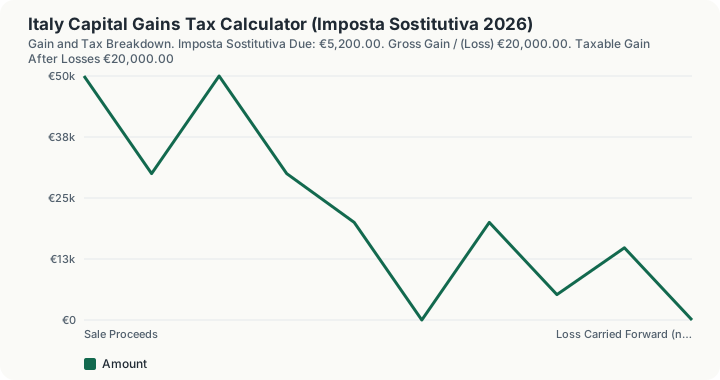
Quick Answer: Selling listed shares for €50,000 that cost €30,000 produces a €20,000 gain, which bears imposta sostitutiva of €5,200.00 at the standard 26% rate, leaving a net cash gain of €14,800.00. That rate applies to the full gain because the inclusion factor for ordinary securities is 100%. Government bonds are taxed at the same 26% but on only 48.08% of proceeds and costs, and crypto-assets bear 33% from 1 January 2026.
What does this calculator do?
Italy taxes capital gains on financial instruments through the imposta sostitutiva on redditi diversi di natura finanziaria, a substitute tax that replaces ordinary IRPEF rather than stacking with it. Your other income does not affect the rate, and the gain does not push you into a higher band.
The standard rate is 26%. Two departures matter, and one of them is almost universally implemented wrongly.
There is no 12.5% rate for government bonds. The rate on Italian State and white-list government bonds is still 26%. The relief comes from an inclusion factor: only 48.08% of the amount realised is taken into account. The Agenzia delle Entrate's own instructions for Redditi PF 2026 are explicit that both sides are scaled: "i corrispettivi ed i costi vanno riportati per il 48,08 per cento del loro ammontare". Because 0.4808 × 0.26 = 0.125008, the effective rate on a profitable disposal is 12.5008%, which is where the familiar "12.5%" comes from.
On a gain the two constructions give the same answer. On a loss they do not, and that is why the distinction matters: a loss on a government bond is itself haircut to 48.08% of its nominal amount before it can be carried forward.
The second departure is crypto. From 1 January 2026 gains on crypto-assets bear 33%, and the €2,000 annual exemption threshold that existed under the previous rules is gone: deleted outright, not merely lowered. A narrow carve-out added by the 2026 budget law keeps euro-denominated e-money tokens at 26%.
How is this calculated?
Gain = (Proceeds × ϕ) − (Cost × ϕ)
Taxable = max(0, Gain − Prior losses used); Tax = Taxable × rate
Step 1: Determine the inclusion factor. 48.08% for Italian and white-list government bonds; 100% for every other asset type.
Step 2: Scale the proceeds. Sale proceeds multiplied by the inclusion factor.
Step 3: Scale the acquisition cost by the same factor. This is the step most calculators omit. Scaling only the proceeds would produce a materially wrong gain.
Step 4: Compute the gross gain or loss. Included proceeds less included cost. Unlike the France page, a negative result is retained here rather than floored, because it becomes a carryforward.
Step 5: Apply carried-forward losses. Losses offset only positive gains and only up to the size of the gain, so the offset used is the lesser of the two. Losses are ring-fenced by category: a Sez. II-A loss cannot be set against a Sez. III-A or IV-A gain, and the calculator assumes the figure you enter is same-category.
Step 6: Compute the taxable gain. Gross gain less the losses applied, floored at zero.
Step 7: Select the rate. 33% for crypto-assets, 26% for euro-denominated e-money tokens, 26% for everything else including government bonds.
Step 8: Compute the substitute tax. Taxable gain multiplied by that rate.
Step 9: Compute the net cash gain. Your actual cash gain, unscaled proceeds less unscaled cost, minus the tax paid. For a government bond this deliberately uses the real cash figures, not the 48.08% ones, because the inclusion factor is a tax fiction and your bank balance is not.
Step 10: Compute the remaining carryforward. Any prior loss not consumed, plus any fresh loss from this disposal. It is available against same-category gains for the next four tax years, then it expires.
Step 11: Compute the effective rate on your cash gain. Tax divided by the nominal gain. For government bonds this lands at 12.5008%.
Step 12: Compute the securities counterfactual. The identical disposal at the plain 26% securities treatment, so the value of the inclusion factor or the cost of the crypto rate is visible directly.
The regime selector (amministrato, dichiarativo or gestito) is an informational flag. It determines who computes and withholds the tax and whether losses net automatically, not how much a given net gain bears.
Worked Example
Defaults: €50,000 proceeds, €30,000 acquisition cost, listed shares, no carried-forward losses, risparmio amministrato.
Step 1: Find the inclusion factor. Ordinary securities, so 100%
Step 2: Compute the included proceeds and cost. €50,000 × 100% = €50,000 and €30,000 × 100% = €30,000
Step 3: Compute the gross gain. €50,000 − €30,000 = €20,000
Step 4: Apply carried-forward losses. None entered, so €0 applied and the taxable gain remains €20,000
Step 5: Apply the rate. €20,000 × 26% = €5,200.00
Step 6: Compute the net cash gain. €20,000 − €5,200.00 = €14,800.00
The same cash flows on a BTP
Step A: Scale both sides by 48.08%. Proceeds: €50,000 × 48.08% = €24,040.00 Cost: €30,000 × 48.08% = €14,424.00
Step B: Compute the gain the tax sees. €24,040.00 − €14,424.00 = €9,616.00
Step C: Apply the same 26% rate. €9,616.00 × 26% = €2,500.16
Step D: Compute the effective rate on the real cash gain. €2,500.16 ÷ €20,000 = 12.5008%
Step E: Compute the net cash gain. €20,000 − €2,500.16 = €17,499.84
Note that step C uses 26%, not 12.5%. The two routes agree here because the disposal is profitable. Had the same BTP produced a €20,000 loss, the carryforward would be 48.08% of it (€9,616, not €20,000) and treating the relief as a 12.5% rate would have overstated the available loss by more than double.
Crypto from 1 January 2026
Step F: Apply the crypto rate to the same €20,000 gain. €20,000 × 33% = €6,600.00, against €5,200.00 at the securities rate
What does this calculator not account for?
- Single disposal, single year. The calculator prices one transaction. It does not aggregate a year's Quadro RT, net gains against losses within the year, or split results across categories.
- Category ring-fencing is assumed, not enforced. The loss figure you enter is taken to be same-category. The calculator cannot tell whether your minusvalenza belongs to Sez. II-A, III-A or IV-A.
- Cross-regime loss haircuts. Losses carried in from an older 12.50% regime (48.08%) or 20% regime (76.92%) are not converted. The figure entered is used as given.
- Loss ageing. The four-year window is stated but not tracked. The calculator does not know how old your carried-forward losses are, so it cannot expire them.
- Bollo and other wealth taxes. The imposta di bollo on financial products and IVAFE on foreign-held assets are separate annual charges and are not computed.
- Withholding mechanics and timing. Under the amministrato regime the intermediary withholds; under the dichiarativo regime you pay through the Quadro RT with its own deadlines. Cash-flow timing is not modelled.
- Partecipazioni qualificate history and PEX. The distinction between qualified and non-qualified holdings was harmonised at 26%, but company-level participation exemption regimes are outside scope.
- Foreign assets, treaty relief and foreign tax credits. The calculation assumes an Italian resident with no creditable foreign withholding.
- The e-money token conversion carve-out. L. 199/2025 art. 1 c.28 provides that mere conversion between euro and qualifying euro-denominated e-money tokens, and redemption at nominal value, is not a realisation event at all. The calculator will still tax a gain you enter for that asset type; whether the event is a realisation is a question you must answer before using the page.
- The €2,000 crypto threshold is gone and is not applied, having been deleted by L. 207/2024 art. 1 c.25. Guidance that still mentions it is describing repealed law.
What mistakes do people make with this?
Applying a 12.5% rate to a government bond gain. It produces the right answer on a gain and the wrong one on a loss. The statute works by including 48.08% of proceeds and costs and then applying 26%. Model it any other way and a bond loss carryforward will be more than twice as large as the law allows.
Scaling only the proceeds and not the cost. The Agenzia's instruction covers both sides expressly. Scaling proceeds alone on this disposal would give a taxable gain of €24,040 − €30,000, a fictitious loss, rather than the correct €9,616 gain.
Still relying on the €2,000 crypto exemption. It was deleted with effect from 2026. Every crypto gain is now taxable from the first euro, at 33%.
Assuming every crypto-asset bears 33%. Euro-denominated e-money tokens under Regulation (EU) 2023/1114 carry a 26% carve-out added by the 2026 budget law. The distinction is instrument-specific, not a matter of choice.
Expecting the regime choice to change the tax. Amministrato, dichiarativo and gestito determine who computes and withholds, and whether losses net automatically inside one relationship. They do not change the tax due on a given net gain.
Offsetting losses across categories. A minusvalenza is deductible only against gains of the same category. The four-year window is also strict: unused losses expire at the end of the fourth following tax year rather than carrying indefinitely.
Frequently Asked Questions
What is the capital gains tax rate in Italy for 2026?
Are Italian government bonds really taxed at 12.5%?
Does the €2,000 crypto exemption still exist?
How long can I carry forward a capital loss in Italy?
Does risparmio amministrato reduce my tax compared with dichiarativo?
Is capital gains tax in Italy added to my income tax?
Sources
- Standard 26% rate: art. 3 D.L. 66/2014 (conv. L. 89/2014), restated by L. 207/2024 art. 1 comma 23 (Gazzetta Ufficiale, cod. red. 24G00229), confirmed against the Agenzia delle Entrate Redditi PF 2026 istruzioni, Quadro RT Sez. II-A. agenziaentrate.gov.it
- Government and white-list bonds at a 48.08% inclusion factor applied to both proceeds and costs: Agenzia delle Entrate, Redditi PF 2026 Fascicolo 2, Sez. II-A ("i corrispettivi ed i costi vanno riportati per il 48,08 per cento del loro ammontare"), and D.Lgs. 461/1997 art. 6 c.1. agenziaentrate.gov.it/portale/documents/d/guest/pf2_istruzioni_2026_agg-13-05-2026
Also consulted: Qualifying instruments: Italian State and equated securities under art. 31 D.P.R. 601/1973, and bonds of white-list States under D.M. 4 settembre 1996; Crypto at 33% from 1 January 2026: L. 207/2024 art. 1 comma 24. Deletion of the €2,000 threshold: comma 25; Euro-denominated e-money token carve-out at 26%, and the non-realisation treatment of mere conversion: L. 199/2025 art. 1 comma 28 (Gazzetta Ufficiale, cod. red. 25G00212), referring to art. 3(1)(7) of Regulation (EU) 2023/1114; Four-year, same-category loss carryforward: Agenzia delle Entrate, Redditi PF 2026 Fascicolo 2, righi RT52-RT56; Regimes: D.Lgs. 461/1997 art. 5 (dichiarativo), art. 6 (amministrato, including the automatic loss netting at comma 5) and art. 7 (gestito).
All sources below were read on 2026-08-31. Full citations sit in engine/primitives/italy-tax.ts section 7.