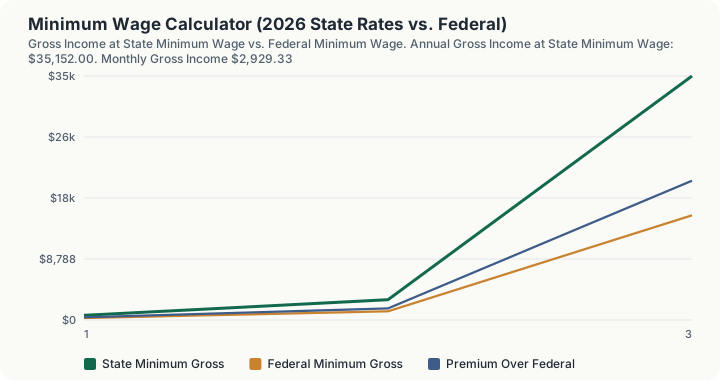
Quick Answer: At California's 2026 minimum wage of $16.90/hour, a full-time worker (40 hours/week, 52 weeks/year) earns $35,152.00 a year, $20,072.00 more than the same schedule at the $7.25 federal minimum wage. In Texas, which has no state minimum wage above the federal floor, that same full-time schedule earns exactly $15,080.00, the federal minimum, with no state premium at all.
Overview
The federal minimum wage has been $7.25 per hour since July 24, 2009, the longest stretch without a federal increase since the Fair Labor Standards Act was enacted in 1938. In the years since, most states have set their own, higher minimum wage, and a covered employee is entitled to whichever rate (federal, state, or in some cases local) is highest. This calculator looks up the 2026 minimum wage for the state you select, computes weekly, monthly, and annual gross income at that rate for the hours you enter, and compares it against what the same schedule would earn at the federal floor.
Roughly 30 states plus the District of Columbia currently set a minimum wage above $7.25. Around 13 states match the federal rate exactly, either by statute or because they have no state minimum wage law at all, and a handful of states (Georgia and Wyoming among them) technically have a state statutory rate below $7.25 on the books, but federal law preempts it for nearly all covered employers, so the effective floor is still $7.25.
How This Is Calculated
- Look up the applicable rate. The calculator retrieves the selected state's current statewide minimum wage from a maintained rate table, along with whether that state indexes its rate to inflation.
- Gross income at the selected rate.
- Federal comparison. The same formulas are applied using the flat $7.25 federal rate, using the same hours and weeks you entered, to produce a same-schedule comparison.
- State premium. The difference between the state hourly rate and the federal rate, and the resulting difference in annual gross income.
Worked Example
Using the calculator's default inputs (California, 40 hours/week, 52 weeks/year):
- California's 2026 minimum wage is $16.90/hour.
- Weekly gross: $16.90 × 40 = $676.00.
- Annual gross: $676.00 × 52 = $35,152.00.
- Monthly gross: $35,152.00 ÷ 12 = $2,929.33.
- Federal comparison at the same schedule: $7.25 × 40 × 52 = $15,080.00 annually.
- State premium: $16.90 − $7.25 = $9.65/hour, or $35,152.00 − $15,080.00 = $20,072.00 more per year than the federal minimum would produce.
Now compare a part-year schedule in Washington, one of the states with the highest 2026 minimum wage: 35 hours/week for 50 weeks (accounting for two unpaid weeks off). Weekly gross is $17.13 × 35 = $599.55; annual gross is $599.55 × 50 = $29,977.50; monthly gross is $29,977.50 ÷ 12 = $2,498.13.
Which States Index Their Minimum Wage to Inflation
A state's minimum wage can rise in two structurally different ways: a flat statutory rate that only changes when the legislature passes a new law (or voters approve a ballot measure setting specific future dollar figures), or an inflation-indexed rate that adjusts automatically every year based on a formula tied to the Consumer Price Index, with no new legislation required.
As of this calculator's 2026 data, states with an active CPI/inflation-indexing formula already driving their annual adjustment include Alaska, Arizona, California, Colorado, Connecticut, Maine, Minnesota, Montana, New Jersey, Ohio, Oregon, South Dakota, Vermont, Virginia, and Washington, along with the District of Columbia. Several additional states, including Florida, Michigan, Missouri, Nebraska, and New York, are currently finishing a legislated step schedule and are scheduled to transition into automatic CPI indexing starting in a future year (2027 in most cases), so their 2026 rate reflects the last step of that fixed schedule rather than an inflation calculation. Every other state with a minimum wage above the federal floor, including Arkansas, Delaware, Illinois, Maryland, Massachusetts, Nevada, New Mexico, Rhode Island, and West Virginia, sets its rate by flat statute with no automatic inflation mechanism at all.
This distinction matters for planning: a flat-rate state's minimum wage can stay unchanged for years until the legislature acts again, while an indexed state's rate reliably moves a little every January (or, in a few states, mid-year) in line with inflation, typically by a few percent.
What This Does Not Account For
- Local minimum wage ordinances. Many cities and counties (Seattle, San Francisco, New York City, and dozens of others) set a local minimum wage above their state's rate. This calculator uses the statewide rate only and does not capture city- or county-level premiums.
- Tipped employee rates. States handle tip credits differently; some allow a lower cash wage for tipped workers (as long as tips bring total pay up to the standard minimum), while others (like California and Washington) require the full minimum wage in cash regardless of tips. This calculator computes gross wages at the standard (non-tipped) minimum wage only.
- Overtime. Federal and state law generally require overtime pay (commonly 1.5x the regular rate) for hours worked beyond 40 in a week for non-exempt employees. This calculator does not apply an overtime multiplier; entering more than 40 hours per week simply multiplies the flat hourly rate by those hours.
- Taxes and deductions. All figures shown are gross income before federal, state, and payroll taxes, and before any other deductions. Take-home pay will be lower than the amounts shown here.
- Employer size and industry exceptions. Some states set different minimum wage thresholds by employer size, revenue, or industry (for example, Ohio's small-employer carve-out, or New Jersey's seasonal/small-employer rate). This calculator uses each state's general, standard adult minimum wage and does not model these carve-outs.
- Sub-state regional rates. A few states (Oregon, New York) set different minimum wages by region within the state. This calculator uses each state's standard or most broadly applicable statewide figure; see that state's notes for the specific regional breakdown.
Common Pitfalls
- Assuming every state above the federal floor adjusts every year. Only the states listed above as actively CPI-indexed change automatically each year. A flat-rate state's minimum wage can remain unchanged for several years in a row.
- Missing a local ordinance that's higher than the state rate. If you live or work in a major city, always check for a local minimum wage ordinance; it frequently exceeds the statewide figure shown here.
- Treating the tipped minimum wage as the same as the standard minimum wage. Tipped employee pay structures vary significantly by state and are not modeled by this calculator.
- Forgetting that some very low state statutory rates never actually apply. Georgia and Wyoming both have state-law minimum wages below $7.25 on the books, but federal law preempts that rate for virtually every covered employer, so $7.25 is the real effective floor in those states, not the lower number.
- Not accounting for overtime when entering more than 40 hours per week. This calculator applies a flat hourly rate to every hour entered; it does not add an overtime premium for hours beyond 40 in a week.
Frequently Asked Questions
Is the federal minimum wage still $7.25 in 2026?
How many states have a minimum wage above the federal rate?
Which state has the highest minimum wage in 2026?
Does my city's minimum wage override my state's minimum wage?
Why does this calculator show a $7.25 rate for a state whose law technically says something lower?
Sources
- U.S. Department of Labor, Wage and Hour Division: State Minimum Wage Laws (federal preemption rules and the $7.25 federal minimum wage). dol.gov/agencies/whd/minimum-wage/state
Also consulted: Individual state labor department and department of workforce/economic development publications for each state's current statutory minimum wage; National Employment Law Project and payroll-compliance aggregators (Paycor, Paycom) for cross-referencing current-year rate changes and inflation-indexing status across states.