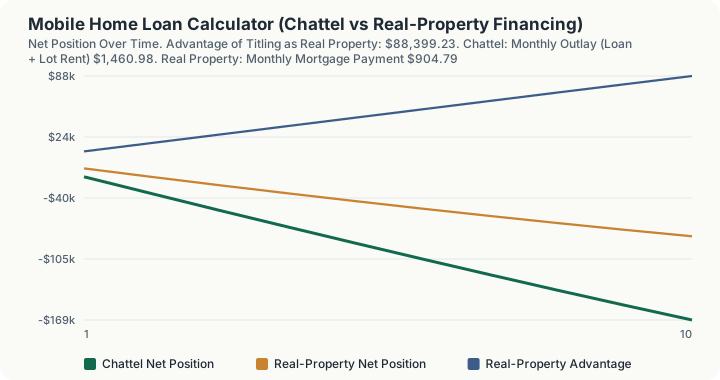
Quick Answer: A $95,000 manufactured home on a $60,000 lot, titled together as real property and financed at 6.75% over 360 months, leaves you $88,399.23 better off over ten years than a 9.75% chattel loan over 240 months plus $650 a month of lot rent. That holds despite the mortgage costing $556.19 more monthly, because the comparison is net position: equity minus every dollar paid in.
What does this calculator do?
A manufactured home can be financed two ways, and they are not two prices for the same product. They are two different assets.
Chattel. The home is personal property, like a vehicle. You rent a lot in a community. The loan is smaller, but it carries a higher rate over a shorter term, and lot rent runs alongside it forever.
Real property. The home is permanently affixed to land you own and the two are titled together. There is no lot rent. The loan is larger, because it buys the land as well.
The comparison almost everyone runs is the payment, and the payment gives the wrong answer. A chattel loan payment can be lower than a mortgage payment on the same home and still be the worse deal, for two reasons that no payment comparison can see:
- The structure depreciates on both paths, but only the real-property buyer owns land underneath it, and land is the part that holds or gains value.
- Lot rent buys no equity at all. It is a permanent outflow with no residual.
So this calculator judges the two structures on net position: what you own at the horizon, less what you still owe, less every dollar of cash you put in along the way. That single figure is what the decision should turn on.
How is this calculated?
net position = (asset value − debt owed) (equity) − (down + payments + rent) (cash in)
Step 1: Size the chattel loan. It finances the home alone. $95,000 x 10% = $9,500 down, leaving $95,000 - $9,500 = $85,500 borrowed
Step 2: Size the real-property loan. It finances home plus land. $95,000 + $60,000 = $155,000, and $155,000 x 10% = $15,500 down, leaving $139,500 borrowed
Step 3: Payment on the chattel loan. $85,500 at 9.75% / 12 over 240 months = $810.98
Step 4: Add the lot rent, because it is not optional on that path. $810.98 + $650 = $1,460.98 monthly outlay
Step 5: Payment on the mortgage. $139,500 at 6.75% / 12 over 360 months = $904.79
Step 6: The monthly difference. $904.79 - $1,460.98 = -$556.19, meaning the mortgage is $556.19 a month cheaper in total outlay despite being the larger loan
Step 7: Depreciate the structure over the 10-year horizon. This happens on both paths. $95,000 x (1 - 2%)^10 = $77,621.92
Step 8: Appreciate the land. Real-property path only. $60,000 x (1 + 3.5%)^10 = $84,635.93
Step 9: Read the chattel balance at month 120. $62,016.19
Step 10: Chattel equity. $77,621.92 - $62,016.19 = $15,605.73
Step 11: Chattel cash in: down, payments and rent. $9,500 + ($810.98 x 120) + ($650 x 120) = $9,500 + $97,317.60 + $78,000 = $184,817.60
Step 12: Chattel net position. $15,605.73 - $184,817.60 = -$169,211.87
Step 13: Read the mortgage balance at month 120. $118,995.69
Step 14: Real-property equity, home plus land less debt. $77,621.92 + $84,635.93 - $118,995.69 = $43,262.16
Step 15: Real-property cash in: down and payments only. $15,500 + ($904.79 x 120) = $15,500 + $108,574.80 = $124,074.80
Step 16: Real-property net position. $43,262.16 - $124,074.80 = -$80,812.64
Step 17: The advantage. -$80,812.64 - (-$169,211.87) = $88,399.23 in favour of the real-property structure
Worked Example
Both net positions are negative, and that is not a defect in the arithmetic. Housing costs money; renting would also produce a negative number, and a larger one. What matters is the gap, and where the gap comes from.
Step 1: Isolate the lot rent. $650 x 120 = $78,000 paid with no residual whatsoever
Step 2: Isolate the land. $84,635.93 of land value at the horizon, against $60,000 of purchase price. The engine applies the down payment percentage to the combined home-and-land cost rather than splitting it between the two, so the whole $15,500 sits against a $155,000 asset base.
Step 3: Compare the two directly. The rent stream and the land are the same decision seen from two sides. One is $78,000 gone; the other is an $84,635.93 asset.
Step 4: Now strip the appreciation out entirely. Setting land appreciation to zero holds the land at $60,000 rather than $84,635.93, which removes $24,635.93 from the real-property equity. The advantage narrows by that amount but does not vanish, because the $78,000 of rent is still gone either way.
Step 5: Now cut the lot rent to $350. That removes $36,000 of chattel outlay over the same ten years and narrows the gap by that much. A genuinely cheap community changes this comparison more than any other single input.
Step 6: Now shorten the hold to three years. Both depreciation and appreciation have had far less time to compound, and the larger mortgage has barely begun amortising, so closing into the bigger loan has not yet paid for itself. The advantage shrinks sharply.
The year-by-year table on the page runs exactly this: the net position of each structure at every anniversary out to your horizon, with the advantage in the third column. The point at which the two lines separate is what you should be reading, not the payment.
Carrying The Two Structures Out To The Horizon
Step 7: After one year. Chattel net position -$17,972.17, real-property net position -$9,170.82, advantage to the mortgage $8,801.35
Step 8: After two years. -$35,757.51 against -$18,126.63, advantage $17,630.88. The gap is widening by almost exactly the same amount each year.
Step 9: After five years. Advantage $44,229.56, and the mortgage balance has fallen only to $130,956.93 from $139,500
Step 10: After ten years. Chattel -$169,211.87, real property -$80,812.64, advantage $88,399.23
The advantage accumulates at roughly $8,800 a year and it is remarkably linear, because its two largest components ($7,800 a year of lot rent with no residual, and land appreciating rather than a structure depreciating) both run at a steady rate. There is no year at which closing into a real-property loan suddenly pays off. It pays off from the first anniversary and keeps compounding, which is why the length of the hold is the input that decides this comparison.
What does this calculator not account for?
- Property tax, insurance and maintenance. Neither path carries them here. Real property is generally taxed as real estate and chattel is often taxed as personal property, sometimes with sizeable differences, and none of that is modelled.
- Lot rent increases. The rent is held flat for the whole horizon. In practice community rents rise, which understates the chattel path's cost, often substantially over ten years.
- The cost of affixing the home and converting title. Foundation, permits, engineering certification and the legal conversion to real property are real costs and are not inputs.
- Site preparation, utility connection, well and septic on land you buy.
- Loan eligibility. Whether an FHA Title I, Title II, VA, USDA or conventional product is available to you on either path is not modelled. The engine prices whatever rate and term you enter.
- Selling costs at the horizon. Equity is stated gross of the cost of realising it, which for a manufactured home on a rented lot can be significant.
- Whether the community will allow a sale in place, which is a real constraint on chattel resale value that this model does not capture.
- The opportunity cost of the extra $6,000 of down payment the real-property path requires.
What mistakes do people make with this?
- Comparing loan payments instead of total outlay. The chattel loan payment is $810.98 against the mortgage's $904.79, which looks cheaper. Add the $650 of lot rent and the chattel path costs $556.19 a month more.
- Assuming a mobile home is always a depreciating asset. The structure depreciates on both paths, identically. What differs is whether you own land under it.
- Treating lot rent as equivalent to property tax. Tax is a cost of owning an asset. Lot rent is the price of not owning one, and it never ends.
- Believing the shorter chattel term is thrift. It is a constraint. HUD's Title I programme caps a manufactured home loan at 20 years and 32 days, against the 30 years a real-property mortgage commonly runs, and a shorter term at a higher rate is what pushes the chattel payment up.
- Ignoring the community's control over your rent. No authority publishes or caps community lot rents. Your largest recurring cost on the chattel path is set by someone else.
- Reading a negative net position as a failure. Both are negative at ten years. The comparison is between them, not against zero.
Frequently Asked Questions
What is the difference between a chattel loan and a mortgage on a manufactured home?
Why is the chattel rate so much higher?
How long can a manufactured home loan run?
Is it always better to buy the land?
Why are both net positions negative?
Can I convert a chattel-financed home to real property later?
Sources
- 24 CFR 201.11(a) and (c), HUD Title I maximum maturities: 20 years and 32 days for a manufactured home loan, and 25 years and 32 days for a multi-module home and lot combination. Read 2026-08-30 at law.cornell.edu/cfr/text/24/201.11
Also consulted: Chattel rates, mortgage rates, lot rent, home depreciation and land appreciation are all user inputs. No public authority publishes any of them, and the engine treats none of them as sourced constants; Balances at the horizon are read from standard monthly amortisation schedules on each loan rather than estimated, and asset values are compounded annually at the rates you supply.