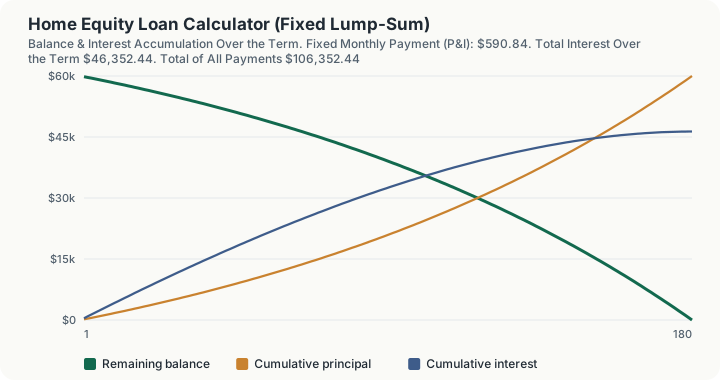
Quick Answer: A $60,000 fixed home equity loan at 8.5% over 15 years costs $590.84 a month, $46,351.87 in total interest, and pushes your combined loan-to-value to 68.89% on a $450,000 home with a $250,000 first mortgage.
Overview
A home equity loan is a second mortgage secured by the equity in your home, disbursed as a single fixed lump sum at closing, at a fixed interest rate, repaid on a fixed monthly schedule for a fixed term. It behaves exactly like a standard installment loan, because structurally it is one: you know your payment, your rate, and your payoff date from day one, and none of the three changes over the life of the loan.
This is mechanically different from a HELOC (Home Equity Line of Credit), even though both borrow against home equity. A HELOC is revolving: you are approved for a credit limit, you draw against it as needed rather than receiving the full amount at once, the rate is typically variable, and most HELOCs structure an interest-only draw period followed by a separate amortizing repayment period once the line closes to new draws. A home equity loan has none of that structure. There is one draw (the full loan amount, once, at closing), one rate (fixed for the term), and one payment (fixed and fully amortizing from the first month). If you want to model a HELOC's draw-period and repayment-period structure specifically, use this platform's separate HELOC calculator; this calculator is for the fixed lump-sum product only.
Because a home equity loan is a second lien behind your existing mortgage, lenders evaluate it based on combined loan-to-value, or CLTV: your existing mortgage balance plus the new home equity loan, divided by your home's current value. Most lenders cap CLTV somewhere around 80% to 85%, which limits how much you can borrow regardless of your home's total value.
How This Is Calculated
- Fixed monthly payment. The loan amount amortizes at the fixed rate over the fixed term using standard amortization math, the same engine this platform uses for every fully amortizing loan:
payment = amortize(loanAmount, rate, termMonths). - Combined loan-to-value (CLTV). Your existing mortgage balance plus the new home equity loan amount, divided by current home value:
CLTV = (existingBalance + loanAmount) / homeValue. - Existing (first-lien) loan-to-value. Your existing mortgage balance alone, divided by home value, shown separately so you can see how much of your CLTV comes from the loan you already have versus the new one.
- Total interest and total paid. Standard amortization totals: the sum of every interest payment across the full term, and the sum of every payment (principal plus interest) across the full term.
- Illustrative max loan at an 85% CLTV cap. A common (not universal) lender ceiling, shown as
max(0, homeValue × 0.85 − existingBalance), purely as a directional sanity check on how much room you may have, not an underwriting decision.
Worked Example
A homeowner with a $450,000 home value, a $250,000 existing mortgage balance, taking out a $60,000 home equity loan at a fixed 8.5% rate over 15 years:
- Fixed monthly payment: $590.84
- Combined loan-to-value: 68.89% ($310,000 total debt ÷ $450,000 value)
- Existing (first-lien) loan-to-value alone: 55.56%
- Total interest over 15 years: $46,351.87
- Total of all payments: $106,352.44
- Illustrative max loan at an 85% CLTV cap: $132,500 (85% of $450,000, or $382,500, minus the $250,000 already owed)
If the same borrower instead chose a 10-year term at the same rate, the fixed monthly payment rises to $743.91, a $153.07 increase, but total interest drops to $29,269.70, a savings of $17,082.17 compared to the 15-year term. This is the standard fixed-loan tradeoff: shortening the term always raises the payment and lowers the total interest, since less time is available for interest to accrue against the outstanding balance.
What This Does Not Account For
- Variable-rate home equity loans. Most home equity loans are fixed-rate, which is the point of comparison against a HELOC, but a small number of lenders offer variable-rate versions; this calculator models the fixed-rate case only.
- Closing costs to originate the loan. Home equity loans typically carry their own closing costs (appraisal, title work, origination fees), separate from your existing mortgage's closing costs; use this platform's closing costs calculator for a general estimate of that category of fee.
- Tax deductibility of the interest. Under current federal tax law, home equity loan interest is deductible only when the loan proceeds are used to buy, build, or substantially improve the home securing the loan; interest on proceeds used for other purposes (debt consolidation, tuition, etc.) is generally not deductible. This calculator does not model any tax effect.
- Lender-specific CLTV caps, credit score tiers, and underwriting overlays. The 85% CLTV figure shown is illustrative and common, not universal; some lenders go higher or lower, and your actual approved amount depends on credit, income, and property type.
- Changes in home value over the loan term. CLTV is calculated against your home's value today; if the home's value falls, your effective equity position weakens even though the loan payment itself does not change.
Common Pitfalls
- Confusing this product with a HELOC. The two are both "home equity" borrowing, but a fixed lump-sum loan and a revolving variable-rate line are structurally different products with different payment behavior; using HELOC assumptions (interest-only payments, a later payment jump) to budget for a home equity loan will produce the wrong number, since a home equity loan's fixed payment already includes principal from month one.
- Borrowing against a home value that is not current. Using an outdated or optimistic home value estimate inflates your apparent CLTV headroom; lenders will order a current appraisal, and the actual approved amount may be lower than this illustrative estimate suggests.
- Ignoring that this is a second lien. If you default, the first mortgage lender is paid from foreclosure proceeds before the home equity loan lender, which is part of why home equity loan rates typically run higher than first-mortgage rates.
- Assuming a longer term is "cheaper" because the payment is lower. A longer term lowers the monthly payment but, as shown in the worked example, increases total interest paid over the life of the loan.
- Not comparing against a cash-out refinance. In some rate environments, refinancing your entire first mortgage with cash out can be cheaper than stacking a second-lien home equity loan on top of an existing first mortgage; compare both structures using this platform's mortgage refinance calculator before deciding.
Frequently Asked Questions
What's the real difference between a home equity loan and a HELOC?
How much can I borrow with a home equity loan?
Is home equity loan interest tax-deductible?
Why is my rate higher than my first mortgage's rate?
Can I pay off a home equity loan early?
Sources
- Consumer Financial Protection Bureau (CFPB): "What is a home equity loan?" and Regulation Z (Truth in Lending Act) disclosure requirements for closed-end home equity loans. ecfr.gov/current/title-12/chapter-X/part-1026
- Federal Reserve Board: consumer guidance on home equity loans versus home equity lines of credit. federalreserve.gov
- Internal Revenue Service: Publication 936, "Home Mortgage Interest Deduction," on the buy/build/substantially-improve test for home equity loan interest deductibility. irs.gov/publications/p936