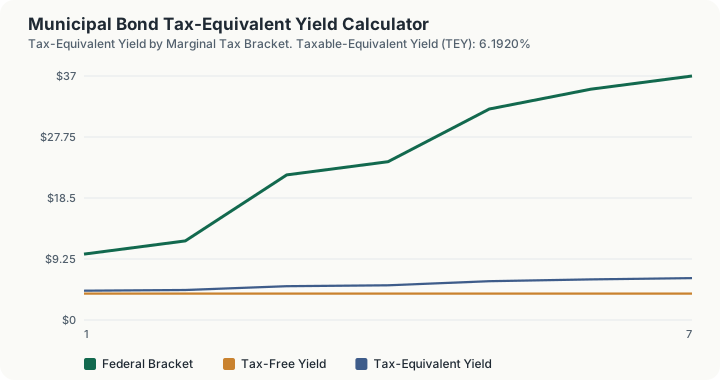
Quick Answer: A municipal bond yielding 4.00% tax-free is worth the same to an investor in the 32% federal bracket paying 5% state tax as a fully taxable bond yielding 6.1920%, because that investor's combined 35.40% marginal rate means only 64.6 cents of every taxable dollar earned actually reaches them.
Overview
Municipal bond yields look small next to corporate bond or CD yields, and that comparison is misleading on its face. Interest from most municipal bonds is exempt from federal income tax, and often from state income tax too if you buy a bond issued by your home state, so a muni's quoted yield already reflects money you get to keep in full. A taxable bond's quoted yield does not: you have to pay ordinary income tax on every dollar of interest it pays before you can spend or reinvest it. Tax-equivalent yield (TEY) translates a tax-free muni yield into the yield a taxable bond would need to offer to leave you with the same after-tax income, so you can put the two side by side and see which one is actually the better deal for your specific tax situation.
This calculator computes TEY two ways: using only your federal marginal tax bracket, and using a combined federal-plus-state rate that accounts for the fact that state income tax is itself deductible against federal taxable income, the standard combined-rate formula used across the municipal bond industry.
How This Is Calculated
Tax-equivalent yield, the core formula:
The intuition: if your marginal tax rate is $t$, a taxable bond only lets you keep $(1-t)$ of every dollar it pays. To match a muni paying you the full tax-free yield, the taxable bond has to pay enough that $(1-t)$ of it equals the muni's yield, which is exactly what dividing by $(1-t)$ solves for.
Combined federal and state marginal rate, when the muni is also exempt from your state's income tax (typically true only for bonds issued by your own state of residence):
State income tax paid is generally deductible when computing federal taxable income, so simply adding federal and state rates together would double-count part of the benefit; multiplying the state rate by $(1 - \text{Federal Rate})$ correctly nets that out. This is the standard combined-rate formula used by brokerage TEY calculators industry-wide.
Worked Example
An investor in the 32% federal bracket, paying 5% to their state, is looking at an in-state municipal bond quoted at 4.00% tax-free.
Step 1 -- The federal rate as a decimal. 32% / 100 = 0.32
Step 2 -- The state rate net of its federal deductibility. 5% x (1 - 0.32) = 3.40%
Step 3 -- The combined marginal rate. 32.00% + 3.40% = 35.4000%
Step 4 -- The share of a taxable dollar that survives. 1 - 0.3540 = 0.6460, so 64.6 cents of every taxable dollar reaches the investor
Step 5 -- The tax-equivalent yield. 4.00% / 0.6460 = 6.1920%
Step 6 -- The yield pickup a taxable bond must offer. 6.1920% - 4.00% = 2.1920 percentage points
Every figure in steps 3 through 6 is a rate, not an amount. Nothing here says how much income the bond pays; it says what a taxable bond would have to yield to be equivalent.
Now remove the state exemption, which is what happens when the bond is issued outside the investor's own state:
Step 7 -- The federal-only equivalent. 4.00% / (1 - 0.32) = 5.8824%
Step 8 -- What the state exemption was worth. 6.1920% - 5.8824% = 0.3096 percentage points, or about 31 basis points
The same bond, the same coupon, the same investor. Thirty-one basis points of the comparison turn purely on the issuer's state matching the buyer's.
The bracket does far more work than the state does:
Step 9 -- A top-bracket investor in Texas or Florida. Combined rate 37.0000% with no state component, giving a TEY of 6.3492% and a required pickup of 2.3492 pts
Step 10 -- A 22% federal bracket with 4% state tax. Combined rate 22% + 4% x 0.78 = 25.1200%, TEY 5.3419%, pickup 1.3419 pts
Step 11 -- The bottom of the ladder, 10% federal and no state tax. 4.00% / 0.90 = 4.4444%, a pickup of well under half a point
Step 12 -- The spread across the bracket ladder. 6.3492% at the top against 4.4444% at the bottom, a range of 1.9048 percentage points on one unchanged 4.00% bond
Step 12 is why the same security is aggressively marketed to one investor and ignored by another. The exemption is worth exactly the tax it avoids, and a low-bracket buyer has little to avoid.
Why the Same Muni Is Worth More to Some Investors Than Others
Tax-equivalent yield is not a property of the bond; it is a property of the bond combined with your specific tax bracket. The exact same 4.00% muni is worth 6.1920% pre-tax to an investor in the 32%-federal-plus-5%-state example above, but only 4.44% pre-tax to someone in the 10% federal bracket paying no state tax, since 4.00% ÷ (1 − 0.10) = 4.44%. This is why municipal bonds are marketed heavily to high earners and largely ignored by lower-bracket investors: the tax benefit scales directly with how much tax you'd otherwise owe.
What This Does Not Account For
- The Alternative Minimum Tax (AMT). Interest from certain "private activity" municipal bonds is not exempt from AMT even though it's exempt from regular federal income tax; this calculator assumes a standard, non-AMT muni.
- The federal SALT deduction cap. Since 2018, the federal deduction for state and local taxes has been capped, which can reduce the practical benefit of the state-tax-deductibility assumption baked into the combined-rate formula, especially for high-income filers who are already at the cap for other reasons.
- Credit risk and call risk. TEY is a pure tax-arithmetic conversion; it says nothing about the muni issuer's creditworthiness or whether the bond can be redeemed early by the issuer.
- Net Investment Income Tax (NIIT). High earners may owe an additional 3.8% NIIT surtax on investment income above certain thresholds; that surtax generally does not apply to muni interest itself but this calculator does not model NIIT on the taxable-bond comparison side.
- Capital gains or losses from selling the bond before maturity. This calculator compares yields only, not total return including price changes.
Common Pitfalls
- Using your average tax rate instead of your marginal rate. TEY should use the marginal rate on your next dollar of taxable income, since that's the rate a taxable bond's interest would actually be taxed at, not your blended average rate across all your income.
- Applying the state-tax exemption to an out-of-state bond. Most states only exempt interest from bonds issued within that state; a muni from another state is typically still taxable at the state level, so use the federal-only TEY figure for those.
- Forgetting AMT exposure on private activity bonds. Some munis, especially those financing airports, hospitals, or housing projects, carry an AMT preference item that can erase part of the tax benefit for AMT-exposed investors.
- Assuming TEY makes munis better for everyone. The whole point of the calculator is that TEY only exceeds the muni's own yield meaningfully once your marginal rate is high enough; at low tax brackets the tax-equivalent yield can be close enough to a comparable taxable bond that the muni is not obviously better.
Frequently Asked Questions
Do I need to include state tax in this calculation?
Why isn't the combined rate just federal rate plus state rate added together?
Is a muni bond always the better choice once TEY exceeds a comparable taxable bond's yield?
What tax bracket should I use if I'm near the edge of two brackets?
Does this apply to municipal bond funds too?
Sources
- Internal Revenue Service, IRC §103, tax exemption for state and local bond interest. law.cornell.edu/uscode/text/26/103
- Internal Revenue Service, Rev. Proc. 2025-32, 2026 federal income tax brackets. irs.gov
- U.S. Securities and Exchange Commission, Investor.gov, municipal bonds overview. investor.gov
Also consulted: Municipal Securities Rulemaking Board (MSRB), EMMA, municipal bond disclosure and tax treatment guidance.