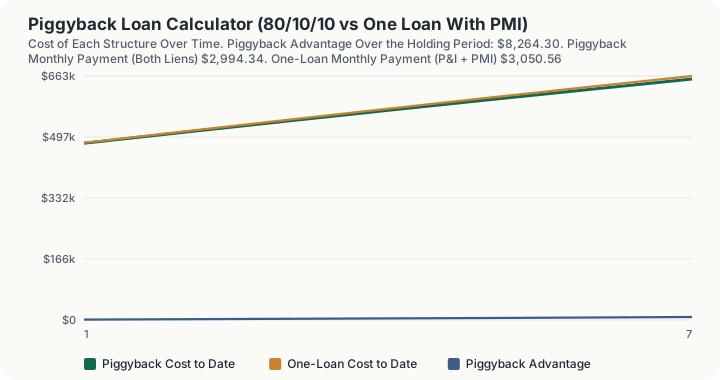
Quick Answer: An 80/10/10 on a $500,000 home beats one $450,000 loan with 0.55% annual PMI by $8,264.30 over an 84-month hold, pairing a $400,000 first lien at 6.5% over 360 months with a $50,000 second at 9.5% over 240. The comparison is cash paid plus debt still outstanding at the horizon, and the piggyback wins even though PMI on the single loan terminates automatically in month 109.
What does this calculator do?
The 80/10/10 exists for one reason: a first lien at 80% loan-to-value carries no mortgage insurance. Split the borrowing so that the first lien stops exactly at 80%, put a small expensive second lien behind it, and you have bought your way out of PMI at the cost of a worse rate on a small slice of the debt.
Whether that trade is worth taking is not a question about the payment in month one. Three things decide it:
PMI is temporary. Under the Homeowners Protection Act you may request cancellation at 80% of original value, and the servicer must terminate it automatically at 78%. So PMI is a finite stream, not a perpetuity. At the defaults it stops on its own in month 109 whether you do anything or not.
The second lien is not temporary. It amortises over its own 240-month term at its own 9.5% rate, for all of it. Nothing terminates it.
Comparing "total paid" is wrong. The two structures pay principal down at different speeds, so a structure that merely defers principal would look cheaper. This calculator compares cash paid to the horizon plus the debt still outstanding at the horizon, which removes that distortion entirely.
The input that flips the answer is your holding period. A horizon shorter than the PMI termination month is a completely different comparison from one longer than it.
This page is distinct from the PMI removal calculator, which answers when PMI comes off a loan you already have. This one answers whether to take PMI at all.
How is this calculated?
cost to horizon = ∑(m = 1 to H) paymentₘ + balance_H
evaluated for both structures, with the advantage being the single loan's cost minus the piggyback's.
Step 1: Cash down, identical under both structures. $500,000 x 10% = $50,000
Step 2: Size the first lien at the LTV that avoids mortgage insurance. $500,000 x 80% = $400,000
Step 3: The second lien picks up whatever is left. $500,000 - $50,000 - $400,000 = $50,000
Step 4: The single-loan alternative borrows the same total. $500,000 - $50,000 = $450,000
Step 5: Confirm the combined loan-to-value. ($400,000 + $50,000) / $500,000 = 90.00%
Step 6: Payment on the first lien. $400,000 at 6.5% / 12 over 360 months = $2,528.27
Step 7: Payment on the second lien. $50,000 at 9.5% / 12 over 240 months = $466.07
Step 8: Combined piggyback payment, with no mortgage insurance. $2,528.27 + $466.07 = $2,994.34
Step 9: Principal and interest on the single loan. $450,000 at 6.5% / 12 over 360 months = $2,844.31
Step 10: The monthly PMI premium, quoted annually against the original balance. $450,000 x 0.55% / 12 = $206.25
Step 11: Total single-loan payment while PMI is in force. $2,844.31 + $206.25 = $3,050.56
Step 12: The monthly advantage at the start. $3,050.56 - $2,994.34 = $56.22 in favour of the piggyback
Step 13: Find when PMI terminates automatically. The engine runs the single loan's amortisation schedule and records the first month the scheduled balance falls to 78% of the $500,000 original value, which is $390,000. That is month 109.
Step 14: Total PMI actually paid over the 84-month horizon. $206.25 x 84 = $17,325, because the horizon ends before termination
Step 15: Cash paid to the horizon under each structure. Piggyback: $251,524.56. Single loan: $256,247.04
Step 16: Debt still outstanding at the horizon under each. Piggyback: $403,330.89. Single loan: $406,872.71
Step 17: Total cost to the horizon, cash plus debt. Piggyback: $251,524.56 + $403,330.89 = $654,855.45 Single loan: $256,247.04 + $406,872.71 = $663,119.75
Step 18: The advantage. $663,119.75 - $654,855.45 = $8,264.30 in favour of the piggyback
Worked Example
The whole decision hinges on where your horizon sits relative to month 109, so the useful exercise is to move it.
Step 1: Hold for 36 months instead of 84. PMI has been running for all 36 of them: $206.25 x 36 = $7,425 of premium paid, with termination still 73 months away.
Step 2: This is the case the piggyback is designed for. Every month of a short hold is a month the single-loan borrower pays insurance and the piggyback borrower does not, while the second lien has not yet had time to accumulate much extra interest.
Step 3: Now hold the full 360 months. PMI stopped in month 109, so the single-loan borrower pays $206.25 x 109 = $22,481.25 in total and nothing thereafter.
Step 4: The second lien, meanwhile, keeps running. $466.07 a month for 240 months = $111,856.80 of payments on a $50,000 borrowing.
Step 5: Which is why the answer can reverse. Over a long hold the finite PMI stream ends while the expensive second lien is still being serviced. Whether it actually reverses on your inputs depends on your PMI factor and your second-lien rate, which is exactly what the table on this page shows: the cost of both structures at every anniversary, so you can find the crossing point rather than accept one verdict at one horizon.
Step 6: Test a cheap PMI factor. At 0.30% instead of 0.55%, monthly PMI falls from $206.25 to $112.50 and the single loan's disadvantage narrows sharply. A strong credit profile is the most common reason a piggyback is not worth doing.
Step 7: Test an expensive second. At 12% instead of 9.5%, the second lien payment rises materially and eats the piggyback's edge from the other side.
Note what step 12 and step 18 say together: a $56.22 monthly payment advantage over 84 months is only $4,722, yet the total advantage is $8,264.30. The rest comes from the balance, because the piggyback is paying its debt down faster. That difference is invisible to any comparison that stops at the payment.
Carrying Both Structures Forward Anniversary by Anniversary
Step 8: Year one. Piggyback total cost to date $480,580.70, single loan $481,576.89, piggyback ahead by $996.19. PMI paid so far on the single loan: $2,475.00.
Step 9: Year two. Piggyback $510,774.58, single loan $512,816.94, advantage $2,042.36. PMI paid: $4,950.00.
Step 10: What year two added. $2,042.36 - $996.19 = $1,046.20 of fresh advantage in a single year, more than year one produced, because the second lien is amortising faster than it is accruing.
Step 11: Year seven, the stated horizon. Piggyback $654,855.45, single loan $663,119.75, advantage $8,264.30, with $17,325.00 of PMI paid and termination still 25 months away.
The advantage compounds while PMI is running and stops compounding the month it terminates. Everything the piggyback wins on this borrower's inputs is won before month 109, which is why the horizon is the input that decides this question and the interest rates are the input that decides by how much.
What does this calculator not account for?
- The request-based cancellation at 80%. The engine models only the automatic termination at 78% of original value, the one that happens without you doing anything. You may request cancellation earlier, at 80%, but it requires a written request, so the engine does not assume it. Modelling it would make the single loan look better than the figures here.
- PMI cancellation on a new appraisal. Appreciation-based removal is investor policy rather than statute and is not modelled at all. The PMI removal calculator covers that route.
- Closing costs on either structure. A second lien has its own origination costs, and two loans generally cost more to close than one.
- Lender-paid or single-premium mortgage insurance. Only borrower-paid monthly PMI is modelled.
- HELOC behaviour. The second lien is priced as a fixed, fully amortising loan. A HELOC with a draw period, a variable rate or a balloon behaves differently.
- Tax treatment of either interest stream.
- Refinancing. A single loan can be refinanced out of PMI; a piggyback structure is harder to refinance because the second lien holder must agree to resubordinate.
- Taxes, insurance and HOA, which are identical under both structures and would not change the difference.
What mistakes do people make with this?
- Comparing month-one payments. The $56.22 monthly edge accounts for barely half the real advantage here. The rest is the faster principal reduction, which only shows up when you count the balance.
- Treating PMI as permanent. It is not. At the defaults it terminates by law in month 109 with no action from you, and you can ask for it to go at 80% earlier than that.
- Forgetting the second lien never terminates. It runs its full 240 months. That is the mirror image of the point above and it is what makes long holds favour the single loan.
- Ignoring your actual holding period. This is the input that decides the answer, and most people guess it badly. The median owner does not stay 30 years.
- Assuming the second lien rate is negotiable at the margin. It is subordinate debt and prices accordingly. No authority publishes the spread, and it varies sharply by lender.
- Overlooking resubordination. Refinancing a first lien with a second behind it requires the second lien holder's consent. That is a real constraint the arithmetic does not show.
Frequently Asked Questions
What is an 80/10/10 loan?
When does PMI actually come off?
Is a piggyback always cheaper than PMI?
Why is the second lien rate so much higher?
Does the piggyback save me money every month?
Should I use my holding period or the full loan term?
Sources
- 12 U.S.C. 4901(2), the cancellation date, and 12 U.S.C. 4901(18), the termination date: read 2026-08-30 at law.cornell.edu/uscode/text/12/4901
- 12 U.S.C. 4902(b), automatic termination when the balance is first scheduled to reach 78% of original value: read 2026-08-30 at law.cornell.edu/uscode/text/12/4902
Also consulted: Every interest rate, the PMI factor and the loan-to-value split are user inputs. No public authority publishes current rates by loan type, the second-lien spread, or the mortgage insurance premium schedule, and the engine treats none of them as sourced constants.