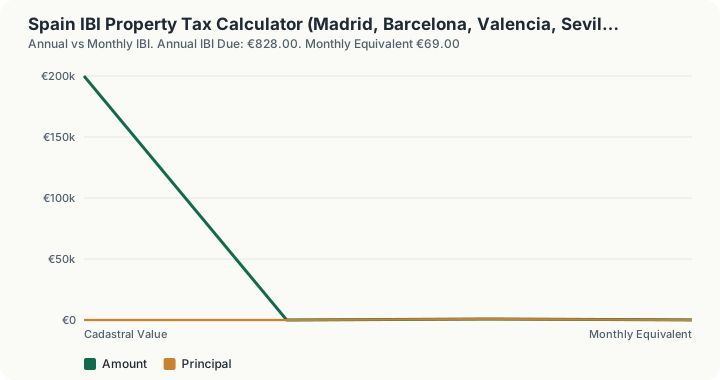
Quick Answer: A property with a €200,000 cadastral value (valor catastral) in Madrid owes €828/year in IBI at the city's 0.414% rate -- the lowest of the five major cities modeled here. The same cadastral value in Sevilla, which has the highest rate of the five at 0.662%, owes €1,324/year, nearly €500 more for an identical cadastral value.
Overview
IBI (Impuesto sobre Bienes Inmuebles) is Spain's annual municipal property tax, owed by whoever holds the property on 1 January of the tax year, regardless of whether they sell it later that year. Unlike a US-style property tax based on assessed market value, IBI is calculated from the valor catastral -- an official cadastral value set by Spain's Catastro (land registry) that is typically well below actual market value, often somewhere in the range of 50%-70% of it, though this varies enormously by municipality and how recently that municipality's cadastral values were last revised.
Each ayuntamiento (city council) sets its own IBI rate by local ordinance, within a statutory range set by national law: generally 0.4% to 1.1% for urban property. That means two identical properties with the same cadastral value can owe meaningfully different IBI bills purely based on which city they're in -- this calculator covers five major cities as representative examples of just how much that variation matters.
How This Is Calculated
IBI is charged on the valor catastral, an administrative value maintained by the Catastro that typically sits well below what the property would sell for. That gap is the single most important thing to understand about a Spanish property tax bill, because a rate that looks high applies to a base that is not the market price. The calculation itself is a single multiplication:
The city rate (tipo de gravamen) is set annually by each ayuntamiento and must fall within the statutory range for that property type -- 0.4% to 1.1% for urban property under Spain's Ley Reguladora de las Haciendas Locales, though specific legal conditions can permit some municipalities to set rates outside that general range.
Worked Example
An owner in Madrid holds a flat whose valor catastral is €200,000, and wants the 2026 bill.
Step 1 -- Establish the base. Valor catastral = €200,000. This is the Catastro figure from the bill, not the market price the flat would fetch.
Step 2 -- The city's tipo de gravamen. Madrid's 2026 urban rate = 0.414%, reduced from 0.428%
Step 3 -- Check it against the statutory range. 0.414% sits inside the 0.4% - 1.1% band the Ley Reguladora de las Haciendas Locales sets for urban property
Step 4 -- Annual IBI. €200,000 x 0.414% = €828.00
Step 5 -- Monthly equivalent. €828.00 / 12 = €69.00
Only one multiplication does any work here, and that is the point worth taking away: nothing in the bill is negotiated against the property's condition, its rental income, or what the owner paid for it. Two identical flats on the same street carry identical IBI, and the only levers that move the number are the Catastro's valuation and the ayuntamiento's ordinance.
The same €200,000 in each covered city
| City | Rate | Annual IBI | Monthly |
|---|---|---|---|
| Madrid | 0.414% | €828.00 | €69.00 |
| Málaga | 0.451% | €902.00 | €75.17 |
| Valencia | 0.578% | €1,156.00 | €96.33 |
| Barcelona | 0.660% | €1,320.00 | €110.00 |
| Sevilla | 0.662% | €1,324.00 | €110.33 |
Step 6 -- The spread between the cheapest and dearest city. €1,324.00 - €828.00 = €496.00 a year, on an identical cadastral value
Step 7 -- Expressed as a multiple. 0.662% / 0.414% = 1.60x. Sevilla charges sixty percent more per euro of cadastral value than Madrid.
A larger property in a higher-rate city
Step 8 -- €450,000 cadastral value in Barcelona. €450,000 x 0.660% = €2,970.00 a year
Step 9 -- Monthly. €2,970.00 / 12 = €247.50
Because the charge is a flat percentage with no bands, step 8 scales exactly: doubling the cadastral value doubles the bill, and there is no threshold at which the marginal rate changes. That makes IBI unusually easy to forecast, and unusually blunt -- it is the revaluation of the valor catastral, which can arrive as a step change after a municipal ponencia, that produces the nasty surprises rather than the rate itself.
What This Does Not Account For
- Only 5 major cities are modeled directly. Spain has thousands of municipalities, each setting its own rate; use the "Custom" option to enter your own city's published rate if it isn't one of the five covered here.
- Cadastral value is NOT market value. It's a distinct official figure set by Catastro, and the ratio between cadastral and market value varies enormously depending on when a municipality's values were last revised -- some are decades out of date, others recently updated.
- Bonificaciones (discounts) that many municipalities offer for large families, certain energy-efficiency installations, or other specific circumstances are not modeled.
- Rural (rústica) property, which follows a different statutory rate range (0.3%-0.9%) than urban property, is not modeled -- this calculator assumes urban property throughout.
- Special-characteristics property (bienes inmuebles de características especiales), which follows its own separate rate range, is out of scope.
- Rate changes are frequent and city-specific -- always confirm your city's current published rate for the actual tax year in question rather than assuming last year's rate still applies, since city councils commonly adjust rates annually.
Common Pitfalls
- Confusing cadastral value with market value. IBI is calculated purely on the cadastral figure, which is often significantly lower than what you'd actually get selling the property -- don't estimate your IBI bill from an online market-value estimate.
- Assuming IBI rates are uniform across Spain. The nearly €500/year gap between Madrid and Sevilla on an identical cadastral value in this calculator's own comparison shows just how much city-level variation exists.
- Forgetting IBI is owed by whoever holds the property on 1 January, regardless of a sale later in the year -- this commonly needs to be prorated contractually between buyer and seller at closing, a detail this calculator does not compute.
- Not checking for available bonificaciones. Many municipalities offer meaningful discounts for specific situations (large families, certain solar installations, etc.) that can reduce the bill below the headline rate calculation.
- Assuming last year's rate is this year's rate. City councils frequently adjust IBI rates from year to year; always verify the current year's published rate rather than assuming continuity.
Frequently Asked Questions
Where do I find my property's cadastral value?
Why is my city's IBI rate different from a neighboring city's?
Does a higher cadastral value always mean a higher market value?
Who pays IBI if I sell my property mid-year?
Can my city change its IBI rate every year?
Sources
- Spanish Tax Agency (Agencia Tributaria), the official authority for the national tax authority this calculator relates to. sede.agenciatributaria.gob.es
Also consulted: Ley Reguladora de las Haciendas Locales, establishing the statutory 0.4%-1.1% urban-property IBI rate range and the Valor Catastral × tipo de gravamen calculation method; Madrid city tax portal news release confirming the 2026 rate reduction to 0.414% (from 0.428%); Current secondary reporting corroborating Barcelona (0.660%), Valencia (0.578%), Sevilla (0.662%), and Málaga (0.451%, frozen since 2014) city rates.