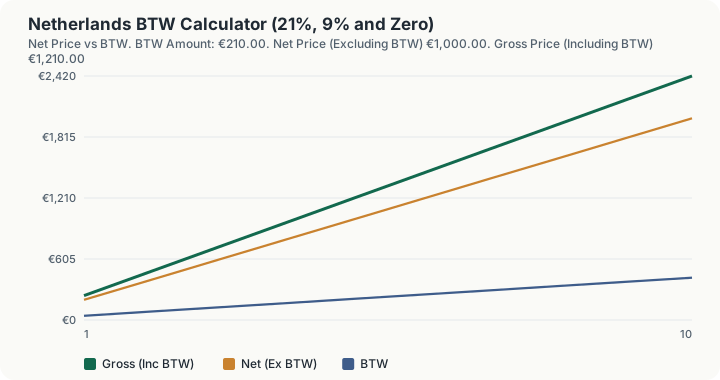
Quick Answer: Adding the general 21% rate to a €1,000 net price adds €210.00, giving €1,210 gross. Removing BTW from a €1,000 gross price gives €173.55, not €210, because the tax is 21/121 of the gross. From 1 January 2026 accommodation moved from 9% to 21%, so hotel and short-let pricing published before then is out of date.
What does this calculator do?
Dutch BTW has three rates: the general 21%, a reduced 9% covering food, books, medicines and similar, and 0% for exports and intra-Community supplies.
One change matters this year. Logies, the supply of accommodation, moved from the reduced 9% rate to the general 21% rate on 1 January 2026. Hotels, holiday parks and short-term rentals are all affected. Separately supplied extras such as breakfast, pool access or a theme-park ticket stay at 9%, so a single hotel bill can now carry both rates.
The other recurring issue is the same one every VAT system produces: adding and removing the tax are not mirror operations.
How is this calculated?
Adding BTW:
BTW = Net × rate; Gross = Net × (1 + rate)
Removing BTW uses the VAT fraction, since the tax is a share of the gross:
BTW = Gross × rate/(1 + rate)
At 21% that is 21/121; at 9% it is 9/109.
The KOR. The kleineondernemersregeling lets a business with turnover at or below €20,000 opt out of charging BTW altogether. In exchange it cannot reclaim input BTW, and the choice binds for three years.
Worked Example
A ZZP'er invoices €1,000 net at the general rate and needs the gross.
Step 1: The rate. Algemeen tarief, so r = 21%
Step 2: The BTW. €1,000 x 21% = €210.00
Step 3: The gross. €1,000.00 + €210.00 = €1,210.00
Reverse the question and the arithmetic changes shape. Suppose the €1,000 in hand already includes the tax.
Step 4: The BTW fraction. 21 / 121 = 17.36% of gross
Step 5: Extract the BTW. €1,000 x (21 / 121) = €173.55
Step 6: The net. €1,000.00 - €173.55 = €826.45
The wrong method, done by hand rather than by this calculator:
Step 7: Deducting 21% of the gross. €1,000 x 21% = €210.00, leaving a net of €790.00
Step 8: The error. €826.45 - €790.00 = €36.45 understated on one €1,000 receipt
Step 9: Close the loop. €1,210 x (21 / 121) = €210.00, net €1,000.00, back where Step 3 finished
At the reduced rate the fraction is different again:
Step 10: 9% on €1,000 net. €1,000 x 9% = €90.00, gross €1,090.00
Which rate applies is exactly what changed for accommodation on 1 January 2026:
Step 11: A hotel night at €200 net, 2026 rules. €200 x 21% = €42.00, a gross of €242.00
Step 12: The same night under the old 9% treatment. €200 x 9% = €18.00, a gross of €218.00
Step 13: The move. €42.00 - €18.00 = €24.00 more tax on one room night, a 12-point rate change with no change to the room
Finally the KOR test, which turns on turnover rather than on any single invoice:
Step 14: Turnover of €15,000. At or below the €20,000 ceiling: eligible for the KOR small-business exemption
Step 15: Turnover of €25,000. Above the €20,000 KOR ceiling, so BTW must be charged
Eligibility is not the same as advantage. A business that opts in charges no BTW and reclaims no input BTW, and the election binds for three years.
The Fraction, the Sweep and the KOR Ceiling
Right method against wrong method, priced. Removing BTW from a €1,000 gross price at the general rate returns €173.55 of BTW and €826.45 of net. That is 21/121 of the gross. Deducting 21% of the gross instead gives €210.00 of BTW and a €790.00 net, which understates the net by €36.45 on a single €1,000 invoice and overstates the BTW by the same amount. The error is 3.6% of the invoice and it scales linearly, so it is roughly €3,645 wrong across €100,000 of gross turnover.
The two directions are not symmetrical, and the sweep makes that obvious. Adding 21% to a €1,000 net price gives €210.00 of BTW and €1,210.00 gross. Removing 21% from a €1,000 gross price gives €173.55. Same rate, same €1,000, two different BTW figures, because one €1,000 is a net amount and the other is a gross amount.
Each additional €100 of net price adds €21.00 of BTW at the general rate and €9.00 at the reduced rate. Moving the amount from €1,000 to €1,100 in add mode moves the BTW from €210.00 to €231.00 and the gross from €1,210.00 to €1,331.00.
The rate selector, priced on the same €1,000. At the general rate the BTW is €210.00 and the gross €1,210.00. At the reduced rate they are €90.00 and €1,090.00. The difference of €120.00 on €1,000 of net price is what the 1 January 2026 reclassification of accommodation from 9% to 21% did to a hotel's published pricing: a €1,000 net room night that used to gross €1,090.00 now grosses €1,210.00.
The KOR ceiling is a genuine cliff, and the calculator walks it exactly. Enter €19,999 of annual turnover and the status output reads "Eligible for the KOR small-business exemption". Enter €20,000 and it still reads eligible, because the test is at-or-under rather than strictly under. Enter €20,001 and it flips to "Above the €20,000 KOR ceiling". One euro of turnover separates the two outcomes.
What the KOR check does not do. It is a pure threshold test on the figure you type. It does not change the BTW computed above it: the €210.00 on a €1,000 net invoice is reported identically whether the status reads eligible or not, because opting into the KOR is an election you make, not an automatic consequence of being under the ceiling. Leave the turnover field at zero and the status reads "Not assessed" rather than eligible.
What does this calculator not account for?
- Which rate applies to which supply. Classification is the difficult part and the Belastingdienst publishes detailed guidance for it.
- Exempt supplies such as healthcare, education, insurance and certain financial services, which differ from zero-rated: exempt businesses cannot reclaim input BTW.
- The reverse charge (verleggingsregeling), common in construction and in cross-border business-to-business supplies.
- The One Stop Shop and the €10,000 EU distance selling threshold.
- Import BTW and the article 23 licence, which permits deferral to the periodic return.
- The margin scheme for second-hand goods, art and antiques.
- Herziening of input BTW on investment services, a rule that applies from 2026.
- BTW on property, which has its own regime.
- Whether opting into the KOR is wise. It removes input BTW recovery, so it usually suits businesses selling to consumers rather than to other businesses.
What mistakes do people make with this?
- Deducting 21% from a gross price. €1,000 minus 21% is €790, which is wrong by €36.45. The correct net is €826.45.
- Using the 9% rate for accommodation. It moved to 21% on 1 January 2026. Pricing, invoicing templates and quotes prepared earlier will understate the tax.
- Charging one rate across a whole hotel bill. The room is now 21% while separately supplied breakfast or pool access remains 9%, so the invoice may need splitting.
- Treating the KOR as a pure saving. Opting in means you cannot reclaim input BTW on your costs, which is a genuine loss for a business with significant purchases.
- Confusing exempt with zero-rated. Zero-rated supplies allow input BTW recovery; exempt supplies do not.
- Rounding per line rather than per invoice, which can produce small mismatches against a supplier's calculation.
Frequently Asked Questions
Why is removing 21% not the same as adding it?
Did the VAT rate on hotels really change?
What is the KOR?
What falls under the 9% rate?
Do I charge BTW to customers in other EU countries?
Is zero-rated the same as exempt?
Sources
- Belastingdienst: "Btw-tarieven: welke tarieven zijn er, en wanneer moet u ze toepassen?", 21% general and 9% reduced rates. belastingdienst.nl/wps/wcm/connect/bldcontentnl/belastingdienst/zakelijk/btw/tarieven_en_vrijstellingen
All figures verified on 30 August 2026
Also consulted: Belastingdienst: "Vanaf 1 januari 2026: btw-tarief logies omhoog naar 21%", accommodation moved to the general rate, with separately supplied extras remaining at 9%; Belastingdienst: kleineondernemersregeling turnover ceiling of €20,000.