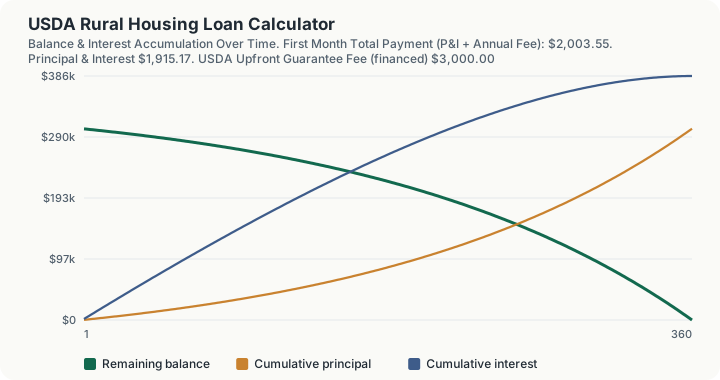
Quick Answer: A $300,000 USDA Guaranteed loan with no down payment at 6.5% over 30 years carries a $3,000 upfront guarantee fee financed into the balance, a first-month payment of about $2,003.54 including the 0.35% annual fee, and roughly $407,269 in combined interest and annual fee charges over the life of the loan.
Overview
USDA Guaranteed Rural Housing loans let eligible buyers in USDA-designated rural and many suburban areas finance up to 100% of a home's price with no down payment, competitive fixed rates, and no monthly private mortgage insurance. What USDA loans have instead of PMI is a two-part fee structure that funds the loan guarantee program: a one-time upfront guarantee fee added to the loan at closing, and a smaller annual fee collected in monthly installments for as long as the loan is outstanding. Both fees are set by USDA Rural Development and published in an annual Federal Register notice, and both are frequently misunderstood or left out of back-of-envelope payment estimates entirely.
This calculator models both fees explicitly rather than treating the loan as a plain mortgage. The upfront guarantee fee, currently 1.00% of the base loan amount, is added to your loan balance and financed the way the overwhelming majority of USDA borrowers actually handle it. The annual fee, currently 0.35% of the outstanding balance per year, is billed in equal monthly installments and, because it is calculated against your declining balance, shrinks slightly every year as you pay down principal. The calculator applies that monthly fee against your actual month-by-month balance from the amortization schedule rather than using a single flat estimate for the whole loan term, so the total lifetime fee figure reflects how the balance actually declines.
How This Is Calculated
Step 1: Determine the base loan amount. Home price minus any voluntary down payment. USDA loans do not require a down payment, so this is usually the full home price.
Step 2: Add the upfront guarantee fee. The fee is 1.00% of the base loan amount. It is added to the base loan amount to produce the financed loan amount, which is the balance that actually amortizes:
Step 3: Amortize the financed amount. Standard fixed-rate mortgage formula applied to the financed amount:
where $i$ is the monthly interest rate and $n$ is the total number of monthly payments.
Step 4: Layer on the annual fee. For each month in the schedule, the calculator takes that month's beginning principal balance and multiplies it by one-twelfth of 0.35%:
That monthly fee amount is added on top of the principal-and-interest payment for that month, and the full stream of monthly fees is summed to produce a total lifetime annual fee figure. Because the balance declines every month, this fee slowly shrinks over the life of the loan, unlike principal and interest, which stay level under a standard fixed-rate schedule.
Worked Example
Take a $300,000 home financed with a USDA Guaranteed loan, no down payment, at 6.5% fixed over 30 years.
- Base loan amount: $300,000.
- Upfront guarantee fee: $300,000 × 1.00% = $3,000.
- Financed loan amount: $300,000 + $3,000 = $303,000. This is the balance that amortizes.
- Monthly interest rate: 6.5% ÷ 12 = 0.5416667%.
- Principal and interest payment (360 months): applying the amortization formula to $303,000 gives $1,915.17.
- First month's annual fee: $303,000 × (0.35% ÷ 12) = $88.38.
- First month's total payment: $1,915.17 + $88.38 = $2,003.54.
- Total interest over 30 years: approximately $386,459.80.
- Total annual fee paid over 30 years: approximately $20,809.37, declining each year as the balance is paid down.
Put $10,000 down on the same home and the base loan drops to $290,000, the upfront fee drops proportionally to $2,900, and the financed amount falls to $292,900, lowering every payment and both lifetime totals.
What This Does Not Account For
This calculator isolates principal, interest, the upfront guarantee fee, and the annual fee. Property taxes and homeowners insurance aren't included; both are typically escrowed on top of the payment shown here and vary significantly by county and insurer. Nor does it check whether a specific property address actually falls within a USDA-eligible rural or suburban area, since eligibility is address-specific and determined by USDA's own eligibility maps, which are updated periodically as areas urbanize. USDA household income limits go unmodeled too, even though they cap eligibility at a percentage of the area median income and vary by location and household size. The rate is assumed fixed for the full term. And the annual fee here is recalculated monthly against the actual declining balance, rather than USDA's technical basis of an average annual scheduled balance recalculated once per year; the two approaches converge to nearly identical lifetime totals, but individual monthly fee amounts may differ by a few cents from a lender's official disclosure.
Common Pitfalls
Borrowers frequently budget only for principal and interest and are then surprised when the annual fee shows up as a separate line item on their monthly mortgage statement, functioning much like the PMI they thought they were avoiding by choosing a USDA loan. It is also easy to assume a property qualifies for USDA financing based on driving directions or "it feels rural," when eligibility is determined by USDA's official property eligibility maps down to the specific address, and many areas that look rural on the ground do not qualify while areas that feel suburban sometimes do. Some buyers also assume the annual fee is a flat percentage of the original loan amount for the whole term; it is actually recalculated against the declining balance, so the dollar amount slowly decreases as the loan matures, not something a simple flat multiplication would show. Finally, income limits catch buyers off guard: unlike FHA or conventional loans, USDA Guaranteed loans cap eligibility based on household income relative to the area median, and exceeding that limit disqualifies an otherwise strong borrower regardless of credit score or down payment.
Frequently Asked Questions
Do I have to finance the upfront guarantee fee, or can I pay it in cash?
Why does the annual fee shrink over time if the percentage never changes?
Is the USDA annual fee the same thing as PMI?
Does every rural-sounding address qualify for a USDA loan?
How do household income limits affect whether I qualify?
Sources
- USDA Rural Development, Single Family Housing Guaranteed Loan Program.
Also consulted: USDA Rural Development, OneRD Guarantee Loan Program, Annual Notice of Guarantee Fee Rates, Periodic Retention Fee Rates, Loan Guarantee Percentage, FY2026 (Federal Register, effective October 1, 2025): upfront fee 1.00%, annual fee 0.35%.