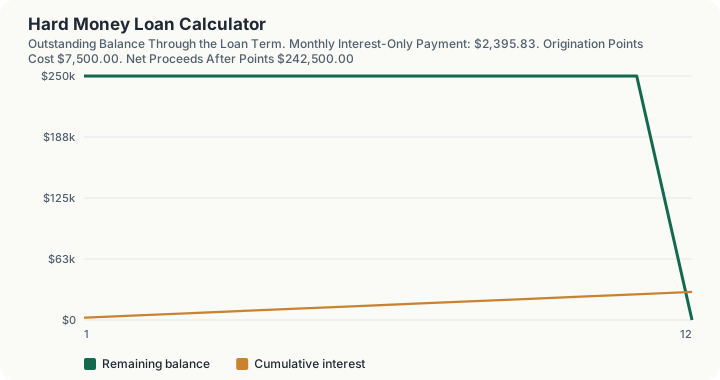
Quick Answer: A $250,000 hard money loan at 11.5% for 12 months with 3 points costs $2,395.83 a month in interest-only payments, $7,500.00 in upfront points, and $36,250.00 in total cost of capital, roughly 14.5% of the loan amount.
Overview
Hard money loans are short-term, asset-based financing, typically used by real estate investors doing fix-and-flip projects, fast acquisitions, or deals that conventional lenders won't touch on a tight timeline. Instead of underwriting the borrower's income and credit the way a bank does, a hard money lender underwrites the collateral: the property's current value, its after-repair value (ARV), and how much equity cushion the lender has if it has to foreclose and resell.
That collateral-first approach is what makes hard money loans fast (some close in days) and flexible (properties that need major repair, or borrowers with credit issues, can still qualify), but it also makes them expensive. Rates typically run 8% to 15%, well above conventional mortgage rates, and lenders almost always charge points, an upfront origination fee expressed as a percentage of the loan amount, where 1 point equals 1% of the loan. Points are usually deducted directly from the loan proceeds at closing, meaning the borrower nets less cash than the face amount of the loan.
Like most short-term real estate financing, hard money loans are typically interest-only, with the full principal due at the end of the term, funded by selling the property, refinancing into permanent debt, or paying off from another source.
How This Is Calculated
- Monthly interest-only payment. Loan amount multiplied by the monthly interest rate (annual rate divided by 12). This is the fixed payment due every month; it doesn't change because the principal doesn't amortize.
- Total interest cost. The monthly interest payment multiplied by the number of months in the term.
- Points cost. Loan amount multiplied by the points percentage. This is charged once, upfront, and typically withheld from the loan proceeds rather than paid separately in cash.
- Net proceeds at closing. Loan amount minus the points cost, which is what actually funds the deal.
- Total cost of capital. Total interest plus points, the full price of borrowing beyond the principal itself.
- Effective cost as a percentage of the loan. Total cost of capital divided by the loan amount, a rough all-in gauge useful for comparing offers with different rate and points combinations.
Worked Example
A $250,000 hard money loan at 11.5% APR for a 12-month term, with 3 points charged at closing:
- Monthly rate: 11.5% ÷ 12 = 0.9583333%
- Monthly interest-only payment: $250,000 × 0.9583333% = $2,395.83
- Total interest over the term: $250,000 × 11.5% × (12 ÷ 12) = $28,750.00
- Points cost: $250,000 × 3% = $7,500.00
- Net proceeds at closing: $250,000 − $7,500.00 = $242,500.00
- Total cost of capital: $28,750.00 + $7,500.00 = $36,250.00
- Effective cost as a percentage of the loan: $36,250.00 ÷ $250,000 × 100 = 14.5%
Compare a faster deal: a $180,000 loan at 12% APR for a 6-month term with 2 points. The monthly interest-only payment is $180,000 × 1% = $1,800.00, total interest over the shorter 6-month term is $180,000 × 12% × (6 ÷ 12) = $10,800.00, and points cost $180,000 × 2% = $3,600.00. Even though the rate is higher, the shorter hold and lower points bring the total dollar cost down substantially, which is exactly why speed of exit matters so much in hard money underwriting.
Where the Real Cost Sits, and It Is Not the Rate
The headline on this page is a $2,395.83 monthly interest payment, and it is the least informative number the calculator produces. The figures below come from moving each input in turn.
Points cost more than the rate does, per unit. Setting origination points to zero takes the total cost of capital from $36,250.00 to $28,750.00 and the effective cost from 14.5% to 11.5% of the loan. Setting them to 5 takes the total to $41,250.00 and the effective cost to 16.5%. Each point is worth $2,500.00 on a $250,000 loan, and it is charged whether the loan runs one month or twelve.
Which is why the term changes everything. At a 6-month term the same 3 points and 11.5% rate produce $14,375.00 of interest, $7,500.00 of points, $21,875.00 of total cost and an effective cost of 8.75% of the loan. At 24 months the interest reaches $57,500.00 and the effective cost 26%. The monthly interest payment is $2,395.83 in every one of those cases: the headline does not move at all while the true cost of the money nearly triples.
The annualised comparison the effective cost figure hides. Over 12 months a 14.5% total cost is roughly a 14.5% annual cost. Over 6 months the 8.75% figure is roughly 17.5% annualised, because the same $7,500 of points is amortised over half the time. The engine reports total cost as a percentage of the loan and does not annualise it, so a shorter loan looks cheaper on this page while being more expensive per month of use. That is the single most important thing to know about the effective cost output.
A point of rate against a point of origination. Moving the rate from 11.5% to 12.5% takes total interest from $28,750.00 to $31,250.00 over twelve months, a $2,500.00 increase, exactly matching what one origination point costs. On a 12-month loan a point and a point are equivalent; on a 6-month loan the rate increase costs $1,250.00 and the point still costs $2,500.00.
Net proceeds, which is what actually funds the deal. The engine returns $242,500.00 of net proceeds at closing on a $250,000 loan with 3 points. At 5 points it returns $237,500.00. A borrower sizing a purchase to the loan amount rather than the net proceeds is short by the points on day one.
What the schedule does and does not do. All twelve rows carry $0.00 of principal and a constant $250,000 balance until the final row, which repays the whole loan in a $252,395.83 balloon. That is correct for an interest-only bridge. The engine charges no exit fee, no extension fee for the very common case of a flip that runs past its term, no draw-based rehab funding and no appraisal or legal cost, and it applies no after-repair-value constraint on the loan amount even though ARV is what actually sizes these loans.
What This Does Not Account For
- Draw-based rehab financing. Many hard money loans for fix-and-flip projects release rehab funds in draws as work completes, similar to a construction loan, rather than disbursing the full amount at once; this calculator assumes the full principal is outstanding from day one.
- Extension fees. If the project runs past the original term, extending a hard money loan typically carries an additional fee, often 1 point or more per extension.
- Exit fees or prepayment minimums. Some hard money lenders charge a minimum interest guarantee or an exit fee even if the loan is repaid early.
- Loan-to-ARV or loan-to-cost limits. Hard money lenders typically cap loan size relative to the property's after-repair value or total project cost; this calculator doesn't check your loan amount against those limits.
- Third-party closing costs. Title, escrow, appraisal, and legal fees on top of lender points aren't included here.
Common Pitfalls
- Underestimating total cost by focusing on the interest rate alone. Points can add several percentage points of effective cost on top of the quoted rate, especially on shorter-term loans where the upfront fee is amortized over fewer months of benefit.
- Assuming the loan amount is what funds the deal. Because points are usually deducted from proceeds, net cash to the borrower is meaningfully less than the face loan amount.
- Misjudging the exit timeline. Hard money loans are priced for a fast turnaround. A flip that takes twice as long as planned doesn't just delay profit, it roughly doubles the interest-only carrying cost.
- Comparing hard money offers by rate only. Two loans with the same rate can have very different total costs once points, term, and any junior fees are factored in; always compare total cost of capital, not just the headline rate.
Frequently Asked Questions
Why are hard money loan rates so much higher than a conventional mortgage?
What are points, exactly?
Do I make principal payments during a hard money loan term?
How quickly can a hard money loan close?
What happens if I can't repay a hard money loan when it's due?
Sources
- Consumer Financial Protection Bureau (CFPB): Truth in Lending Act (Regulation Z) disclosure standards applicable to business-purpose and consumer-purpose short-term real estate lending. ecfr.gov/current/title-12/chapter-X/part-1026
- Federal Trade Commission (FTC): guidance on points and origination fee disclosure in mortgage lending. consumer.ftc.gov
Also consulted: American Association of Private Lenders (AAPL): private and hard money lending industry standards and typical rate/points ranges.