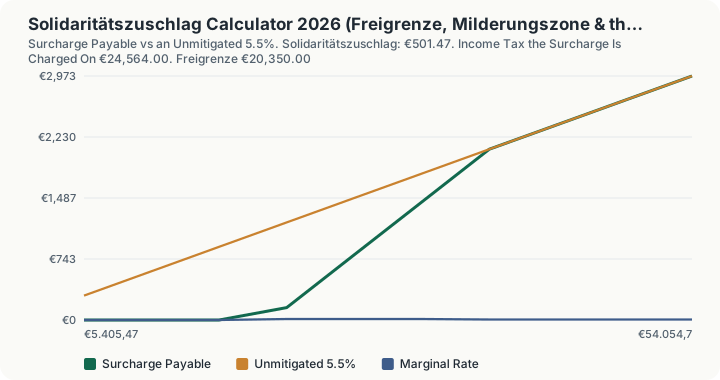
Quick Answer: €85,000 of taxable income assessed singly attracts €24,564.00 of §32a EStG income tax and a Solidaritätszuschlag of €501.47. That is not 5.5% of the income tax, which would be €1,351.02: this taxpayer sits in the Milderungszone, where the surcharge is capped at 11.9% of the amount by which income tax exceeds the €20,350 Freigrenze, so the §§3-4 SolzG mitigation is worth €849.55 and the effective rate is 2.041% of income tax.
What does this calculator do?
The Solidaritätszuschlag is charged on assessed income tax, never on income. Since the 2021 reform it has three zones, and which one you are in changes the answer by an order of magnitude.
Below the Freigrenze: €20,350 of income tax for a single assessment, €40,700 joint: there is no surcharge at all. That exempts roughly nine taxpayers in ten.
Above it lies the Milderungszone, a glide zone in which the surcharge is capped at 11.9% of the excess over the Freigrenze. The marginal rate in this band is 11.9% of each further euro of income tax, more than double the headline 5.5%. Because income tax is itself progressive, the surcharge here behaves like a second, steeper progression stacked on top of the first.
Above the glide zone, the flat 5.5% takes over. The crossover is exact and easy to derive: 5.5% of the base first stops exceeding 11.9% of the excess when the income tax reaches 0.119/0.064 = 1.859375 times the Freigrenze, which is €37,838.28 single and €75,676.56 joint.
A Freigrenze is not a Freibetrag. Exceed it and the whole base becomes chargeable in principle, rather than only the excess. The Milderungszone exists precisely to stop that from producing a cliff at the threshold.
How is this calculated?
Soli = 0, T ≤ F; min(5.5%⋅T, 11.9%⋅(T − F)), T > F
where $T$ is the assessed income tax and $F$ the Freigrenze.
Step 1: Establish the income tax base. If you entered taxable income, the calculator runs the §32a EStG tariff on it, applying the Splitting tariff for a joint assessment. If you entered the assessed income tax directly, that figure is used unchanged and is exact.
Step 2: Select the Freigrenze. €20,350 for a single assessment, €40,700 for a joint one.
Step 3: Compute the flat 5.5% figure. Income tax x 5.5%. This is what §4's headline rate alone would produce.
Step 4: Compute the 11.9% mitigation cap. The income tax above the Freigrenze, floored at zero, multiplied by 11.9%.
Step 5: Decide the zone. If income tax is at or below the Freigrenze, the surcharge is zero. Otherwise, if the mitigation cap is lower than the flat figure, you are in the Milderungszone and the cap governs. Otherwise the flat 5.5% governs.
Step 6: Take the governing amount as the surcharge.
Step 7: Report the marginal rate. Zero below the Freigrenze, 11.9% inside the Milderungszone, 5.5% above it.
Step 8: Compute the end of the glide zone. The Freigrenze multiplied by 1.859375, which is 0.119 divided by 0.064.
Step 9: Report the effective rate. Surcharge divided by income tax. It rises from 0% at the Freigrenze to 5.5% at the end of the glide zone, and stays at 5.5% thereafter.
Step 10: Quantify the relief. The flat 5.5% figure minus the surcharge actually payable. That is the whole 5.5% below the Freigrenze and falls to zero at the end of the glide zone.
Step 11: Sample the curve. The table walks the surcharge across ten income tax levels, spaced one seventh of the glide-zone end apart, so the shape can be read rather than taken on trust.
Worked Example
A single filer with €85,000 of zu versteuerndes Einkommen.
Step 1: Income tax under §32a EStG. €85,000 of taxable income produces €24,564.00 of Einkommensteuer
Step 2: Freigrenze. Single assessment, so €20,350.00
Step 3: Is the Freigrenze exceeded? €24,564.00 > €20,350.00, so yes, a surcharge arises. Headroom to the Freigrenze is €0.00
Step 4: Income tax above the Freigrenze. €24,564.00 - €20,350.00 = €4,214.00
Step 5: The flat 5.5% figure. €24,564.00 x 5.5% = €1,351.02
Step 6: The 11.9% mitigation cap. €4,214.00 x 11.9% = €501.47
Step 7: Which binds? €501.47 is lower than €1,351.02, so this is the Milderungszone and the cap governs.
Step 8: Surcharge payable. €501.47
Step 9: Relief from the Freigrenze and glide zone. €1,351.02 - €501.47 = €849.55
Step 10: Effective rate on income tax. €501.47 / €24,564.00 = 2.041%
Step 11: Marginal rate on the next euro of income tax. 11.9%, more than double the headline rate
Step 12: Where the glide zone ends. €20,350.00 x 1.859375 = €37,838.28 of income tax
So this taxpayer keeps 88.1 cents of every further euro of income tax reduction, in surcharge terms, until their income tax reaches €37,838.28. Past that point, the flat 5.5% takes over and the marginal rate falls back.
What does this calculator not account for?
- The Kapitalertragsteuer surcharge has no Freigrenze and is not modelled here. The 5.5% surcharge levied on withholding tax on investment income operates outside this mechanism entirely, so a saver with Abgeltungsteuer deducted at source pays a surcharge that this calculator does not see.
- Trade tax, corporation tax and the corporate surcharge are out of scope. The Solidaritätszuschlag on Körperschaftsteuer is charged at a flat 5.5% with no Freigrenze at all.
- The income tax figure derived from taxable income is a tariff computation, not your Bescheid. If you have the assessed Einkommensteuer, entering it directly is exact and is the recommended mode. Anything that changes assessed tax (Kinderfreibeträge applied in the Günstigerprüfung, foreign tax credits, Progressionsvorbehalt) will move the surcharge and is not modelled.
- Church tax is a separate charge. It is computed on the same income tax base but at 8% or 9% depending on the Land, with its own Kappung rules, and it is not included in this figure.
- Wage tax withholding is not simulated. Employers apply the surcharge to the monthly Lohnsteuer with the Freigrenze scaled to the pay period, which can differ from the annual assessment for irregular income.
- The Splitting tariff is applied by doubling the Freigrenze and using the joint tariff. It does not model separate assessment of spouses or the Faktorverfahren.
- The curve sampled in the table is generated from the same function. It is an illustration of the shape at your filing status, not a statement about your own liability at those income tax levels.
What mistakes do people make with this?
- Multiplying income tax by 5.5% and stopping. For anyone whose income tax falls between the Freigrenze and €37,838.28 single, that overstates the surcharge, in the worked example by €849.55.
- Treating the Freigrenze like an allowance. It is a Freigrenze: cross it and the entire base becomes chargeable in principle, not just the excess. Without the Milderungszone, one euro over €20,350 would have triggered €1,119.31 of surcharge. With it, that euro costs 12 cents.
- Assuming the surcharge is charged on income. It is charged on assessed income tax. A €20,350 income tax figure corresponds to a much larger income, which is why the exemption reaches so far up the income distribution.
- Forgetting the joint Freigrenze is exactly double. €40,700 for a joint assessment. The same €30,000 of income tax is entirely exempt jointly and costs €1,148.35 on a single assessment.
- Believing the "Soli was abolished" headline. The 2021 reform removed it for the large majority of taxpayers by raising the Freigrenze sharply. It was not repealed. Above the glide zone the full 5.5% still applies.
- Missing the 11.9% marginal rate when planning. Inside the glide zone, anything that reduces your income tax reduces the surcharge at 11.9%, not 5.5%. A deduction is worth measurably more there than the headline rate suggests.
- Applying this to investment income withheld at source. That surcharge has no Freigrenze and is charged at 5.5% from the first euro.
Frequently Asked Questions
Was the Solidaritätszuschlag abolished?
What is the Milderungszone and why is its rate 11.9%?
At what income tax does the glide zone end?
Why is my marginal surcharge rate more than double the headline rate?
Does the Freigrenze double for married couples?
Should I enter my income or my income tax?
Sources
- §3 Abs.3 SolzG 1995, gesetze-im-internet.de/solzg_1995: no surcharge unless the Bemessungsgrundlage exceeds "40 700 Euro" in the §32a Abs.5/6 EStG cases (joint assessment) or "20 350 Euro" in all other cases. Read 2026-08-30 in the consolidated text as amended by the Steuerfortentwicklungsgesetz of 23 December 2024.
Also consulted: §4 SolzG 1995, same source, "Der Solidaritätszuschlag beträgt 5,5 Prozent der Bemessungsgrundlage", capped at "11,9 Prozent des Unterschiedsbetrages" between the base and the Freigrenze; §32a EStG (Einkommensteuertarif), the income tax tariff used when the calculator derives income tax from taxable income; cited in full in engine/primitives/germany-tax.ts section 1.