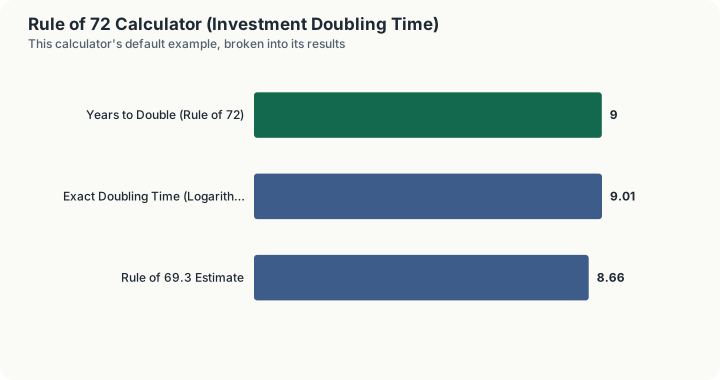
Quick Answer: The Rule of 72 estimates how many years it takes an investment to double at a given annual compound rate by dividing 72 by that rate, and this calculator also shows the more precise Rule of 69.3 and the exact logarithmic doubling time for comparison.
Overview
The Rule of 72 is one of the oldest and most widely used mental-math shortcuts in finance. It answers a question every investor eventually asks: at this rate of return, how long until my money doubles? Rather than working through the full compound interest formula, the rule offers a shortcut: divide 72 by the annual percentage rate, and the result is approximately the number of years required for an investment to double in value under compound interest.
The rule's usefulness comes from how good the approximation actually is across the range of rates most investors and savers care about, roughly 4% to 15% annually, where it typically lands within a few weeks of the mathematically exact answer. Part of the reason is that 72 is conveniently divisible by many common small numbers (1, 2, 3, 4, 6, 8, 9, 12), which makes the mental arithmetic fast: at 6%, doubling takes about 12 years; at 8%, about 9 years; at 12%, about 6 years. Investors, bankers, and financial educators have leaned on it for generations precisely because it requires no calculator and no formula memorization, just a single division.
The rule works equally well in reverse: divide 72 by the number of years you want an investment to double in, and the result approximates the annual return you would need to achieve that. It also generalizes past doubling. Dividing 72 by a rate estimates years to double; the same relationship, scaled, gives rough tripling or quadrupling times using slightly different constants (approximately 114 for tripling and 144 for quadrupling), though 72 remains the standard reference number in personal finance.
This calculator runs the classic Rule of 72 alongside two more accurate figures: the Rule of 69.3, a closer approximation rooted in continuous compounding, and the mathematically exact doubling time solved directly from the compound interest equation, so you can see exactly how much precision the mental-math shortcut is trading away.
How This Is Calculated
The Rule of 72 is simply:
The constant 72 is itself an approximation. The exact doubling time under annual compounding solves the equation $(1+r)^n = 2$ for $n$, which gives:
For small values of $r$, $\ln(1+r) \approx r$, and since $\ln(2) \approx 0.6931$, the exact formula approximately reduces to $n \approx 0.6931 / r$, or in percentage terms, $n \approx 69.31 / \text{Rate}$. The constant 72 was chosen over the mathematically purer 69.3 specifically because 72 has so many small integer divisors, trading a small amount of accuracy for dramatically easier mental math. This calculator reports both the traditional Rule of 72 estimate and the Rule of 69.3 estimate, plus the fully exact value.
The exact value is computed using the platform's time-value-of-money solver: setting a present value of -1 and a future value of 2 and solving for the number of periods at the given periodic rate returns precisely $\ln(2) / \ln(1+r)$, the same closed-form solution shown above, computed to full Decimal precision rather than approximated.
Worked Example
Consider an investment expected to compound at 8% annually, starting with $10,000:
Step 1: Rule of 72 estimate.
Step 2: Rule of 69.3 estimate.
Step 3: Exact doubling time.
Step 4: Doubled value.
At an 8% annual return, the classic Rule of 72 estimates 9.0 years to double, which is remarkably close to the exact answer of roughly 9.006 years, an error of less than three days. The Rule of 69.3, at 8.6625 years, actually understates the exact figure slightly more than the Rule of 72 overstates it at this particular rate, illustrating why 72 remains the more commonly taught constant even though 69.3 is theoretically purer at very small rates.
What This Does Not Account For
The Rule of 72, and its variants, assume a constant, steady annual compound rate applied without interruption for the entire doubling period. Real investment returns are volatile year to year; a portfolio that averages 8% annually over a decade rarely earns exactly 8% in any single year, and sequence-of-returns effects mean the actual doubling time for a volatile asset can differ from the rule's estimate even when the long-run average return matches. The calculation also ignores taxes, fees, and inflation entirely; a nominal 8% return can translate to a meaningfully longer real (inflation-adjusted) doubling time, and taxable accounts that lose a portion of gains to taxes each year will take longer to double than the pre-tax rate implies. It assumes reinvestment of all gains with no withdrawals. The rule's accuracy also degrades at very high or very low rates; it remains quite reliable in the single-digit and low-double-digit range but increasingly diverges from the exact value as rates climb toward 20% and beyond.
Common Pitfalls
- Applying the rule to volatile, non-guaranteed returns as if they were fixed. The Rule of 72 is exact only under a truly constant compound rate; using a long-run historical average return as the input still leaves real-world timing uncertain.
- Forgetting to account for taxes and fees. A rate net of expected taxes and fund expenses gives a far more realistic doubling estimate than a gross, pre-cost return figure.
- Using the rule at very high interest rates without checking the exact figure. The approximation error grows meaningfully above roughly 20%, where the gap between 72/rate and the true logarithmic answer can stretch into multiple months or more.
- Confusing nominal and real (inflation-adjusted) rates. Applying the Rule of 72 to a nominal return overstates how quickly your money's real purchasing power actually doubles.
- Assuming the rule applies to simple, non-compounding interest. The Rule of 72 is derived specifically from compound growth; it does not apply to investments or loans that accrue interest on a simple, non-compounding basis.
Frequently Asked Questions
Why 72 and not a more mathematically exact number?
How accurate is the Rule of 72?
Can I use the Rule of 72 to estimate how a loan's balance grows?
Does the Rule of 72 work for monthly or daily compounding?
What is the difference between the Rule of 72 and the exact doubling time shown here?
Sources
- CFA Institute. Time Value of Money, CFA Program Curriculum. cfainstitute.org
- Federal Reserve Bank of St. Louis, Economic Education. Compound Interest and Growth Rate Fundamentals. federalreserve.gov
- U.S. Securities and Exchange Commission, Investor.gov, the official authority for the investing this calculator relates to. investor.gov
Also consulted: Investopedia. "Rule of 72 Definition.".