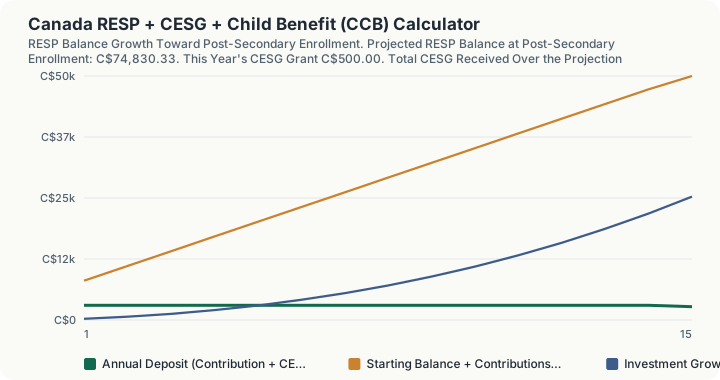
Quick Answer: Contributing C$2,500 a year to an RESP (earning the full C$500 20% CESG match) from a C$5,000 balance grows to C$74,830.33 over 15 years at 5%: C$37,500 of contributions, C$7,200 of lifetime CESG, and C$25,130.33 of growth. The same family, with one child under 6 and one aged 6 to 17 on C$75,000 of Adjusted Family Net Income, receives C$839.75 a month of CCB.
Overview
This calculator combines two of Canada's major family-support programs into one tool, because most Canadian parents are managing both simultaneously: the Registered Education Savings Plan (RESP), a tax-deferred account for a child's post-secondary education that the federal government tops up with a matching grant (the Canada Education Savings Grant, CESG), and the Canada Child Benefit (CCB), a monthly, income-tested cash payment made directly to eligible families regardless of whether they save anything at all.
The RESP + CESG side works like this: any Canadian resident can contribute to an RESP for a beneficiary (no annual limit, though a C$50,000 lifetime cap per beneficiary applies), and the growth inside the account is tax-deferred until withdrawal. On top of your own contribution, the federal government adds a CESG grant equal to 20% of what you contribute, up to C$500 per year ordinarily, or up to C$1,000 per year if you're using carried-forward grant room from an earlier year where you contributed less than the full amount -- all capped at a C$7,200 lifetime maximum per child.
The CCB side is entirely separate and income-tested: it pays a maximum annual amount per child (higher for children under 6, lower for ages 6-17), which then gets reduced as your family's Adjusted Family Net Income (AFNI) rises, using a two-phase reduction formula that gets steeper as your number of children and income both increase.
How This Is Calculated
RESP + CESG
This year's CESG grant:
The annual cap is C$500 ordinarily (reached at a C$2,500 contribution), or C$1,000 if carry-forward grant room from an under-contributed prior year is being used (reached at a C$5,000 contribution) -- both subject to the C$7,200 lifetime cap per beneficiary.
Growth projection: each year, your RESP contribution plus that year's CESG grant is deposited, compounding via this platform's shared time-value-of-money solver. Once the C$7,200 lifetime CESG cap is reached partway through the projection, later years stop adding any further grant (contributions alone continue).
Canada Child Benefit (CCB)
Step 1 -- maximum benefit before any reduction:
Step 2 -- apply the AFNI-based reduction, using a rate tier based on TOTAL number of children (4+ children share one tier):
| Children | Phase 1 Rate | Phase 2 Fixed + Rate |
|---|---|---|
| 1 | 7.0% | C$3,123 + 3.2% |
| 2 | 13.5% | C$6,022 + 5.7% |
| 3 | 19.0% | C$8,476 + 8.0% |
| 4+ | 23.0% | C$10,260 + 9.5% |
Worked Example
RESP + CESG, over 15 years: C$2,500/year contribution, C$5,000 starting balance, 5% annual return.
Year 1's grant is C$500 (20% of C$2,500). Depositing C$3,000/year (contribution + grant) and compounding at 5%, after 15 years the account reaches C$74,830.33 -- C$37,500 in your own contributions, C$7,200 in cumulative CESG (the full lifetime cap is reached during year 15, since C$500/year x 14.4 years = C$7,200), and C$25,130.33 of tax-deferred investment growth.
CCB, 1 child under 6 + 1 child aged 6-17, AFNI C$75,000:
AFNI C$75,000 falls in the phase-1 band (2-children rate, 13.5%):
What This Does Not Account For
- The Canada Learning Bond (CLB). A separate, additional federal grant of up to C$2,000 lifetime for children from lower-income families, paid WITHOUT requiring any RESP contribution at all -- not modeled here, since it depends on family income and number of children in a way distinct from CESG.
- Provincial RESP grants. Some provinces (British Columbia's C$1,200 BCTESG, Quebec's refundable tax credit) add their OWN grant on top of the federal CESG -- not modeled here.
- RESP withdrawal rules (EAPs vs. contribution refunds). Withdrawing RESP funds involves splitting the withdrawal into an Educational Assistance Payment (taxable to the STUDENT, drawing from grant + growth) and a separate tax-free return of original contributions -- not modeled by this growth-only projection.
- The RESP's C$50,000 lifetime contribution limit per beneficiary. This calculator does not cap your MODELED contributions against that limit; check your own cumulative total separately.
- CCB's true income-splitting/shared-custody rules. Shared-custody parents each receive 50% of the CCB they'd otherwise qualify for individually -- not modeled here, which assumes a single household claiming the full amount.
- CCB base-year timing. The AFNI entered is treated as directly determining THIS benefit year's payment; in reality, the July 2026-June 2027 CCB uses your 2025 tax return's AFNI, with the following year's benefit based on the NEXT year's return.
- The Child Disability Benefit (CDB). An additional CCB top-up for a child eligible for the Disability Tax Credit -- not included in this calculation.
Common Pitfalls
- Not contributing at least C$2,500/year and leaving CESG money on the table. Contributing less than C$2,500 in a year means missing part of that year's full C$500 CESG match -- though the unused GRANT ROOM (not the contribution room itself) carries forward, so it can be caught up on later at the C$1,000/year catch-up rate.
- Assuming CESG is unlimited. It is not -- C$7,200 is a hard LIFETIME cap per beneficiary, reached at C$36,000 of total lifetime contributions if you always get the full 20% match (C$36,000 x 20% = C$7,200). Contributions beyond that still grow tax-deferred, they just stop earning any further grant.
- Confusing the RESP contribution limit with the CESG grant cap. RESP contributions themselves have no ANNUAL cap (only a C$50,000 LIFETIME cap); it's specifically the CESG GRANT that has both an annual cap (C$500/C$1,000) and a lifetime cap (C$7,200).
- Forgetting the CCB reduction rate rises with more children. A family with 4+ children faces a materially steeper reduction curve (23% phase-1, 9.5% phase-2) than a single-child family (7% phase-1, 3.2% phase-2) -- more children raises the maximum benefit, but each additional dollar of income above the thresholds is clawed back faster too.
- Treating CCB and RESP/CESG as the same program. They are entirely independent: CCB is a monthly cash payment with no savings requirement at all, while CESG is strictly a MATCHING grant tied to money you actually deposit into an RESP.
Frequently Asked Questions
How much is the CESG grant on RESP contributions?
What is the current CCB maximum amount per child?
At what income does the Canada Child Benefit start being reduced?
Can I catch up on CESG if I didn't contribute the full amount in past years?
Does having more children increase or decrease my CCB per child?
Sources
- Government of Canada, Registered Education Savings Plans and related benefits. canada.ca/en/services/benefits/education/education-savings/resp.html
- Canada Revenue Agency. canada.ca/en/revenue-agency.html
Also consulted: Income Tax Act (Canada), s. 146.1, "Registered Education Savings Plans," and the Canada Education Savings Act -- the CESG's 20% match, annual caps, and C$7,200 lifetime cap; Income Tax Act (Canada), s. 122.61, "Canada Child Benefit" -- the AFNI-based reduction formula; CESG figures (20% match, C$500/C$1,000 annual caps, C$7,200 lifetime cap): cross-verified across Questrade, Embark, RBC Royal Bank, and Wealthsimple; CCB figures for the July 2026-June 2027 benefit year (C$8,157/C$6,883 maximums; C$38,237/C$82,847 AFNI thresholds; phase-1 rates 7%/13.5%/19%/23%; phase-2 rates 3.2%/5.7%/8%/9.5%): cross-verified across multiple independent CCB calculator and news sources, with the phase-2 fixed dollar amounts independently arithmetic-checked against the phase-1 rates and thresholds for internal consistency. canada.ca's own CCB calculation-sheet pages returned an HTTP 403 to direct fetch in this session and could not be independently re-confirmed against the primary source in this pass -- cross-verify directly against canada.ca or CRA My Account before relying on this calculator for a real benefit estimate.