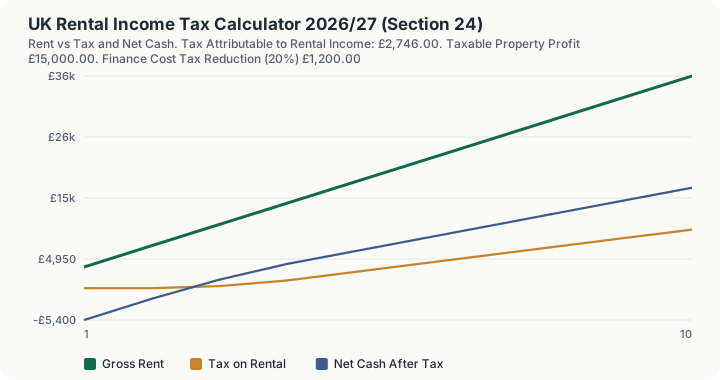
Quick Answer: A landlord with a £40,000 salary, £18,000 of rent, £3,000 of expenses and £6,000 of mortgage interest pays £2,746.00 of tax attributable to the property. The rent produces a £15,000 taxable profit, mortgage interest is not deducted from it, and the interest instead gives a £1,200 tax reduction at 20%. Net cash after interest and tax is £6,254.
What does this calculator do?
Since April 2020, mortgage interest is no longer an expense for residential landlords. It is not deducted in computing property profit. Instead it gives a tax reduction at the basic rate of 20%, applied after the tax is worked out.
This is section 24, and it is the single most consequential rule in UK property taxation. Two things follow from it:
First, your taxable profit is measured before interest, so a heavily mortgaged landlord can be taxed on a profit substantially larger than the cash they actually keep. Second, because that larger profit stacks on top of your other income, mortgage interest can push you into the higher rate band even though it is a genuine cost of the business.
Rental income is non-savings income, so Scottish taxpayers pay Scottish rates on it.
How is this calculated?
Step 1: Property profit. Rent less allowable expenses, with finance costs excluded:
Profit = Rent − Expenses; (mortgage interest is not subtracted)
Step 2: Stack it on your other income. The profit is added to salary and other non-savings income, and Income Tax is computed on the total using the bands for your region. For 2026/27 those are the ordinary rates of 20%, 40% and 45%.
Step 3: The finance cost tax reduction. Relief is 20% of the lowest of three figures:
- the finance costs for the year, plus any brought forward from earlier years
- the property business profit
- adjusted total income, being income above the Personal Allowance excluding savings and dividends
Reduction = 0.20 × min(finance costs, property profit, adjusted total income)
Where the profit or income figure binds rather than the finance costs, the unrelieved excess is carried forward to future years.
Step 4: Tax attributable to the property is the difference between your total tax with the rental profit included and the tax you would have paid on your other income alone.
Worked Example
£40,000 salary, £18,000 rent, £3,000 expenses, £6,000 interest:
- Property profit: £18,000 − £3,000 = £15,000. The £6,000 of interest is not deducted
- Total income: £40,000 + £15,000 = £55,000; taxable £42,430 after the allowance
- Tax: £37,700 × 20% + £4,730 × 40% = £7,540 + £1,892 = £9,432
- Finance cost reduction: the lowest of £6,000, £15,000 and £42,430 is the £6,000 of interest → £6,000 × 20% = £1,200
- Total tax after relief: £9,432 − £1,200 = £8,232
- Tax on the salary alone would have been £5,486, so £2,746 is attributable to the property
- Net cash: £18,000 − £3,000 − £6,000 − £2,746 = £6,254
The same let with £18,000 of interest instead:
- Property profit is unchanged at £15,000, because interest is never deducted
- Relief is now capped by the profit, not the interest: £15,000 × 20% = £3,000
- The unrelieved £3,000 of interest carries forward to a future year
- The landlord is taxed on a £15,000 profit while making a cash loss on the property
What does this calculator not account for?
- The 22/42/47 property rates announced at Budget 2025. They take effect 6 April 2027, not 2026. This page applies the 20/40/45 rates in force for 2026/27. Applying the new rates a year early would be wrong for this tax year.
- The property allowance of £1,000, which can be claimed instead of actual expenses where receipts are small.
- Furnished holiday lettings, whose separate regime was abolished from April 2025, and the transitional rules around that.
- Rent a Room relief, which exempts up to £7,500 of income from letting a room in your own home.
- Replacement of domestic items relief, which allows a deduction for replacing furniture and appliances but not for the initial purchase.
- Capital allowances on plant and machinery in commercial lets.
- Jointly owned property, where income is normally split by beneficial ownership, and Form 17 elections for spouses.
- Companies. A property held through a limited company pays Corporation Tax and deducts interest in full, which is why section 24 drove so much incorporation.
- Capital Gains Tax on eventual disposal.
- National Insurance, which does not apply to ordinary property income.
What mistakes do people make with this?
- Deducting mortgage interest as an expense. This is the error section 24 was designed to end, and it remains the most common one. Interest belongs in the finance costs box, not the expenses box, and the difference changes both the profit and the band you land in.
- Assuming a cash loss means no tax. Because profit is computed before interest, a highly geared landlord can owe tax on a £15,000 profit while losing money in cash terms.
- Missing the higher rate crossing. Property profit stacks on other income. A salary of £40,000 plus a £15,000 profit crosses £50,270, so part of the rent is taxed at 40% while relief is only ever given at 20%.
- Forgetting the carry-forward. Where relief is capped by profit or income, the unused finance costs are not lost. They carry forward indefinitely and should be tracked year to year.
- Confusing the capital repayment with interest. Only the interest element of a mortgage payment counts as a finance cost. Capital repayment is not an expense at all.
- Applying the 2027 rates early. The 22/42/47 figures are real but not yet in force. For 2026/27 the ordinary rates apply.
Frequently Asked Questions
Why can I not deduct my mortgage interest?
Why am I paying tax when the property makes no money?
Does rental income push me into the higher rate?
Do Scottish rates apply to rent?
Should I hold property through a company?
What happens to unrelieved finance costs?
Sources
- HM Revenue and Customs (HMRC), the official authority for the national tax authority this calculator relates to. gov.uk/government/organisations/hm-revenue-customs
All figures verified on 30 August 2026 and mirrored in engine/tables/2026/uk-2026-27.json
Also consulted: HMRC Property Income Manual PIM2058, the basic rate tax reduction and the lowest-of-three test; GOV.UK: "Tax relief for residential landlords: how it's worked out", 20% relief rate and the carry-forward rule; GOV.UK: "Income Tax rates and allowances", the bands applied to property profit for 2026/27; GOV.UK technical note on property, savings and dividend rate changes, confirms the 22/42/47 property rates begin 6 April 2027, not 2026.