Quick Answer: Your ACA premium subsidy is set by how your household income compares to the Federal Poverty Line, and for 2026 that subsidy disappears entirely once your income crosses 400% of the poverty line, so retiring early on a fixed income means watching that line closely.
Overview
Retiring before age 65, when Medicare eligibility begins, usually means buying health coverage on the Affordable Care Act marketplace. The sticker price of a marketplace plan can be startling, but most buyers don't pay that sticker price. The government caps what you're expected to pay for a specific reference plan, called the benchmark plan, at a percentage of your household income, and the difference between that capped amount and the plan's actual cost is paid to the insurer as a Premium Tax Credit (PTC).
This is where early retirement planning gets interesting. Unlike a salaried worker whose income is largely fixed by their paycheck, an early retiree often has real control over their reported income in a given year, through the mix of taxable withdrawals, Roth conversions, and capital gains realized. That control matters enormously here, because 2026 marks the return of the ACA's original, harsher subsidy structure. The enhanced, no-cliff subsidies that existed from 2021 through 2025 under temporary federal law expired at the end of 2025. Starting in 2026, the older rule is back: cross 400% of the Federal Poverty Line and the subsidy doesn't taper off, it disappears completely, all at once. Financial advisors sometimes call this "the subsidy cliff," and for an early retiree living on marketplace coverage for a decade or more before Medicare kicks in, managing income to stay under that line can be worth thousands of dollars a year.
How This Is Calculated
The subsidy calculation runs in a few steps, mirroring IRS Form 8962, the form used to reconcile the Premium Tax Credit on a tax return.
- Find your Federal Poverty Line (FPL). The 2026 guideline for the 48 contiguous states and DC is $15,960 for a household of one, plus $5,680 for each additional household member. A household of four sits at $33,000.
- Express your income as a percentage of that FPL. Divide your estimated household income (technically Modified Adjusted Gross Income) by the FPL figure for your household size, then multiply by 100.
- Look up your applicable percentage. The IRS publishes a sliding scale, called the applicable percentage table, that maps your percent-of-FPL to a required contribution rate. For 2026 that table runs from a flat 2.10% for anyone between 100% and 133% of FPL, sliding up through 4.19% at 150% FPL, 6.60% at 200% FPL, 8.44% at 250% FPL, and flattening out at 9.96% for the entire 300%-400% FPL range. Between those published points, the percentage increases in a straight line, exactly as Form 8962's instructions specify.
- Multiply your income by that percentage. This is what the government expects you to pay annually toward the benchmark plan's premium, regardless of what plan you actually choose.
- Subtract that from the benchmark plan's actual premium. Whatever's left over is your Premium Tax Credit, which can be applied to any marketplace plan, not just the benchmark plan itself.
- Check the cliff. If your income comes in above 400% of FPL, the credit drops to exactly zero, no matter how expensive the benchmark plan is. Below 100% of FPL, you're generally outside the marketplace subsidy system entirely and expected to qualify for Medicaid instead (with some exceptions for lawfully present immigrants who don't qualify for Medicaid).
Worked Example
Take a household of two with an estimated income of $65,000 and a benchmark Silver plan that costs $1,150 a month.
The 2026 FPL for a household of two is $15,960 + $5,680 = $21,640. Dividing $65,000 by $21,640 gives roughly 300.37% of FPL, which lands inside the flat 300%-400% band, so the applicable percentage is 9.96%.
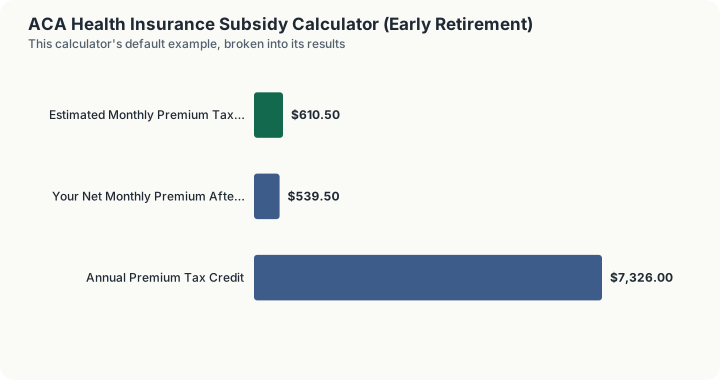
The required annual contribution is $65,000 x 9.96% = $6,474.00, or $539.50 a month. The benchmark plan costs $1,150 x 12 = $13,800 a year. Subtracting the required contribution from the benchmark premium gives a Premium Tax Credit of $13,800 minus $6,474 = $7,326.00 a year, or $610.50 a month.
That subsidy applies to whatever plan the household actually enrolls in, so their net monthly premium comes out to $539.50 if they choose the benchmark plan itself, though a cheaper Bronze plan could end up costing less than that, or even nothing, once the same dollar credit is applied.
Now push that same household's income up to $90,000. That works out to roughly 415.9% of the 2026 FPL for a household of two, which is past the 400% cliff. The subsidy doesn't shrink gradually; it goes to zero, and the household is on the hook for the full $13,800 annual premium.
What This Does Not Account For
- Cost-sharing reductions (CSRs). Households between 100% and 250% of FPL who choose a Silver plan may also qualify for reduced deductibles and copays, a separate benefit from the premium subsidy this calculator estimates.
- State-run marketplaces with their own enhanced subsidies. A handful of states supplement the federal subsidy with their own state-funded programs, which are not modeled here.
- Alaska and Hawaii poverty guidelines. Those two states use separately published, higher FPL figures than the 48 contiguous states plus DC used in this calculator.
- Income changes during the coverage year. Marketplace subsidies are estimated in advance and reconciled on your tax return the following spring; if your actual income differs from your estimate, you may owe money back or receive an additional credit.
- Employer coverage offers. If you or a household member is offered "affordable" employer-sponsored coverage (including COBRA in some interpretations), you may be ineligible for marketplace subsidies regardless of income.
- Medicaid expansion status in your state. In states that expanded Medicaid, the practical floor for marketplace subsidy eligibility is different than in states that didn't.
Common Pitfalls
- Underestimating capital gains and IRA withdrawals. MAGI for ACA purposes includes realized long-term capital gains and any taxable retirement account withdrawals, not just wages. A large one-time Roth conversion can spike your MAGI enough to cross the 400% cliff for that year alone.
- Forgetting that the subsidy is based on the benchmark plan, not your chosen plan. Your actual net premium depends on which plan you pick; a cheaper Bronze plan can result in a very low or even $0 net premium once the same subsidy dollar amount is applied.
- Ignoring the reconciliation step. Because subsidies are paid in advance based on an estimate, guessing too low on your expected income means the IRS may claw back excess subsidy when you file taxes.
- Assuming pre-2026 subsidy rules still apply. The enhanced, no-cliff subsidy structure that ran from 2021 through 2025 expired. Anyone planning early retirement income around 2025 subsidy math needs to re-run the numbers under the reverted 2026 rules.
- Treating "just under 400% FPL" as a hard safety margin. Because MAGI estimates can be imprecise, especially with variable capital gains, cutting it close to the cliff is riskier than it looks on paper.
Frequently Asked Questions
What counts as income for ACA subsidy purposes?
Is there really no subsidy at all above 400% of the Federal Poverty Line in 2026?
Can I control my income to stay under the cliff?
What's the difference between the benchmark plan and the plan I actually buy?
Do I need to buy insurance through the exchange to get this subsidy?
Sources
- Internal Revenue Service, Revenue Procedure 2025-25, applicable percentage table for premium tax credit eligibility, plan year 2026. irs.gov
- U.S. Department of Health and Human Services, Office of the Assistant Secretary for Planning and Evaluation (ASPE), 2026 Federal Poverty Guidelines, published January 15, 2026. aspe.hhs.gov
- Internal Revenue Service, The Premium Tax Credit: The Basics. irs.gov/affordable-care-act/individuals-and-families/the-premium-tax-credit-the-basics
Also consulted: Internal Revenue Service, Form 8962 instructions, "Premium Tax Credit (PTC)," for the applicable percentage table methodology and MAGI definition; Healthcare.gov, "How to save on your monthly insurance bill with a premium tax credit," for general marketplace subsidy mechanics.