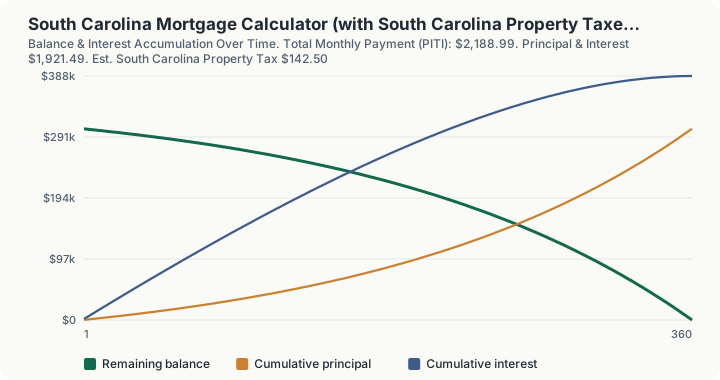
Quick Answer: A $380,000 South Carolina home with 20% down at 6.5% APR carries a total monthly payment (PITI) of approximately $2,188.99, made up of $1,921.49 in principal and interest, $142.50 in property tax, and $125 in insurance.
Overview
South Carolina has one of the lowest effective property tax rates in the country for owner-occupied homes, which is the single biggest reason its total monthly housing payment often looks more affordable than states with similar home prices. This calculator applies a 0.45% effective property tax rate, reflecting the favorable 4% assessment ratio South Carolina grants to legal residences (as opposed to the 6% ratio applied to second homes, rental property, and most commercial real estate).
That low property tax comes with a tradeoff: South Carolina also collects a state individual income tax, which the no-income-tax states next door do not. Buyers weighing South Carolina against no-income-tax states like Tennessee or Texas should recognize that a lower property tax bill here is partially offset by state income tax withheld from every paycheck, something this calculator does not model since it is scoped strictly to the mortgage payment itself.
The underlying loan math, monthly principal and interest, is calculated with the same 30-year fixed amortization engine used across every mortgage calculator on this platform. Only the property tax rate and the state-specific commentary change from state to state; the amortization formula itself is identical everywhere.
How This Is Calculated
- Down payment and loan principal. Down payment percentage is applied to the home price; the remainder becomes the loan principal.
- Principal and interest (P&I). The loan principal is amortized over 360 months (30 years) at the entered interest rate using the standard fixed-rate mortgage formula:
- Property tax. Home price is multiplied by South Carolina's 0.45% effective rate and divided by 12 for a monthly figure.
- Insurance. A flat $125 monthly homeowners insurance estimate is added.
- Total PITI. Principal, interest, tax, and insurance are summed into the headline monthly payment.
Worked Example
Using the calculator's default inputs:
- Home Price: $380,000.00
- Down Payment: 20% ($76,000.00)
- Interest Rate: 6.5%
- Term: 360 months (30 years)
Step by step:
- Loan principal: $380,000 − $76,000 = $304,000.00
- Monthly principal and interest at 6.5% over 360 months: $1,921.49 (verified against the amortization engine's test vectors)
- South Carolina property tax: $380,000 × 0.45% = $1,710.00 per year, or $142.50 per month
- Homeowners insurance estimate: $125.00 per month
- Total monthly PITI: $1,921.49 + $142.50 + $125.00 = $2,188.99
- Total interest paid over the full 30-year term: $1,921.49 × 360 − $304,000 = $387,735.24
What This Does Not Account For
- Assessment ratio mismatches. The 0.45% effective rate assumes the home qualifies for South Carolina's 4% owner-occupied "legal residence" assessment ratio. Second homes, rental properties, and investment properties are assessed at 6%, which roughly one and a half times the effective tax burden modeled here.
- The Homestead Exemption application deadline. South Carolina requires homeowners to file for the 4% legal residence classification, typically by January 15 of the tax year, with their county assessor. Missing this filing can result in being billed at the higher 6% rate.
- Millage rate variation by county and school district. South Carolina's 46 counties, along with municipal and school district levies, produce widely different effective rates; 0.45% is a statewide approximation, not a specific county figure.
- PMI for down payments under 20%. This calculator does not add private mortgage insurance, which is typically required when the down payment is below 20% of the home price.
- HOA dues, flood insurance, or closing costs. None of these common South Carolina coastal and Lowcountry homeownership costs are included.
- State income tax impact on affordability. South Carolina's individual income tax reduces net take-home pay relative to no-income-tax states, which affects true affordability but is outside the scope of a mortgage payment calculation.
Common Pitfalls
- Confusing the primary residence rate with the non-owner-occupied rate. Buyers of second homes or investment property in South Carolina should model a materially higher effective property tax rate, not the 0.45% legal residence figure used here.
- Missing the legal residence filing deadline. Failing to file the required exemption paperwork on time can leave a new homeowner paying the 6% assessment ratio for an entire tax year.
- Overlooking flood zone requirements. Coastal South Carolina properties in FEMA flood zones often require separate flood insurance policies that are not reflected in the $125 monthly insurance estimate.
- Assuming a fixed rate stays fixed forever without reassessment. South Carolina counties periodically reassess property values (often every five years), which can change the tax portion of your payment even if your mortgage rate never adjusts.
- Comparing gross payment across states without factoring income tax. A lower South Carolina property tax bill does not automatically mean lower total cost of living if state income tax offsets the savings.
Frequently Asked Questions
Why is South Carolina's property tax rate so much lower than most states?
Do I need to apply for the lower property tax rate, or is it automatic?
Does South Carolina have a state income tax that affects mortgage affordability?
What happens if I put down less than 20%?
How often does South Carolina reassess property values?
Is the $125 monthly insurance estimate realistic for coastal South Carolina properties?
Sources
- South Carolina Department of Revenue: Property tax assessment ratios and legal residence exemption requirements. dor.sc.gov
- Consumer Financial Protection Bureau: Regulation Z mortgage disclosure standards and PMI requirements. ecfr.gov/current/title-12/chapter-X/part-1026
Also consulted: South Carolina Association of Counties: County millage rate publications; South Carolina Department of Revenue: Individual Income Tax rate schedules.