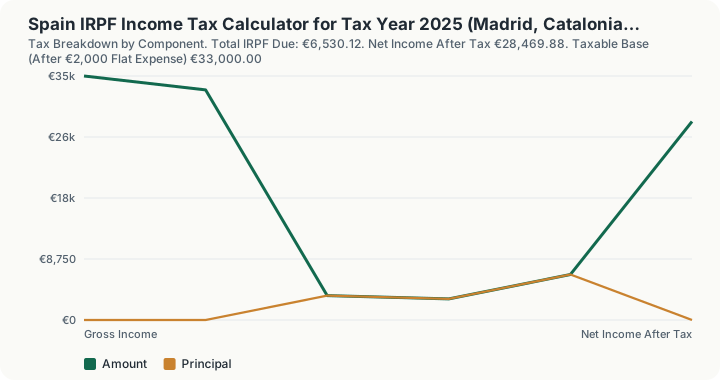
Quick Answer: A worker earning €35,000 gross a year in Madrid owes €6,530.12 of IRPF for tax year 2025, an effective rate of 18.66% and the lowest of the three regions this calculator covers. The same salary owes €6,947.45 in Andalucía and €7,113.25 in Catalonia. Tax year 2025 is the year residents declare in the 2026 Renta campaign running now.
Overview
Spain's IRPF (Impuesto sobre la Renta de las Personas Físicas) is not one flat national income tax. It is a two-layer system: a state scale (gravamen estatal) that is identical everywhere in Spain, PLUS a regional scale (gravamen autonómico) that each of Spain's 17 Comunidades Autónomas sets independently and can change every year. Your final tax bill is the sum of both halves applied to the same taxable base -- which means two people earning identical salaries can owe meaningfully different amounts of tax depending entirely on which region they live in.
This calculator covers three representative regions -- Madrid, Catalonia, and Andalucía -- chosen because they sit at genuinely different points on Spain's regional tax spectrum: Madrid has consistently set one of the lowest regional scales in the country, Catalonia one of the highest, and Andalucía a middle-to-low position after reducing its own rates in recent years to move closer to Madrid's model. Spain's other 14 regions (Valencia, Galicia, Castilla y León, the Basque Country, Navarra, and more) each set their own different scale and are NOT covered here -- if you live elsewhere, this calculator will not give you an exact figure, only a sense of the state-level baseline.
Which tax year this covers, and why
All figures are for tax year 2025 (Ejercicio 2025, declared in the 2026 Renta campaign) and are in euros (€). That is deliberate, for two reasons. First, a Spanish resident filing in 2026 is assessing 2025 income, so 2025 is the year you actually need right now. Second, AEAT has not yet published a Manual Práctico de Renta 2026, and the 2026 consolidated regional scales for Madrid, Catalonia, and Andalucía are not available from a primary source, so no honest 2026 figure can be produced yet. The state general scale in Art. 63 LIRPF has been unchanged since 2021, so the state half of the calculation would be identical in any case; it is the regional half that cannot yet be confirmed for 2026. When AEAT publishes the 2026 manual, this page will be updated and relabelled.
How This Is Calculated
- Taxable base. This calculator starts from gross employment income, subtracts the flat €2,000/year employment expense deduction (Art. 19.2.f LIRPF), and treats the result as your taxable base. It does not model Social Security employee contributions or the more complex sliding "reducción por rendimientos del trabajo" -- see What This Does Not Account For.
- Personal minimum (mínimo del contribuyente). A tax-free amount -- €5,550 for taxpayers under 65, €6,700 for 65-74, €8,100 for 75+ -- is applied using Spain's actual mechanic: the state scale is run TWICE, once on your full taxable base and once on just the minimum amount, and the second result is subtracted from the first. Madrid and Andalucía each set their OWN, higher regional minimum for the regional half of the calculation (Madrid: €5,956.65 base; Andalucía: €5,790 base); Catalonia uses the state default for both halves.
- State tax. The state scale (0-€12,450 at 9.5%, up through 24.5% above €300,000) is applied to your taxable base, net of the state's minimum-amount deduction described above.
- Regional tax. Your selected region's own scale -- which uses its OWN bracket breakpoints, not the state's -- is applied the same way, net of that region's own minimum.
- Total tax = state tax + regional tax.
Worked Example
€35,000 gross income, Madrid, under 65: 1. Taxable base: €35,000 − €2,000 = €33,000 2. State tax: tax on €33,000 minus tax on the €5,550 minimum, both via the state scale = €4,032.75 − €527.25 = €3,505.50 3. Regional tax (Madrid): tax on €33,000 minus tax on Madrid's own €5,956.65 minimum, via Madrid's scale (8.50% up to €13,362.22, rising to 20.50% above €57,320.40) = €3,024.62 4. Total IRPF due: €6,530.12 (effective rate 18.66%) 5. Net income after tax: €35,000 − €6,530.12 = €28,469.88
The same €35,000 in Catalonia: state tax is identical (€3,505.50), but Catalonia's regional scale (9.5% up to €12,500, rising to 25.5% above €175,000) produces a regional tax of €3,607.75 -- for a total of €7,113.25, about €583 more than Madrid for the exact same income.
What This Does Not Account For
- 14 of Spain's 17 Comunidades Autónomas. Only Madrid, Catalonia, and Andalucía are modeled. Valencia, Galicia, the Basque Country (which has its own separate foral tax system entirely), Navarra (also foral), and every other region set their own different scale.
- Joint filing (tributación conjunta). This calculator only models individual filing. Joint filing carries its own separate reduction (€3,400 for a married couple, €2,150 for a single-parent family unit) not modeled here.
- The sliding "reducción por rendimientos del trabajo" (Art. 20 LIRPF). Below roughly €19,747.50 of net work income, an additional reduction (up to €7,302, phasing out) applies on top of the flat €2,000 expense deduction. This calculator does not model that phase-out, so actual tax for lower earners eligible for this reduction will be somewhat lower than shown here.
- Social Security employee contributions, which are deductible from gross salary before arriving at net employment income, are not modeled -- this calculator treats your entered figure as already net of them for simplicity, which understates the deduction slightly if you enter true gross salary.
- Non-employment income (self-employment, rental income, capital gains) uses different rules entirely -- capital gains and investment income specifically use a separate scale, covered in this platform's Spain Capital Gains Tax Calculator.
- Deductions for children, disability, mortgage (in legacy cases), or regional-specific credits are not modeled.
Common Pitfalls
- Assuming IRPF is a single national rate. It genuinely is not -- roughly half your tax bill is set by your Comunidad Autónoma, and that half can vary by several percentage points at the same income level.
- Confusing the regional scale's own breakpoints with the state's. Madrid, Catalonia, and Andalucía each define their OWN bracket boundaries (e.g., Madrid's first bracket ends at €13,362.22, not the state's €12,450) -- state and regional tax must be computed independently against each one's own scale, then summed, not blended into one combined bracket table.
- Forgetting Madrid and Andalucía have their own, larger personal minimum. Applying the state's €5,550 minimum to the regional half in these two regions would overstate your regional tax bill.
- Ignoring that moving between regions genuinely changes your tax bill at an identical salary -- this is one of the most consequential, least understood aspects of Spanish personal taxation for anyone considering relocating within Spain.
- Assuming a single "combined bracket table" you saw online applies everywhere. Many finance sites publish one generic "IRPF 2025 brackets" table; that table reflects only ONE possible regional scale (or a reference scale), not what every region actually charges.
Frequently Asked Questions
Why does my IRPF depend on which Spanish region I live in?
Which of the 3 covered regions has the lowest IRPF?
Is this calculator accurate for Valencia, Galicia, or the Basque Country?
Does this calculator account for children, disability, or mortgage deductions?
Why is my regional minimum different from the state minimum?
Sources
- Agencia Tributaria (sede.agenciatributaria.gob.es), Manual Práctico de Renta 2025, Capítulo 15 "Cálculo del impuesto: determinación de las cuotas íntegras" -- "Gravamen estatal" and "Gravamen autonómico" pages: state scale and confirmation that regional scales are unchanged in structure from prior years, confirmed by direct primary-source read, 2026-08-22. sede.agenciatributaria.gob.es
Also consulted: Agencia Tributaria, Manual Práctico de Renta 2025, Capítulo 14 "Adecuación del impuesto a las circunstancias personales y familiares": state and regional mínimo personal y familiar figures for Madrid, Catalonia, and Andalucía, confirmed by direct primary-source read; Agència Tributària de Catalunya (atc.gencat.cat): independent corroboration of Catalonia's regional scale, matching the AEAT figures exactly; Madrid's regional scale legal basis: Decreto Legislativo 1/2010, as amended. Andalucía's regional scale legal basis: Art. 23bis, Ley 5/2021. Both cited by AEAT's own manual; not independently re-confirmed against the regions' own portals this session (both were unreachable during research), so treat as a single-source (AEAT) confirmation for these two regions specifically.