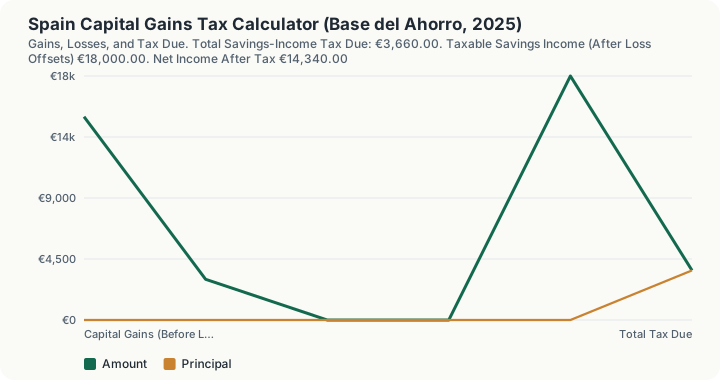
Quick Answer: €15,000 of net capital gains plus €3,000 of dividend and interest income produces €18,000 of taxable savings income under Spain's base del ahorro scale, generating €3,660 of total tax due -- an effective rate of 20.3%. Offsetting €8,000 of capital losses against the same gains instead drops the taxable base to €10,000, meaningfully reducing the tax owed.
Overview
Spain taxes capital gains, dividends, and interest income together under a single national scale called the "base imponible del ahorro" (savings income tax base) -- distinct from the general IRPF scale that applies to salary and business income, and, importantly, uniform across the whole country. Unlike general income tax, which has both a state and regional component that varies by where you live, savings income is taxed at the same rates everywhere in Spain, whether you're in Madrid or Andalusia.
The scale is progressive, with the top rate rising to 30% for savings income above €300,000 following a 2024 law change (Ley 7/2024) that took effect for the 2025 tax year. This calculator applies the full scale to your combined capital gains and investment income, and models Spain's loss-offset rules: capital losses offset gains directly first, and any remaining loss can additionally offset up to 25% of your net dividend and interest income, with anything left over carried forward for up to four years.
How This Is Calculated
- Offset losses against gains first. Capital losses reduce capital gains directly, dollar for dollar, down to a floor of zero.
- Remaining loss offsets up to 25% of investment income. Any loss left over after fully offsetting gains can additionally reduce dividend and interest income, but only up to 25% of that income.
- Taxable savings income. The sum of gains-after-offset and investment-income-after-offset.
- Apply the progressive savings scale. Spain's national base del ahorro brackets (2025, unchanged for 2026): 19% up to €6,000, 21% from €6,000 to €50,000, 23% from €50,000 to €200,000, 27% from €200,000 to €300,000, and 30% above €300,000.
- Carry forward. Any loss not absorbed by gains or the 25% investment-income offset carries forward for use in future years (up to 4 years under current rules).
Worked Example
Using the calculator's default inputs (€15,000 gains, €3,000 dividends/interest, no losses):
- No losses to offset, so gains after offset remain €15,000.
- Taxable savings income: 15,000 + 3,000 = €18,000.
- Applying the scale: first €6,000 × 19% = €1,140; remaining €12,000 × 21% = €2,520.
- Total tax due: 1,140 + 2,520 = €3,660, an effective rate of about 20.3% on the full €18,000.
The Same Income, With €8,000 of Losses
- Gains after offset: max(0, 15,000 - 8,000) = €7,000.
- Taxable savings income: 7,000 + 3,000 = €10,000.
- Tax due: €1,980.00, an effective 19.80%, against €3,660.00 with no losses. The €8,000 offset is worth €1,680.00 of tax, which is the figure the calculator reports on its own Tax Saved By Offsetting Losses line, and none of the loss carries forward because the gains absorbed all of it.
A Large Gain Reaching the Top Brackets
€250,000 of gains plus €10,000 of investment income gives €260,000 of taxable savings income, which lands in the 27% band (€200,000 to €300,000). The calculator returns €61,080.00 of tax, an effective 23.49% against a 27% marginal rate. The gap between those two numbers is the whole point of a progressive scale: €6,000 of that base was taxed at 19%, €44,000 at 21%, €150,000 at 23%, and only the last €60,000 at 27%.
Walking the Savings Scale, Band by Band
The base del ahorro has four real edges, at €6,000, €50,000, €200,000 and €300,000 of taxable savings income. Because the calculator adds dividends and interest to gains before applying the scale, an edge arrives on the gains input earlier than the headline figure suggests: with the default €3,000 of investment income underneath, each edge is reached €3,000 sooner. Sweeping the gains input across each one shows what the step costs.
The €6,000 edge. At €2,000 of gains the tax is €950.00; at €3,000 it is €1,140.00, the €1,000 having cost €190.00. At €4,000 the tax is €1,350.00 and the same €1,000 cost €210.00. The marginal rate output flips from 19% to 21%, and the price of each further €1,000 rises by €20.00.
The €50,000 edge. At €46,000 of gains the tax is €10,170.00 and at €47,000 it is €10,380.00, an increment of €210.00. At €48,000 it is €10,610.00, an increment of €230.00. The step here is worth €20.00 per €1,000, and the marginal rate moves from 21% to 23%.
The €200,000 edge. €196,000 of gains gives €44,650.00; €197,000 gives €44,880.00, costing €230.00; €198,000 gives €45,150.00, costing €270.00. This is the largest single step in the scale: €40.00 more per €1,000 on the far side, as the rate moves from 23% to 27%.
The €300,000 edge. €296,000 of gains gives €71,610.00, €297,000 gives €71,880.00 at €270.00, and €298,000 gives €72,180.00 at €300.00. The Ley 7/2024 top band shows up here as €30.00 more per €1,000.
How much can be realised before the next band
Read backwards from the default €3,000 of dividends and interest, the answers are €3,000 of gains before the 21% band opens, €47,000 before 23%, €197,000 before 27%, and €297,000 before the 30% top band. Each of those is €3,000 below the statutory edge, and every euro of extra dividend or interest income lowers them by another euro, because the two feed one combined base.
The cost of the next €1,000
At the default inputs, sweeping gains from €15,000 upward returns €3,660.00, €3,870.00, €4,080.00, €4,290.00. Each additional €1,000 of gain costs €210.00 and continues to until the base reaches €50,000. On the first euros of a base with no other savings income, the same €1,000 costs €190.00.
Right method against wrong method, priced
The error worth pricing on this page is the 25% cap, which people routinely overlook when a bad year produces losses larger than the gains.
Take €15,000 of gains, €3,000 of dividends and interest, and €18,000 of losses.
Wrong: the loss wipes out everything. The intuition is that €18,000 of losses covers €18,000 of savings income, leaving nothing taxable. The calculator will produce that answer if the facts actually support it: set investment income to zero and the taxable base is €0.00 and the tax €0.00.
Right: gains first, then a quarter of the investment income. The engine offsets €15,000 of loss against the gains, leaving €3,000 of loss. That remainder may only reach 25% of the €3,000 of investment income, which is €750.00. Taxable savings income is therefore €2,250.00, and the tax is €427.50 at an effective 19.00%. €2,250.00 of unused loss carries forward.
The error: €427.50 of tax treated as zero, on a year the taxpayer thought was fully sheltered, plus €2,250.00 of relief pushed into a later year rather than lost. Raise the losses to €23,000 and the current-year answer does not improve at all: still €427.50 of tax on a €2,250.00 base, with the carryforward growing to €7,250.00. The cap binds on the investment income, not on the size of the loss, so beyond the point where the gains are fully absorbed, extra losses buy no further current-year relief.
Limitations of this calculator, stated plainly
It computes one year. The four-year carryforward window is real and the calculator reports the amount that would carry, €2,250.00 in the case above, but it does not track a prior-year balance, apply one to this year, or age anything out. There is no input for a loss brought forward, so a taxpayer with unused losses from an earlier year cannot model them here.
It also assumes the whole gain is taxable. No primary-residence reinvestment relief, no over-65 exemption, and no foreign tax credit is applied, so a seller who qualifies for one of those will owe less than the €3,660.00 the default case reports. And it applies the resident progressive scale throughout: a non-resident taxed at a flat rate is not modelled at any point on this page.
What This Does Not Account For
- The scale is national and uniform -- unlike general IRPF, there is no regional variation in savings income tax rates, so this calculator applies correctly regardless of which Comunidad Autónoma you live in.
- The €1,500/year dividend exemption no longer exists -- it was eliminated in Spain's 2015 IRPF reform, and all dividend income (subject to the loss-offset rules modeled here) is taxable from the first euro.
- Primary-residence capital gains exemptions (e.g. reinvestment in a new primary home, or the over-65 exemption) are not modeled -- this calculator assumes the gain is fully taxable investment-type income.
- Foreign tax credits for capital gains or investment income already taxed abroad under a double-taxation treaty are not modeled.
- Non-resident taxation, which follows different rules (a flat rate rather than this progressive scale for most non-residents), is out of scope.
- Losses older than 4 years cannot be carried forward under current rules, and this calculator does not track a multi-year carryforward history -- it only computes the current year's offset and reports what would need to carry forward.
Common Pitfalls
- Forgetting that losses offset gains before touching investment income. The order matters: Spain's rules require losses to first reduce capital gains fully before any remainder can touch dividend/interest income, and even then only up to a 25% cap.
- Assuming the same rates apply regardless of region. This is one of the few areas of Spanish personal taxation where the same scale genuinely applies everywhere -- don't confuse it with general IRPF, which does vary by Comunidad Autónoma.
- Believing dividends have a small exemption. Many people still recall the old €1,500/year dividend exemption, which was removed in 2015 -- all dividend income is now taxable from the first euro (subject to the same scale and loss-offset rules as gains).
- Missing the 25% cap on offsetting investment income with leftover losses. A large loss can't wipe out all your dividend/interest income in one year -- only a quarter of it, with the rest carried forward.
- Not tracking carried-forward losses year to year. Losses that aren't fully used this year need to be tracked and applied in future years, within the 4-year window, or they're lost.
Frequently Asked Questions
Is Spain's capital gains tax the same everywhere in the country?
Do I still get a dividend allowance in Spain?
How far back can I carry forward unused capital losses?
What changed with the 2025 top-bracket increase?
Do capital losses offset salary income too?
Sources
- Spanish Tax Agency (Agencia Tributaria), the official authority for the national tax authority this calculator relates to. sede.agenciatributaria.gob.es
Also consulted: Ley 7/2024, de 20 de diciembre, raising the top savings-income bracket from 28% to 30% above €300,000, effective tax year 2025; Spain's base imponible del ahorro progressive bracket structure (19%/21%/23%/27%/30%), confirmed current for 2025-2026; Ley 26/2014, establishing the phased-in 25% cap on offsetting capital losses against net investment income (well-established, prior-knowledge figure); General knowledge of the 2015 IRPF reform's elimination of the historical €1,500/year dividend exemption.