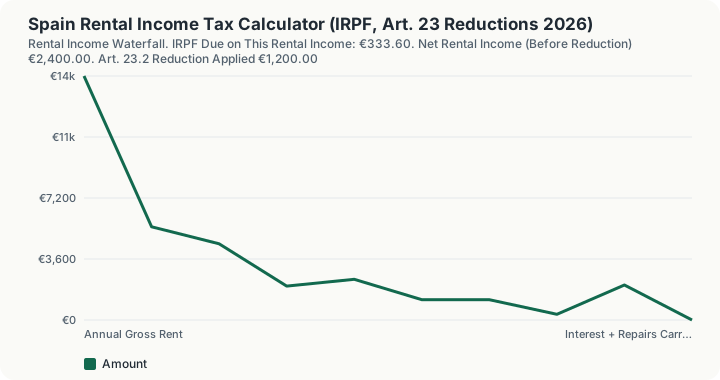
Quick Answer: EUR 14,400 of gross rent, after EUR 4,000 of mortgage interest, EUR 1,500 of repairs, EUR 2,000 of other expenses and EUR 4,500 of amortizacion, costs EUR 333.60 of IRPF for a Madrid taxpayer with EUR 30,000 of other income. Net rental income before the reduction is EUR 2,400, the standard 50% art. 23.2 reduction removes EUR 1,200, and only EUR 1,200 joins the general base. Without the reduction the same let would cost EUR 667.20.
What does this calculator do?
Spanish IRPF treats residential rental income as rendimientos del capital inmobiliario, and the calculation has three features that are easy to get wrong and expensive to get wrong.
The first is the art. 23.2 reduction. Since Ley 12/2023 replaced the old flat 60% with a four-tier structure, a qualifying residential let attracts a reduction of 90%, 70%, 60% or 50% depending on the lease. It is not a choice: it is set by which lettered case in art. 23.2 your lease falls under, tested when the lease is concluded, and it lasts only while the conditions continue to be met. Contracts signed before 26 May 2023 keep the old flat 60% under DT 38a. Tourist and seasonal lets get nothing, because art. 23.2 covers only lettings destined to be a dwelling.
The second is that the reduction applies to positive net income, never to gross rent. This is the single most common error on this calculation. The statute reduces "el rendimiento neto positivo", so the sequence is: gross rent, minus every deductible expense, and only then the percentage.
The third is the art. 23.1 cap. Interest and conservation costs are jointly capped at the year's gross rent for that property, with the excess carried forward four years. Amortizacion is not capped: it is a separate head of art. 23.1. The consequence is structural and rarely stated: because interest is floored at gross rent, interest alone can never push a property into a deductible loss. Depreciation can. If your rental shows a loss against your Spanish salary, amortizacion is what created it.
How is this calculated?
C = min(I + R, G); A = 0.03 × B
N = G − C − A − O; Reduction = N × r, N > 0; 0, N ≤ 0
IRPF = T(other + N − Reduction) − T(other)
where $G$ is gross rent, $I$ interest, $R$ repairs, $O$ other expenses, $B$ the amortizacion base and $T$ the combined state and regional IRPF scales.
Step 1: Sum interest and conservation costs, which share one cap. EUR 4,000 + EUR 1,500 = EUR 5,500.00
Step 2: Cap that sum at the year's gross rent for the property. min(EUR 5,500, EUR 14,400) = EUR 5,500.00 deducted
Step 3: Anything above the cap carries forward four years. EUR 5,500 - EUR 5,500 = EUR 0.00 carried forward
Step 4: Compute amortizacion at 3% of the building value excluding land. EUR 150,000 x 3% = EUR 4,500.00
Step 5: Total the deductions: capped interest and repairs, plus amortizacion, plus other expenses. EUR 5,500 + EUR 4,500 + EUR 2,000 = EUR 12,000.00
Step 6: Net rental income is gross rent less total deductions. EUR 14,400 - EUR 12,000 = EUR 2,400.00
Step 7: Apply the art. 23.2 reduction to the positive net figure. EUR 2,400 x 50% = EUR 1,200.00
Step 8: Taxable rental income is what remains. EUR 2,400 - EUR 1,200 = EUR 1,200.00
Step 9: Stack that on the general base. At EUR 30,000 of other income the marginal rate in Madrid is 15% state plus 12.8% regional. 15% + 12.8% = 27.8%
Step 10: Compute the incremental IRPF. EUR 1,200 x 27.8% = EUR 333.60
Step 11: Compute the counterfactual with no reduction at all. EUR 2,400 x 27.8% = EUR 667.20
Step 12: The reduction's value is the difference. EUR 667.20 - EUR 333.60 = EUR 333.60 saved
Step 13: Net rent after tax is net rental income less the IRPF it caused. EUR 2,400.00 - EUR 333.60 = EUR 2,066.40
Step 14: Effective rate on net rental income before the reduction. EUR 333.60 / EUR 2,400.00 = 13.90%
Step 14 is worth noting. A landlord in the 27.8% marginal band pays an effective 13.90% on the rental's net income, because the 50% reduction halves the base the marginal rate is applied to. The reduction is not a credit and not a rate cut; it is an exclusion from the base, so its value scales directly with your marginal rate.
Worked Example
Now take the same property with heavy borrowing: EUR 16,000 of interest instead of EUR 4,000, everything else unchanged. This is the case where the art. 23.1 cap binds.
Step 1: Sum interest and repairs. EUR 16,000 + EUR 1,500 = EUR 17,500.00
Step 2: Cap at gross rent. min(EUR 17,500, EUR 14,400) = EUR 14,400.00 deducted this year
Step 3: The excess is disallowed this year and carried forward four years. EUR 17,500 - EUR 14,400 = EUR 3,100.00 carried forward
Step 4: Amortizacion, uncapped, is unchanged. EUR 150,000 x 3% = EUR 4,500.00
Step 5: Total deductions. EUR 14,400 + EUR 4,500 + EUR 2,000 = EUR 20,900.00
Step 6: Net rental income. EUR 14,400 - EUR 20,900 = negative EUR 6,500.00
Step 7: The reduction bites only on positive net income. Net income is negative, so the reduction is EUR 0.00 and the taxable figure stays at negative EUR 6,500.00
Look carefully at what produced that loss. Interest was capped at exactly the gross rent, so interest and repairs together brought net income to precisely zero and no further. Every euro of the EUR 6,500 loss came from the uncapped heads: EUR 4,500 of amortizacion and EUR 2,000 of other expenses. That is the structural point the cap creates. Interest cannot generate a rental loss in Spain; depreciation and unrestricted expenses can.
The disallowed EUR 3,100 is not lost. It is deductible over the following four years against the same property, subject in each of those years to the same gross-rent cap. This calculator reports the carried-forward figure but is a single-year model and does not project its release into future years.
What does this calculator not account for?
- It does not project the four-year carryforward. The disallowed interest and repairs are reported, but their release in future years is not modelled.
- It models three regions only. IRPF is half state and half regional, and each of the seventeen comunidades autonomas sets its own scale. Madrid, Catalonia and Andalusia are provided as representative examples; your own region's scale may differ materially.
- It does not test your eligibility for the reduction tier you select. The 90%, 70% and 60% tiers each carry specific statutory conditions: a declared tensioned zone, a rent cut of more than 5% against the previous contract, a first-ever let to a tenant aged 18 to 35, a social or public-body tenant, or a rehabilitation completed within the two years before signing. Choose the tier your lease actually qualifies for.
- It does not enforce the filing condition. The reduction is available only on net income declared in a self-assessment filed before any verification, limited review or inspection procedure has begun, and never on income omitted or expenses improperly deducted and later regularised. That is a procedural condition, not an arithmetic one.
- It does not derive the amortizacion base for you. You must supply the greater of acquisition cost paid or cadastral value, excluding land in either case. Where the split is unknown, apportion using the land and construction values on your IBI receipt.
- It does not apportion for part-year letting or partial private use, nor apply the imputed income (imputacion de rentas inmobiliarias) that falls on a dwelling for the periods it is not let.
- It does not model non-resident landlords under IRNR, where EU and EEA residents deduct expenses at 19% and other non-residents pay 24% on gross rent with no deductions at all.
- It does not model the wealth tax, IBI assessment, or the regional housing levies that apply to some landlords independently of IRPF.
What mistakes do people make with this?
- Applying the reduction to gross rent. The statute reduces the positive net figure. Applying 50% to EUR 14,400 rather than to EUR 2,400 overstates the reduction by a factor of six at the defaults.
- Applying the reduction to a loss. It cannot create or enlarge a loss. A negative net figure gets no reduction at all.
- Assuming the old flat 60% still applies. It applies only to contracts signed before 26 May 2023, under DT 38a. New contracts fall into the 90/70/60/50 structure, and the default case is 50%.
- Claiming the reduction on a tourist let. Short-term and seasonal contracts meet a temporary rather than permanent housing need, so art. 23.2 gives them nothing.
- Deducting improvements as repairs. Repairs and upkeep that preserve the dwelling are deductible under art. 23.1. Improvements that extend or upgrade it are not; they are added to the acquisition cost and recovered through amortizacion at 3% a year.
- Including land in the amortizacion base. The 3% applies to the construction value only. Including land inflates the deduction and is a routine inspection finding.
- Forgetting the interest cap is shared. Interest and conservation costs are capped jointly, not separately, against the same gross rent figure.
- Assuming the excess interest is lost. It carries forward four years, subject to the same cap in each of them.
Frequently Asked Questions
How much of my Spanish rental income is tax free?
Can I deduct my full mortgage interest against Spanish rental income?
What creates a deductible rental loss in Spain, then?
Do I get the 60% reduction on a contract signed in 2022?
Does the reduction apply to a holiday rental?
Sources
- AEAT, Manual Practico de Renta 2025, "Reducciones del rendimiento neto: arrendamiento de inmuebles destinados a vivienda", confirms the reduction applies to positive net income only, and that tourist and seasonal lets get no reduction. sede.agenciatributaria.gob.es/Sede/ayuda/manuales-videos-folletos/manuales-practicos/irpf-2025/c04-rendimientos-capital-inmobiliario/reducciones-rendimiento-neto/arrendamiento-inmuebles-destinados-vivienda.html
- AEAT, Manual Practico de Renta 2025, "Intereses y demas gastos de financiacion del inmueble": the art. 23.1 joint cap of interest and conservation costs at the property's gross income, with a four-year carryforward subject to the same cap each year. sede.agenciatributaria.gob.es/Sede/ayuda/manuales-videos-folletos/manuales-practicos/irpf-2025/c04-rendimientos-capital-inmobiliario/gastos-deducibles/intereses-demas-gastos-financiacion-inmueble.html
- AEAT, Manual Practico de Renta 2025, "Cantidades destinadas a la amortizacion": amortizacion at 3% of the greater of acquisition cost paid or cadastral value, excluding land, and not subject to the interest cap. The 3% itself sits in art. 14 RIRPF (RD 439/2007); confirmed via the AEAT manual rather than the BOE text of the RIRPF. sede.agenciatributaria.gob.es/Sede/ayuda/manuales-videos-folletos/manuales-practicos/irpf-2025/c04-rendimientos-capital-inmobiliario/gastos-deducibles/cantidades-destinadas-amortizacion.html
Also consulted: Ley 12/2023, de 24 de mayo, por el derecho a la vivienda, Disposicion final segunda, apartado Uno, redrafting art. 23.2 LIRPF into the 90% / 70% / 60% / 50% tiers and their trigger conditions. BOE-A-2023-12203, BOE num. 124 of 25/05/2023, pages 71525 to 71526, read from the official BOE PDF on 2026-08-31; DT 38a LIRPF, added by Disposicion final segunda, apartado Dos of the same law: leases concluded before 26 May 2023 keep the reduction as in force on 31 December 2021, the old flat 60%; AEAT, Manual Practico de Renta 2025, "Gravamen estatal" and "Cuota integra autonomica": the state general scale (art. 63.1.1 LIRPF) and each region's own enacted regional scale (art. 74 LIRPF), read 2026-08-22. Catalonia was cross-checked against atc.gencat.cat and matched exactly; Madrid and Andalusia were not checked against a region-run site, and AEAT is treated as authoritative for them; Flagged as partially verified: the itemisation of "otros gastos necesarios" (IBI, community fees, insurance, formalisation and legal-defence costs, landlord-borne utilities and doubtful balances) was confirmed at index level against the AEAT manual rather than read verbatim from primary text.