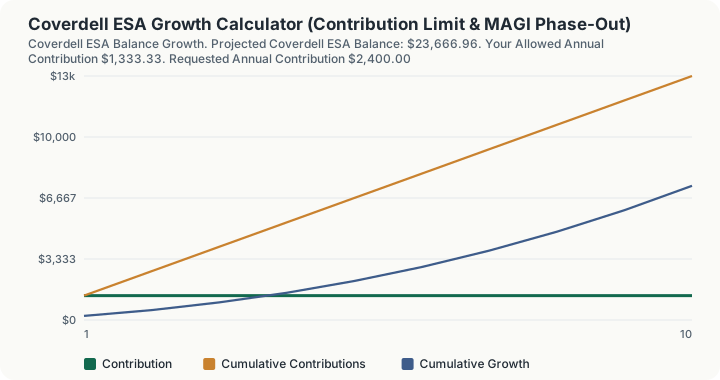
Quick Answer: With a $3,000 starting balance, a $100,000 contributor MAGI (single filer), and a $200/month contribution request, this calculator caps you at $1,333.33/year under the Coverdell's MAGI phase-out (not the full $2,000 limit), projecting a $23,666.96 balance after 10 years at a 6% assumed return, of which $7,333.66 is tax-free investment growth.
Overview
A Coverdell Education Savings Account is the 529 plan's smaller, stricter sibling. Both accounts let investment growth and qualified withdrawals come out federal-tax-free, but a Coverdell adds two constraints a 529 doesn't have: a hard $2,000-per-year-per-beneficiary contribution ceiling, and a Modified Adjusted Gross Income phase-out that can reduce or eliminate a contributor's ability to contribute at all. Both limits are fixed directly in the Internal Revenue Code rather than being inflation-adjusted, so they haven't moved since the account was created and generally won't.
In exchange for those limits, a Coverdell has always allowed K-12 qualified expenses (tuition, books, tutoring, uniforms, even computer equipment) alongside post-secondary costs, a flexibility that 529 plans only gained in a more limited form as of 2026. For a family that wants tax-free growth specifically to cover private K-12 tuition over many years, and who can work within the $2,000 annual ceiling, a Coverdell can still make sense as a complement to a 529, not a replacement for it.
This calculator is built to enforce the Coverdell's actual constraints rather than just project unlimited growth on whatever contribution you request. If your requested contribution exceeds $2,000/year, or if your MAGI phases you out partially or completely, the projection reflects your real allowed contribution, not your wish list.
How This Is Calculated
Three things happen in sequence.
First, the MAGI phase-out. The $2,000 base contribution limit phases out linearly between $95,000 and $110,000 of contributor MAGI for single filers and heads of household, or between $190,000 and $220,000 for married couples filing jointly. Below the floor, you get the full $2,000. At or above the ceiling, you get $0. In between, the platform's shared phase-out primitive computes the exact proportional reduction: at $100,000 MAGI (single), that's $2,000 x (110,000 - 100,000) / 15,000 = $1,333.33.
Second, the contribution cap. Whatever you requested monthly, annualized, gets capped at whichever is lower: the flat $2,000 statutory ceiling, or your MAGI-reduced limit from step one. In the Quick Answer example, a $200/month request annualizes to $2,400, which exceeds even the full $2,000 limit before the phase-out is applied, so the effective contribution here is governed entirely by the $1,333.33 phase-out-reduced number.
Third, the growth projection. Your allowed annual contribution, divided into monthly deposits, compounds against your starting balance using the same TVM future-value solver the 529 calculator uses, chained year by year across your savings horizon.
Worked Example
A single filer with $100,000 of MAGI wants to put $200 a month into a Coverdell ESA for a child ten years from college, starting from a $3,000 balance and assuming 6% returns. The phase-out has other plans for the contribution.
Step 1 -- Locate the MAGI in the phase-out range. $100,000 sits between the $95,000 floor and the $110,000 ceiling
Step 2 -- The remaining fraction of the range. ($110,000 - $100,000) / ($110,000 - $95,000) = 0.6667
Step 3 -- The reduced annual contribution limit. $2,000 base limit x 0.6667 = $1,333.33 a year
Step 4 -- What that is monthly. $1,333.33 / 12 = $111.11 a month
Step 5 -- Compare against the requested amount. $200 x 12 = $2,400 requested against $1,333.33 allowed, so the projection is capped at $1,333.33
Just over $1,000 a year of the intended saving simply cannot go into this account. That constraint, not the return assumption, is what determines the outcome.
The First Two Years of Compounding
Step 6 -- Balance at the end of year one. $3,000 plus twelve $111.11 contributions compounding at 0.5% a month = $4,555.65
Step 7 -- Growth in year one. $4,555.65 - $3,000 - $1,333.33 = $222.32
Step 8 -- Balance at the end of year two. $4,555.65 carried forward with another $1,333.33 contributed = $6,207.25
Step 9 -- Cumulative contributions after two years. $1,333.33 x 2 = $2,666.66
Step 10 -- Cumulative growth after two years. $6,207.25 - $3,000 - $2,666.66 = $540.59
Step 11 -- Growth in year two alone. $540.59 - $222.32 = $318.27
Where the Account Lands at Ten Years
Step 12 -- Total contributed over the horizon. = $13,333.30
Step 13 -- Ending balance. = $23,666.96
Step 14 -- Total tax-free growth. $23,666.96 - $3,000 - $13,333.30 = $7,333.66
Step 14 is the entire tax benefit of the account, and against a college bill it is modest -- which is the honest conclusion here. A 529 has no MAGI phase-out and no $2,000 cap at all, so the same saver constrained to $1,333.33 in this account could have contributed the full $2,400 to a 529 instead. The Coverdell earns its place only where its wider spending rules matter, chiefly K-12 expenses.
The MAGI Phase-Out Ranges That Actually Apply
- Single, Head of Household, or Qualifying Surviving Spouse: Full $2,000 limit below $95,000 MAGI. Phases out linearly between $95,000 and $110,000. No contribution allowed at $110,000 or above.
- Married Filing Jointly: Full $2,000 limit below $190,000 combined MAGI. Phases out linearly between $190,000 and $220,000. No contribution allowed at $220,000 or above.
- These ranges apply per contributor, not per account. Multiple people (parents, grandparents, family friends) can each contribute to the same beneficiary's Coverdell ESA, but the combined total across all contributors and all accounts for that beneficiary still cannot exceed $2,000/year. It's the contributor's own MAGI that determines whether that specific person is eligible to contribute at all.
What This Does Not Account For
- Multiple contributors to one beneficiary. If several people want to contribute to the same child's Coverdell ESA, they must coordinate so the combined total doesn't exceed $2,000/year; this calculator models a single contributor's projection, not a multi-contributor coordination problem.
- The age-18 contribution cutoff and age-30 distribution deadline. Contributions generally cannot be made after the beneficiary turns 18 (except for special-needs beneficiaries), and funds generally must be used by age 30 or rolled to another family member's Coverdell, or the earnings become taxable plus a 10% penalty. This calculator doesn't enforce those age boundaries against your chosen horizon.
- Investment fees. Like the 529 calculator, this tool assumes your entered return rate is net of any account or fund fees, which in practice reduce real-world returns.
- State tax treatment. Coverdell contributions are not federally deductible and most states don't offer a state deduction either, unlike many 529 plans; this calculator only models the federal tax-free growth benefit.
- Coordination with the American Opportunity or Lifetime Learning Tax Credits. The same education expenses cannot be double-counted for a tax-free Coverdell withdrawal and a federal education tax credit; this calculator doesn't model that coordination.
Common Pitfalls
- Assuming the $2,000 limit is per account, not per beneficiary. Opening three separate Coverdell accounts for the same child does not triple the contribution room; the $2,000 ceiling applies across all accounts combined for that beneficiary.
- Missing that the phase-out is based on the contributor's MAGI, not the beneficiary's or the account owner's. A grandparent contributing to a grandchild's Coverdell is subject to the grandparent's own MAGI, which may be well below or above the child's parents' MAGI.
- Forgetting the age-18 contribution cutoff. Unlike a 529, which accepts contributions at any age, a Coverdell generally cannot receive new contributions after the beneficiary turns 18, making it a poor fit for late-starting savers.
- Not comparing against a 529 first. Because the $2,000 annual ceiling is so much lower than what most families can realistically save for college, a Coverdell is usually best used as a K-12-focused supplement to a 529, not a family's primary college savings vehicle.
Frequently Asked Questions
Can I contribute to both a Coverdell ESA and a 529 plan for the same child?
What happens if my MAGI is too high to contribute directly?
What happens to unused Coverdell funds if my child doesn't need them?
Is the $2,000 Coverdell limit ever going to increase?
Can I use Coverdell funds for the same expenses as a 529?
Sources
- Internal Revenue Code Sec. 530, "Coverdell Education Savings Accounts." sec.gov
- IRS Publication 970, "Tax Benefits for Education," Chapter 6 (Coverdell ESA rules and MAGI phase-out worksheet). irs.gov/publications/p970
Also consulted: $2,000 annual contribution limit: IRC Sec. 530(b)(1)(A)(iii) (fixed by statute, not inflation-indexed); MAGI phase-out ranges ($95,000-$110,000 single; $190,000-$220,000 married filing jointly): IRC Sec. 530(c) (fixed by statute, not inflation-indexed).