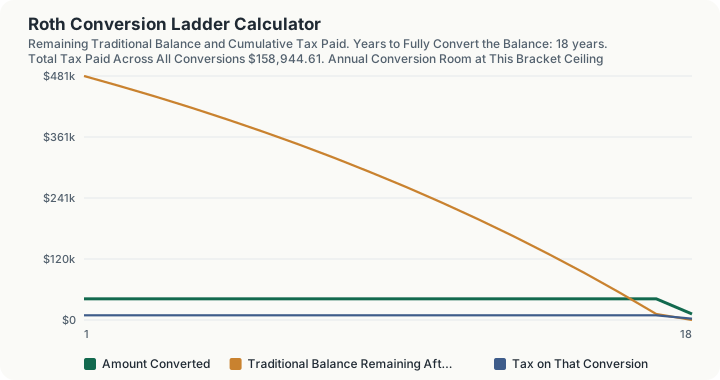
Quick Answer: Converting a $500,000 traditional IRA at a pace that fills the 22% bracket each year (about $41,800 a year on top of $80,000 in other income, for a single filer under 2026 brackets) takes 18 years to fully convert and costs $158,944.61 in total federal tax on $722,475.48 of total converted dollars, an average effective rate of 22.00% because every tranche, including the final partial one, lands entirely inside the 22% bracket.
Overview
A Roth conversion ladder is a multi-year strategy for moving pre-tax retirement money (Traditional IRA or 401(k) balances) into a Roth IRA a bracket at a time, rather than converting everything at once and pushing a huge amount of income into the highest marginal rates in a single year. Each year, you convert only as much as fits underneath a target bracket ceiling, given whatever other taxable income you already have. Do this consistently for enough years and the entire balance eventually moves to Roth, where it grows tax-free and is not subject to Required Minimum Distributions during the original owner's lifetime.
The "ladder" name comes from a second mechanic layered on top of the tax planning: each individual year's conversion is its own separate transaction for purposes of the five-year rule that governs penalty-free access to converted principal before age 59½. A conversion made this year has its own five-year clock; a conversion made next year starts an entirely new, independent five-year clock. Do this every year and you build a "ladder" of tranches that become accessible on a rolling basis, one rung freeing up each year once the strategy has been running for at least five years.
This calculator projects the full multi-year ladder: how much room you have to convert each year without crossing your chosen bracket ceiling, how many years it takes to convert the entire balance at that pace, the total federal tax the strategy costs, and the specific year each tranche clears its five-year penalty-free clock.
How This Is Calculated
Step 1: Determine the annual conversion room. Using the current year's standard deduction and bracket schedule for your filing status, this calculator subtracts your other taxable income (after the standard deduction) from the top of your target bracket:
That is how much additional taxable income you can add via conversion before crossing into the next, higher bracket.
Step 2: Convert the lesser of the annual room or the remaining balance, each year. In every simulated year, the conversion amount is $\min(\text{Annual Room}, \text{Remaining Balance})$. Once the remaining balance drops below a full year's room, that year's conversion is a smaller, final "partial" tranche that finishes the ladder.
Step 3: Compute that year's tax using the same bracket-stacking method used for a single backdoor conversion. The tax owed is the difference between total tax computed with the conversion added on top of other income and total tax computed without it:
Step 4: Apply growth to whatever remains unconverted, and repeat. After each year's conversion is subtracted, the remaining traditional balance grows by your assumed annual rate before the next year's conversion is calculated. The simulation continues until either the balance is fully converted or a 60-year safety cap is reached, since a sufficiently large balance can, under some inputs, grow faster than a fixed annual conversion amount shrinks it (a genuine possibility this calculator surfaces rather than hides, covered further below).
Step 5: Track the five-year clock for every tranche. Each year's conversion tranche becomes penalty-free for withdrawal of converted principal after that same year number plus five, independent of every other tranche's clock.
Worked Example
A single filer with $500,000 sitting in a Traditional IRA, $80,000 of other taxable income each year, filling up the 22% bracket (2026 brackets: standard deduction $16,100, 22% bracket spanning $50,400 to $105,700 of taxable income), assuming 5% annual growth on the unconverted remainder.
- Taxable other income: $80,000 − $16,100 = $63,900, already inside the 22% bracket.
- Annual conversion room: $105,700 − $63,900 = $41,800, which lands stacked taxable income exactly at the 22% ceiling, so the full $41,800 conversion is taxed at a flat 22% every year it applies: $41,800 × 22% = $9,196.00 in year 1.
- Remaining balance after year 1: ($500,000 − $41,800) × 1.05 = $481,110.00.
- Repeating this pace, the balance shrinks each year (since $41,800 in withdrawals outpaces 5% growth on a shrinking base) until, in year 18, only $11,875.48 remains, a smaller final tranche taxed at $2,612.61.
- Total years to fully convert: 18. Total dollars converted: $722,475.48 (seventeen full $41,800 tranches plus the $11,875.48 final one). Total tax paid across all 18 tranches: $158,944.61, an average effective rate of 22.00% on the converted dollars.
- Why the total converted exceeds the $500,000 you started with. The unconverted remainder keeps earning 5% every year, so the ladder ends up moving $722,475.48 to Roth over 18 years, not $500,000. That growth is the correct denominator for the effective rate: dividing the tax by the starting balance instead would report a misleading 31.79%, a number that describes the tax as a fraction of your day-one balance rather than a tax rate on anything. The rate here comes out at exactly the 22% marginal rate because the annual room is defined to land stacked taxable income precisely at the 22% ceiling, so no dollar ever spills into the 24% bracket. Note also that the $8,770.00 of tax you would owe on the $80,000 of other income by itself is not part of this total: Step 3 subtracts it out, counting only the incremental tax the conversion causes.
- Five-year clock: the year 1 tranche is penalty-free starting after year 6; the final, year 18 tranche is penalty-free only after year 23, five full years after its own conversion.
Carrying the Ladder Into Year Two and Beyond
- Year 1: convert $41,800.00, tax $9,196.00, Traditional balance after 5% growth on the remainder $481,110.00. That tranche is penalty-free from year 6.
- Year 2: convert $41,800.00, tax $9,196.00, balance $461,275.50. Cumulative tax $18,392.00. This tranche is penalty-free from year 7 -- each rung starts its own five-year clock.
- Year 10: balance down to $262,403.61, cumulative tax $91,960.00. Ten years of converting at the 22% ceiling has moved $418,000 and retired only 47% of the balance, because 5% growth keeps refilling it.
- Year 18: a final tranche of $11,875.48 taxed at $2,612.61 empties the account. Cumulative tax $158,944.61.
The balance falls by $18,890 in year one and by $39,270.95 in year sixteen: the ladder accelerates because the 5% growth is applied to a shrinking base while the conversion stays fixed. That is the argument for starting earlier rather than converting harder -- an extra year at the front of the ladder does more than a larger tranche at the back, and it is also one more year of five-year clocks already running.
When the Ladder Never Finishes
A fixed annual conversion room only shrinks the remaining balance if the dollar amount converted each year exceeds the dollar amount of growth on the balance that year. At a $41,800 annual room and 5% growth, the breakeven remaining balance is $41,800 × (1/0.05 + 1) = $877,800. Above that threshold, growth on the unconverted remainder outpaces the fixed conversion amount every single year, and the balance grows indefinitely rather than shrinking toward zero. A $1,500,000 starting balance under this calculator's default pace never completes: after the 60-year simulation cap, the "remaining" balance is actually larger than the amount you started with. This is not a bug in the model; it is a genuine strategic finding. Someone in this position needs either a larger annual conversion room (a higher target bracket ceiling), a longer time horizon before they need the funds, or acceptance that only part of the balance will ever move to Roth at this bracket-filling pace.
The Five-Year Bridge: Using a Ladder to Retire Early
The reason most people search for this strategy is early retirement. The ladder is what lets someone who stops working at 45 spend a 401(k) before 59½ without the 10% early-withdrawal penalty: convert a tranche, wait five years, then withdraw that tranche's converted principal penalty-free.
The mechanic that trips people up is that the ladder does not pay you anything for its first five years. Your year 1 conversion is not accessible until the start of year 6. Your year 2 conversion is not accessible until year 7. So if you retire and start converting in the same year, you must fund roughly five full years of living expenses from somewhere else before the first rung ever comes due, and every dollar of that bridge has to come from money that is already penalty-free: a taxable brokerage account, cash and CDs, Roth contributions (which are always withdrawable tax- and penalty-free, unlike conversions), or a 72(t) SEPP series.
Sizing the bridge is straightforward arithmetic that most ladder planning skips:
The second term matters more than it looks. The tax on a conversion is due in the year of the conversion, but the converted money itself is locked for five years, so the tax on the first five rungs also has to be paid out of the bridge. In the worked example above, that is five years of spending plus $9,196 × 5 = $45,980 of federal tax. Paying conversion tax out of the converted balance itself is the classic mistake here: it is treated as a distribution, not a conversion, and if you are under 59½ it draws the 10% penalty on the withheld amount, which is precisely what the ladder exists to avoid.
Two consequences follow. First, the ladder is only worth starting if you have that bridge, which usually means the taxable-account balance is the real constraint on an early retirement date, not the 401(k) balance. Second, if you begin converting a few years before you actually retire, the first rungs mature right around your retirement date and the bridge requirement shrinks accordingly, though those pre-retirement conversions stack on top of your salary and are therefore taxed at your working marginal rate, which is usually the higher one. The trade is a smaller bridge for a larger tax bill.
The ACA Premium Tax Credit Cliff
For an early retiree buying health insurance on a Healthcare.gov or state exchange, the tax bracket is frequently not the binding constraint on how much to convert. The premium tax credit is.
Conversions count as ordinary income and therefore raise your household MAGI, and the ACA credit is calculated as a sliding scale against MAGI as a percentage of the federal poverty level. Every additional dollar converted shrinks the subsidy, which functions as a hidden marginal tax rate stacked on top of the statutory one: a household in the 12% bracket losing roughly 8.5 cents of subsidy per additional dollar of income is facing an effective marginal rate above 20%, and the calculator above will not show it, because it models only the federal bracket schedule.
Two structural details drive the planning:
- The subsidy phaseout is a slope, not a step, only while the enhanced subsidy rules are in force. Under the original ACA statute, credits vanish entirely and abruptly at 400% of FPL, the so-called "subsidy cliff," where one extra dollar of conversion income can cost a family many thousands of dollars in a single stroke. Temporary legislation has repeatedly flattened that cliff into a smooth cap. Whether the cliff is in effect for the year you are converting is a question of current law and should be confirmed before you set your conversion target, because the difference between a slope and a cliff completely changes the optimal amount.
- The relevant number is the year's total MAGI, and conversions are irrevocable. Recharacterization of Roth conversions was eliminated by the Tax Cuts and Jobs Act, so a conversion executed in January cannot be undone in December when the income picture turns out differently. In practice this argues for converting late in the calendar year, once the year's other income is essentially known.
The practical upshot is that many early retirees deliberately cap conversions well below their bracket ceiling, often at whatever amount keeps MAGI under a chosen percentage of FPL, and accept a longer ladder in exchange for keeping the health-insurance subsidy. To model that here, set the target bracket ceiling low enough that the resulting annual conversion room approximates your subsidy-preserving limit, and read the years-to-convert figure as the cost of that choice. Similar MAGI-tested thresholds exist elsewhere and behave the same way, notably IRMAA surcharges on Medicare Parts B and D for anyone 63 or older, since IRMAA is assessed on a two-year lookback.
What This Does Not Account For
- Inflation adjustments to brackets, the standard deduction, or other income. This calculator holds all three constant in today's dollars across every simulated year; real bracket thresholds are adjusted annually for inflation, and real income often changes too.
- State income tax on the converted amount, which varies widely by state and is not included here.
- The Net Investment Income Tax, Additional Medicare Tax, or IRMAA surcharges, all of which can be triggered or worsened by a large conversion pushing income higher, independent of the federal bracket math modeled here.
- Required Minimum Distributions that may apply to the traditional balance during the conversion years once the account owner reaches the applicable RMD age, which would force some distributions regardless of the conversion strategy.
- Market volatility. The growth rate applied to the unconverted remainder is a flat assumed annual figure, not a simulated sequence of actual variable returns.
- The pro-rata rule (IRS Form 8606). This calculator treats the entire traditional balance as fully pre-tax, so 100% of each conversion is taxable. If you have ever made nondeductible traditional IRA contributions, you hold after-tax basis, and the pro-rata rule applies: for tax purposes the IRS aggregates all of your traditional, SEP, and SIMPLE IRAs into one pool as of December 31 of the conversion year, and every conversion carries out basis and pre-tax money in the same proportion as that pool. You cannot elect to convert "just the after-tax part." If $30,000 of a $500,000 aggregate is basis, then 6% of every conversion is tax-free and 94% is taxable, and the ratio is recomputed each year on Form 8606 as the pool shrinks. Anyone with basis should reduce this calculator's tax figures by their own pro-rata percentage. (Balances still inside an employer 401(k) are excluded from the aggregation, which is why rolling a 401(k) into an IRA mid-ladder can silently raise the taxable share of every remaining conversion.)
- ACA premium tax credits, and any other MAGI-tested benefit. Covered in its own section below; the bracket ceiling is often not the binding constraint.
- The Roth IRA five-year rule for earnings, a separate five-year requirement (measured from your very first Roth contribution or conversion, not per-tranche) that governs tax-free treatment of investment earnings, distinct from the per-tranche conversion five-year rule this calculator tracks for penalty-free access to converted principal.
Common Pitfalls
- Converting a fixed dollar amount instead of filling to a bracket ceiling. A flat conversion amount that made sense in one year can silently push you into a higher bracket in a later year if other income changes; recalculating the ceiling-based room each year keeps the strategy on target.
- Forgetting each tranche has its own five-year clock. Withdrawing converted principal from last year's tranche does not free up this year's tranche; every single year's conversion must independently clear five years before penalty-free access, even though ordering and accounting can get confusing with several tranches outstanding at once.
- Assuming a large enough balance will always eventually finish converting. As shown above, a fixed-pace ladder can mathematically fail to ever finish if growth on the unconverted remainder consistently exceeds the conversion amount; the pace has to be large enough relative to the balance, not just non-zero.
- Ignoring RMDs during the conversion window. If the account owner reaches RMD age while still converting, the required distribution amount must generally come out first and is separately taxable, on top of (and not reducible by) the ladder conversion for that year.
- Double-counting the tax cost. The tax owed is the incremental tax caused by adding the conversion on top of existing income, not the conversion amount times the target bracket's rate applied naively; a partial final tranche, or a conversion that straddles two brackets, produces a blended effective rate rather than a single clean percentage.
Frequently Asked Questions
Why does filling a lower bracket ceiling take more years?
Does converting to Roth avoid Required Minimum Distributions?
Can I change my target bracket ceiling partway through the ladder?
Is the five-year rule the same thing as the age-59½ rule?
How much cash do I need before I start a ladder for early retirement?
Does a Roth conversion affect my ACA health insurance subsidy?
I have nondeductible contributions in my IRA. Does that reduce the tax?
What happens to the tax bill if I convert too much in one year?
Sources
- Internal Revenue Service Publication 590-A, Contributions to Individual Retirement Arrangements (IRAs). irs.gov/publications/p590a
- Internal Revenue Service Publication 590-B, Distributions from Individual Retirement Arrangements (IRAs), five-year rule guidance for conversions. irs.gov/publications/p590b
- Internal Revenue Service Revenue Procedure 2025-32 (Internal Revenue Bulletin 2025-45), 2026 inflation-adjusted federal income tax brackets and standard deduction amounts. irs.gov
- Internal Revenue Code section 36B and Internal Revenue Service Publication 974, Premium Tax Credit (PTC), household MAGI definition and the applicable percentage table. irs.gov/publications/p974
Also consulted: Internal Revenue Service Form 8606 and Instructions, Nondeductible IRAs (pro-rata basis aggregation across all traditional, SEP, and SIMPLE IRAs).