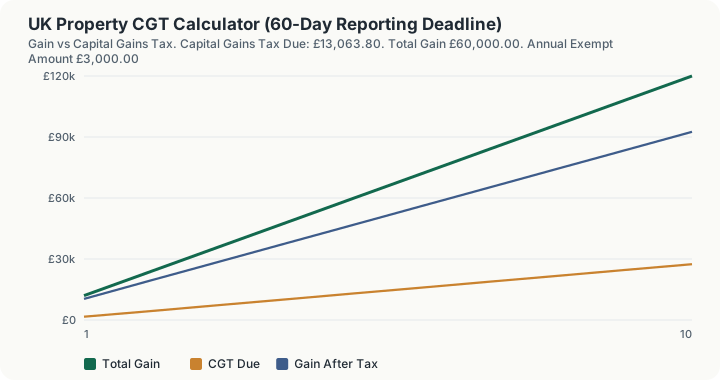
Quick Answer: Selling a buy-to-let for £340,000 that cost £250,000, with £30,000 of buying, selling and improvement costs, produces a £60,000 gain and £13,063.80 of Capital Gains Tax on a £40,000 income. £10,270 of the gain fits the remaining basic rate band at 18%; the other £46,730 is taxed at 24%. The tax must be reported and paid within 60 days of completion, not at the end of the tax year.
What does this calculator do?
Two things about UK property Capital Gains Tax catch people out, and they are unrelated to each other.
The first is the 60-day deadline. Disposals of UK residential property must be reported on a standalone return and the tax paid within 60 days of completion. This is separate from Self Assessment, applies even if you normally file a return, and carries penalties for lateness. Many sellers assume the tax is due the following January.
The second is that the rate depends on your income. Capital gains sit on top of your income, so how much of the gain is taxed at 18% rather than 24% depends on how much basic rate band your salary leaves unused. A £60,000 gain costs a £20,000 earner £11,863.80 and a £70,000 earner £13,680.
Since 30 October 2024 residential property and other assets share the same 18% and 24% rates. There is no longer a higher residential rate, and there has never been a short-term versus long-term distinction in the UK.
How is this calculated?
Step 1: The gain. Sale price less purchase price less allowable costs:
Gain = Sale − Purchase − Costs
Allowable costs include stamp duty and legal fees on purchase, agent and legal fees on sale, and capital improvements such as an extension. Repairs, maintenance and mortgage interest are not allowable.
Step 2: The Annual Exempt Amount. £3,000 is deducted from the gain. This is the figure after successive cuts from £12,300 in 2022/23, and it is no longer indexed.
Step 3: Find the remaining basic rate band. Your taxable income is deducted from the £37,700 basic rate band. Whatever is left is the amount of gain that can be taxed at the lower rate:
Band remaining = max(0, 37,700 − (income − 12,570))
Step 4: Apply the rates. The gain within that remaining band is taxed at 18%; everything above it at 24%.
Worked Example
£340,000 sale, £250,000 purchase, £30,000 costs, £40,000 income:
- Gain: £340,000 − £250,000 − £30,000 = £60,000
- Less the £3,000 Annual Exempt Amount: £57,000 taxable
- Income of £40,000 leaves £37,700 − £27,430 = £10,270 of basic rate band
- £10,270 × 18% = £1,848.60
- £46,730 × 24% = £11,215.20
- Total: £13,063.80, an effective rate of 21.77% on the gain
The same sale on a £20,000 income:
- More band remains, so £30,270 is taxed at 18% and only £26,730 at 24%
- Total: £11,863.80, £1,200 less on an identical property
The same sale on a £70,000 income:
- No basic rate band remains, so the whole £57,000 is taxed at 24%
- Total: £13,680
What does this calculator not account for?
- Private Residence Relief. If the property has been your main home at any point, part or all of the gain may be exempt, including the final nine months of ownership. This calculator assumes no relief applies, which is correct for a pure investment property but not for a former home.
- Lettings relief, now available only where the owner shared occupancy with the tenant.
- Jointly owned property. Each owner is taxed on their share and has their own £3,000 exempt amount, so a couple can shelter £6,000 between them.
- Capital losses, brought forward or realised in the same year, which reduce the gain.
- Non-residents, who are subject to their own rules and rebasing dates.
- Properties held in a company, which pay Corporation Tax on gains instead.
- Mixed-use property, where only the residential part falls within the 60-day regime.
- Gifts and transfers between spouses, which are made on a no gain, no loss basis.
- The interaction with Self Assessment. The 60-day return is provisional; the gain is reported again on your tax return, and any difference settled then.
What mistakes do people make with this?
- Assuming the tax is due the following January. It is due within 60 days of completion. This is the single most expensive mistake on this topic, because HMRC charges penalties and interest from day 61.
- Deducting mortgage interest or repairs. Neither is an allowable cost for CGT. Only capital expenditure and transaction costs count, so a new roof to fix a leak is not deductible while an extension is.
- Using a flat 24%. The rate depends on your income in the year of sale. A lower-income year can move a meaningful slice of the gain into the 18% band.
- Forgetting the exempt amount is now only £3,000. It was £12,300 as recently as 2022/23, and old guidance still circulates.
- Overlooking Private Residence Relief on a former home. If you ever lived in the property, the exempt portion can be substantial, and this calculator does not model it.
- Ignoring the joint ownership advantage. Two owners have two exempt amounts and two sets of basic rate band, which can save several thousand pounds.
Frequently Asked Questions
When exactly is the tax due?
What if I miss the 60-day deadline?
Why is my rate 18% on part and 24% on the rest?
Can I deduct my mortgage interest?
Does this apply if I lived in the property?
Do my spouse and I each get the exempt amount?
Sources
- HM Revenue and Customs (HMRC), the official authority for the national tax authority this calculator relates to. gov.uk/government/organisations/hm-revenue-customs
All figures verified on 30 August 2026 and mirrored in engine/tables/2026/uk-2026-27.json
Also consulted: GOV.UK: "Capital Gains Tax rates and allowances", Annual Exempt Amount £3,000, rates of 18% and 24%; GOV.UK: "Report and pay Capital Gains Tax on UK property", the 60-day reporting and payment deadline; HM Treasury, Autumn Budget 2024, from 30 October 2024 the rates on other assets were raised to match property's existing 18% and 24%.