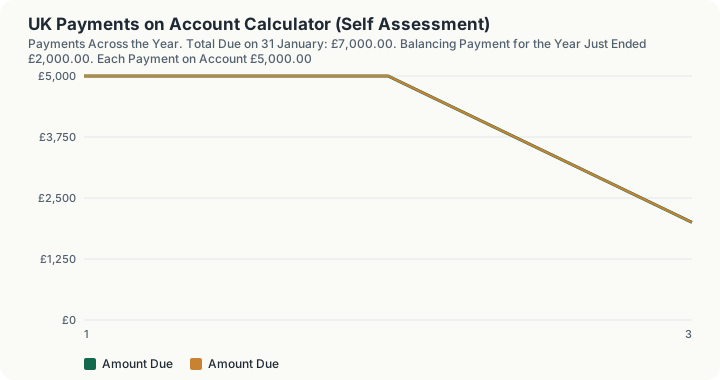
Quick Answer: If last year's liability was £10,000 and this year's is £12,000, you owe £7,000.00 on 31 January. That is the £2,000 balancing payment for the year just ended, plus the first £5,000 payment on account for the year already running. A second £5,000 follows on 31 July.
What does this calculator do?
Payments on account are the part of Self Assessment that catches people out most, because the 31 January bill is not just last year's tax. It combines two separate things: the balancing payment settling the year you have just filed, and the first instalment toward the year you are currently living through.
The result is that a first year of self-employment with a meaningful profit produces a January bill of roughly one and a half times the tax actually owed for that year. Nothing has gone wrong when this happens, but it is a common and unwelcome surprise.
Each payment on account is simply half of last year's liability, so the system assumes this year will look like last year and corrects the difference later.
How is this calculated?
Step 1: Are payments on account required at all? They are not, if either of these applies:
- Last year's liability was less than £1,000, or
- More than 80% of last year's tax was already collected at source, through PAYE or bank deduction
Note the test is more than 80%. Exactly 80% still requires payments.
Step 2: Each payment on account is half of last year's liability:
POA = (previous year’s liability)/2
Step 3: The balancing payment reconciles the year just filed against the two payments already made toward it:
Balancing = this year’s liability − 2 × POA
This can be negative, which means a repayment is due to you.
Step 4: The 31 January total carries both the balancing payment for the year just ended and the first payment on account for the year now running:
31 January = Balancing + POA
Worked Example
Liability rising from £10,000 to £12,000:
- Each payment on account: £10,000 ÷ 2 = £5,000
- Two payments of £5,000 were already made toward this year's £12,000
- Balancing payment: £12,000 − £10,000 = £2,000
- Due 31 January: £2,000 + £5,000 = £7,000
- Due 31 July: £5,000
Liability falling from £10,000 to £6,000:
- Payments on account of £5,000 each, totalling £10,000, were made toward a liability of only £6,000
- Balancing payment: £6,000 − £10,000 = −£4,000, a repayment
- If you know your income has fallen, you can apply to reduce your payments on account rather than overpaying and waiting for the refund. HMRC charges interest if you reduce them too far.
A first year of self-employment with £10,000 of tax:
- Entering a prior year liability of £0 and a current year liability of £10,000 returns a status of "Not required: last year's liability was below £1,000", a balancing payment of £10,000.00 and £10,000.00 due on 31 January
- In practice HMRC would also charge a first payment on account of £5,000 for the year now running, making the real January bill £15,000
- The calculator does not produce that £15,000, because it derives the payments on account from the prior year only and credits two of them against the current year. This is the one case on the page where the engine understates the January demand, by exactly half the current year's liability
The Two Exemption Cliffs, One Percentage Point Apart
Both exemptions are true cliffs. There is no taper on either side, and the calculator's "Payments on Account Status" line names which one fired.
Last year's liability below £1,000. Holding this year's liability at £12,000, a prior year figure of £999 returns £0.00 for each payment on account, £0.00 due on 31 July and the whole £12,000.00 on 31 January. A prior year figure of £1,000 flips the status to "Required": each payment on account becomes £500.00, the balancing payment falls to £11,000.00 and 31 January drops to £11,500.00, with £500.00 now due on 31 July.
The comparison in the code is less than £1,000, not up to. At exactly £1,000 payments are required. One pound of extra liability in the prior year moves £500.00 of cash out of January and into the following July.
More than 80% collected at source. At the default £10,000 and £12,000, setting the deducted-at-source figure to 80% leaves the status at "Required": £7,000.00 due on 31 January and £5,000.00 on 31 July. Setting it to 81% flips the status to "Not required: more than 80% was collected at source", and the January figure jumps to £12,000.00 with nothing due in July.
One percentage point therefore adds £5,000.00 to the January demand. The total across the year is £12,000.00 either way, so this cliff changes only the timing of the cash, not the amount, which is the opposite of how an exemption is usually assumed to work.
What Each Extra £1,000 Does to the January Bill
The two liability inputs push the January figure in opposite directions, and both do so at a perfectly constant rate.
Last year's liability, swept upward in £1,000 steps: £10,000 gives £7,000.00 on 31 January, £11,000 gives £6,500.00, £12,000 gives £6,000.00, £13,000 gives £5,500.00, £14,000 gives £5,000.00. Each additional £1,000 of last year's liability reduces the January bill by £500.00, because half of it was already credited twice against the current year while only half is re-charged as the new payment on account.
This year's liability, swept the same way: £9,000 gives £4,000.00, £10,000 gives £5,000.00, £11,000 gives £6,000.00, £12,000 gives £7,000.00, £13,000 gives £8,000.00. Each additional £1,000 of current year liability adds exactly £1,000.00 to January, and nothing at all to July, since the July instalment is fixed by last year alone.
The reverse question: what makes the balancing payment vanish? A current year liability equal to last year's. At £10,000 against £10,000 the balancing payment is £0.00 and the January and July instalments are £5,000.00 each, the steady state the system is built around.
And when income falls. At £10,000 last year against £6,000 this year, the balancing payment is minus £4,000.00 and only £1,000.00 falls due on 31 January. Note what the calculator still shows on 31 July: £5,000.00, unchanged. The engine has no model of an SA303 claim to reduce payments on account, so it will keep charging half of the old liability in July however far the current year has fallen. That gap is the single most valuable thing to act on manually, and this page cannot compute it for you.
What does this calculator not account for?
- Capital Gains Tax. CGT is excluded from the payment-on-account calculation and is payable in full with the balancing payment on 31 January.
- Student loan repayments, which are also excluded from payments on account and paid with the balancing payment.
- Class 2 National Insurance, likewise settled with the balancing payment rather than spread across instalments.
- Interest and penalties for late payment or for reducing payments on account below the eventual liability.
- Time to Pay arrangements, which HMRC may agree where the bill cannot be met in full.
- Payments already made, including any voluntary payments or amounts collected through your tax code.
- Computing the liability itself. This starts from figures you supply.
What mistakes do people make with this?
- Budgeting for the balancing payment alone. The 31 January bill is the balancing payment plus the first payment on account. Setting aside only the tax owed for the year leaves you roughly 50% short.
- The first-year shock. With no prior year, there are no payments on account to credit, so the first January brings a full year's tax plus half a year again. This is the single most common Self Assessment cash-flow problem.
- Reducing payments on account too aggressively. You can apply to reduce them if income has genuinely fallen, but if the final liability turns out higher, HMRC charges interest back to the original due dates.
- Assuming the 80% test is a rounded figure. It is more than 80%. Exactly 80% still requires payments on account.
- Including Capital Gains Tax in last year's liability. CGT is excluded from the payment-on-account base. Including it inflates every future instalment.
- Forgetting the 31 July payment. It arrives with no new tax return and no reminder of the underlying calculation, six months after the January bill.
Frequently Asked Questions
Why is my January bill more than my tax for the year?
When am I exempt from payments on account?
Can I reduce my payments on account?
Does Capital Gains Tax count?
What happens if my income falls and I overpay?
Sources
- HM Revenue and Customs (HMRC), the official authority for the national tax authority this calculator relates to. gov.uk/government/organisations/hm-revenue-customs
Also consulted: GOV.UK: "Understand your Self Assessment tax bill: payments on account", each payment is half the previous year's liability, due 31 January and 31 July; GOV.UK: exemption where the previous year's liability was under £1,000, or where more than 80% of tax was deducted at source; All rules verified on 30 August 2026 and recorded in engine/tables/2026/uk-2026-27.json.