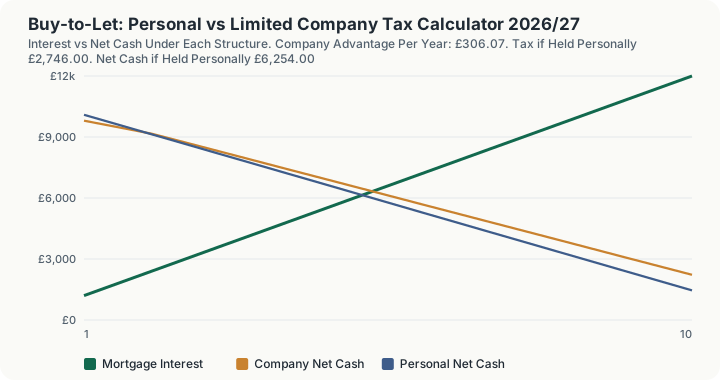
Quick Answer: On £18,000 of rent with £3,000 of expenses and £6,000 of mortgage interest, alongside a £40,000 salary, a limited company leaves you £306.07 better off per year. Personally you pay £2,746 and keep £6,254; through a company you pay £1,710 of Corporation Tax plus £729.93 of dividend tax and keep £6,560.07. The gap widens with more borrowing and reverses entirely if there is no mortgage.
What does this calculator do?
Section 24 removed mortgage interest as a deductible expense for individual landlords, but not for companies. That single asymmetry is why so many landlords have incorporated since 2017.
It is not a one-way argument. A company deducts interest in full and pays Corporation Tax at 19% on small profits, but extracting the money means a second layer of tax as a dividend. Whether the company wins depends almost entirely on how much interest you pay.
On the default figures the company is ahead by £306 a year. Remove the mortgage and the company is £626 worse off, because there is no interest restriction to escape and the double tax layer is pure cost.
How is this calculated?
Personal ownership. Property profit is rent less expenses, with interest excluded. That profit is added to your other income and taxed at your marginal rate. A tax reduction of 20% of the lowest of the finance costs, the property profit, or adjusted total income is then deducted.
Company ownership. The company deducts all costs including interest:
Company profit = Rent − Expenses − Interest
Corporation Tax is charged at 19% up to £50,000 of profit, 25% above £250,000, with Marginal Relief between. If profit is extracted, the post-tax amount is a dividend, taxed on you at 10.75%, 35.75% or 39.35% after the £500 allowance, stacked on your other income.
The comparison is net cash in your hand under each route.
Worked Example
A landlord with a £40,000 salary lets a flat for £18,000 a year, spends £3,000 on agent fees and repairs, and pays £6,000 of mortgage interest.
Held personally
Step 1: Property profit, with interest excluded. £18,000 - £3,000 = £15,000
Step 2: Total income for the year. £40,000 + £15,000 = £55,000
Step 3: Income tax before the section 24 reduction. Tax on £55,000 minus tax on £40,000 = £3,946
Step 4: The section 24 tax reduction. 20% of the lowest of the finance costs (£6,000), the property profit (£15,000) and adjusted total income = £6,000 x 20% = £1,200
Step 5: Tax attributable to the let. £3,946 - £1,200 = £2,746
Step 6: Net cash in hand. £18,000 - £3,000 - £6,000 - £2,746 = £6,254
Note what step 3 did. The £6,000 of interest is a real cash cost that never touched the tax computation, so a higher rate taxpayer is charged 40% on income they never kept, and then handed 20% of it back. That 20-point wedge is the whole of section 24.
Held in a limited company
Step 7: Company profit, with interest fully deducted. £18,000 - £3,000 - £6,000 = £9,000
Step 8: Corporation Tax. £9,000 is below the £50,000 small profits threshold, so 19% applies: £1,710
Step 9: Profit after Corporation Tax. £9,000 - £1,710 = £7,290
Step 10: Dividend tax on extraction. The £500 dividend allowance covers the first slice, and the £40,000 salary leaves the remainder inside the basic rate band: £6,790 x 10.75% = £729.93
Step 11: Net cash in hand. £7,290.00 - £729.93 = £6,560.07
Step 12: The company advantage. £6,560.07 - £6,254.00 = £306.07 a year
Two layers of tax totalling £2,439.93 still beat one layer of £2,746, because the second structure got to deduct the interest before either layer was applied.
Where the answer flips
The computed table steps the mortgage interest in £1,200 increments and reports net cash under both routes. The crossover is visible in the first two rows:
Step 13: At £1,200 of interest. Personal net cash £10,094, company net cash £9,803.11: personal ownership wins by £290.89
Step 14: At £2,400 of interest. Personal £9,134, company £9,162.60: the company has taken the lead by £28.60
Step 15: At £6,000 of interest, the base case. Personal £6,254, company £6,560.07
Step 16: At £12,000 of interest. Personal £1,454, company £2,222.52, an advantage of £768.52
From the second row onward every £1,200 of extra interest moves the comparison a further £92.49 in the company's favour, in a straight line, because the personal side gets 20% relief where the company side gets 100%. The break-even for this landlord sits at roughly £2,290 of annual interest, and it will sit somewhere different for every landlord depending on their salary and their rent.
Step 17: With no mortgage at all. Personal tax £3,946 against a company's £2,850 of Corporation Tax plus £1,722.38 of dividend tax, so the company is £626.38 worse off
Step 17 is the control case. Strip out the interest and there is nothing for the company structure to rescue, so all that is left is paying tax twice. Incorporation is a remedy for section 24, not a general-purpose saving.
Step 18: Retaining the profit instead of extracting it. Skipping the £729.93 of dividend tax lifts the company advantage to £1,036.00
That figure is real but it is a deferral, not a saving. The dividend tax is still waiting the day the money comes out, and at whatever rate applies then.
What does this calculator not account for?
- The cost of incorporating an existing property. Transferring a property you already own is a disposal for Capital Gains Tax and a purchase for Stamp Duty, including the 5% surcharge. These one-off costs frequently exceed many years of annual saving and are the main reason incorporation is often not worth it.
- Higher mortgage rates for companies. Limited company buy-to-let products typically carry higher rates and fees, which can erase the tax advantage entirely.
- Running costs. Accounts, corporation tax returns, confirmation statements and an accountant, typically several hundred pounds a year.
- Directors' loan accounts, which often allow tax-free extraction of funds originally introduced, materially changing the early-year picture.
- Incorporation relief and section 162, which can defer the CGT charge where a genuine property business is transferred.
- Annual Tax on Enveloped Dwellings for high-value residential property held corporately.
- Inheritance tax, where the two structures differ significantly.
- Mortgage interest relief within the company being restricted by the corporate interest restriction, which applies only to very large groups.
What mistakes do people make with this?
- Comparing only the annual tax. The recurring saving here is a few hundred pounds. Incorporating an existing property can cost tens of thousands in CGT and Stamp Duty. The payback period is often decades.
- Assuming a company is always better. With no mortgage it is usually worse, because the double tax layer has no interest restriction to offset it.
- Forgetting the second layer of tax. Corporation Tax at 19% looks attractive next to 40% income tax, but the money is not yours until it is extracted, and extraction is taxed again.
- Ignoring higher company mortgage rates. A rate premium of even a quarter of a point can outweigh the tax saving on a typical loan.
- Treating retained profit as a saving. It defers dividend tax rather than avoiding it, unless the money genuinely stays invested in the company long term.
- Overlooking Corporation Tax at the margin. Above £50,000 of profit the effective rate rises to 26.5% through the Marginal Relief band, which narrows the company advantage.
Frequently Asked Questions
Is a limited company better for buy-to-let?
Why does the company pay tax twice?
Should I move my existing properties into a company?
What about higher mortgage rates for companies?
Does it help to leave the profit in the company?
What if my company profits exceed £50,000?
Sources
- HM Revenue and Customs (HMRC), the official authority for the national tax authority this calculator relates to. gov.uk/government/organisations/hm-revenue-customs
All figures verified on 30 August 2026 and mirrored in engine/tables/2026/uk-2026-27.json
Also consulted: HMRC Property Income Manual PIM2058, the section 24 finance cost restriction for individuals; GOV.UK: "Corporation Tax rates and reliefs" and HMRC CTM03925, the 19% small profits rate, 25% main rate and Marginal Relief; GOV.UK: "Tax on dividends", the £500 allowance and the 10.75% / 35.75% / 39.35% rates; GOV.UK: "Stamp Duty Land Tax: buying an additional residential property", the 5% surcharge relevant to incorporating an existing portfolio.