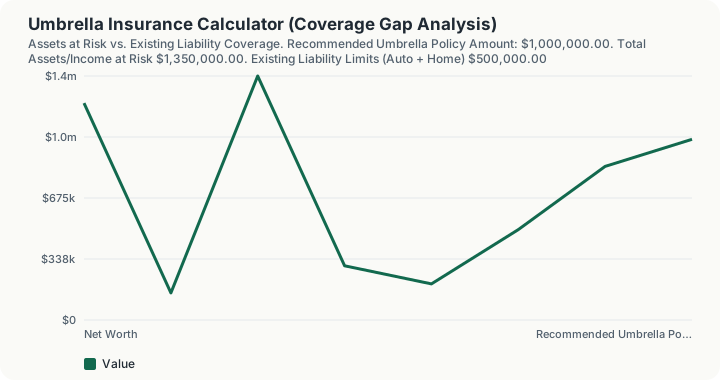
Quick Answer: A household with $1,200,000 in net worth, $150,000 in annual income, a $300,000 auto liability limit, and a $200,000 homeowners liability limit has $1,350,000 of assets and income at risk against only $500,000 of existing liability coverage, a gap of $850,000. Rounded up to the standard increment, the recommended umbrella policy is $1,000,000.
Overview
Personal umbrella insurance is extra liability coverage that sits above the liability limits on your auto and homeowners (or renters) policies. If a lawsuit judgment or settlement exceeds those underlying limits, an umbrella policy picks up the remainder, up to the umbrella policy's own limit, protecting savings, home equity, and future wages from being seized to satisfy the judgment.
The standard planning guidance from the Insurance Information Institute (III) and consumer-facing NAIC materials is straightforward: carry enough total liability coverage (underlying policy limits plus umbrella) to cover your net worth, plus a cushion for future earnings a court could garnish through a wage-garnishment order following an at-fault judgment. Umbrella policies are sold in standard increments, almost universally starting at $1,000,000 and stepping up in $1,000,000 blocks, and they are inexpensive relative to the coverage they provide, commonly $150-$300 a year for the first $1,000,000 of coverage.
This calculator sizes the gap between what you have and what standard guidance recommends, then rounds up to the nearest $1,000,000 increment, since that is how umbrella policies are actually sold.
How This Is Calculated
- Total assets and income at risk. Net worth (all assets minus all liabilities) is added to gross annual income, a standard proxy for the future earnings a lawsuit judgment could put at risk through wage garnishment.
- Existing liability limits. Your auto policy's liability limit and your homeowners/renters policy's liability limit are summed.
- Coverage gap. Assets at risk minus existing limits, floored at zero.
- Recommended umbrella policy. The gap is rounded up to the nearest $1,000,000 increment, since umbrella policies are sold in $1,000,000 blocks.
Worked Example
Using the calculator's default inputs:
- Net Worth: $1,200,000
- Annual Income: $150,000
- Auto Liability Limit: $300,000
- Home Liability Limit: $200,000
Step by step:
- Total assets/income at risk: $1,200,000 + $150,000 = $1,350,000
- Existing liability limits: $300,000 + $200,000 = $500,000
- Coverage gap: $1,350,000 − $500,000 = $850,000
- Rounded up to the nearest $1,000,000 increment: $1,000,000 recommended umbrella policy
This household should shop for a $1,000,000 umbrella policy, which combined with its $500,000 of existing underlying liability limits brings total liability protection to $1,500,000, comfortably above its $1,350,000 of assets and income at risk.
Why Underlying Limits Matter
Umbrella carriers require you to carry minimum liability limits on the policies underneath the umbrella, commonly $250,000/$500,000 for auto bodily injury and $300,000 for home liability, before they will write the umbrella policy. Raising your underlying auto and home limits to meet these minimums is often cheaper than the perceived cost, since higher liability limits on an existing policy usually cost far less per additional $100,000 of coverage than the first layer did. Check your umbrella carrier's minimum underlying limit requirements before assuming your current auto and home policies qualify.
What This Does Not Account For
- Umbrella carrier minimum underlying limits. Carriers set their own minimum required limits on the policies beneath the umbrella; this calculator does not check whether your specific auto/home limits meet a given carrier's threshold.
- Watercraft, rental property, or other liability exposures. Boats, rental properties, and business pursuits carry their own liability exposure that a personal umbrella may or may not extend to, depending on the policy and whether those assets are separately scheduled.
- Excess uninsured/underinsured motorist coverage. Many umbrella policies also offer excess UM/UIM coverage as an add-on; this calculator only sizes the liability gap, not that optional coverage.
- High-risk factors. Owning a swimming pool, a trampoline, an aggressive dog breed, or hosting frequent large gatherings are common umbrella-underwriting risk factors this calculator does not weigh.
- Actual premium cost. This tool sizes the recommended coverage amount; it does not estimate what an umbrella policy of that size would cost, since pricing depends on the carrier, underlying policies, claims history, and risk factors.
Common Pitfalls
- Assuming home and auto liability limits alone are enough. A serious at-fault accident or a significant injury on your property can produce a judgment well above typical $300,000-$500,000 underlying limits, especially with lost future wages factored in.
- Underestimating net worth by excluding retirement accounts. While many retirement accounts have some creditor protection, that protection varies significantly by state and account type, so most planners still include them in the net-worth figure used for umbrella sizing.
- Buying umbrella coverage without raising underlying limits first. Umbrella carriers typically require specific minimum underlying limits; skipping this step can leave a coverage gap between where your base policy's limit ends and where the umbrella's coverage begins.
- Forgetting to add a rental property or a teen driver. Both materially increase liability exposure and often require notifying the umbrella carrier to keep the policy in force.
- Treating $1,000,000 as always sufficient. High-net-worth households, or households in states with a history of large jury verdicts, often carry $2,000,000-$5,000,000 in umbrella coverage; this calculator's increment-based recommendation is a floor, not a ceiling.
Frequently Asked Questions
Why does this calculator include my income, not just my net worth?
Why does the recommendation round up to $1,000,000 increments?
Do I need umbrella insurance if I don't own a home?
How much does a $1,000,000 umbrella policy typically cost?
Does umbrella insurance cover intentional acts or business liability?
Sources
- National Association of Insurance Commissioners (NAIC): Consumer guidance on liability insurance and umbrella policies. content.naic.org
Also consulted: Insurance Information Institute (III): Personal umbrella / excess liability insurance overview and coverage-sizing guidance; Insurance Information Institute (III): Facts + Statistics on liability claims and typical umbrella policy pricing.