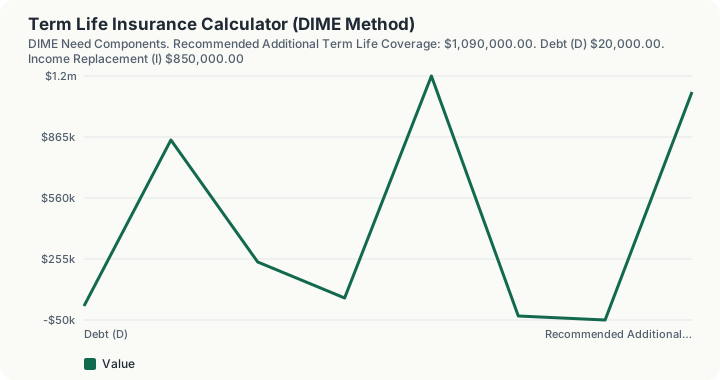
Quick Answer: A household earning $85,000 a year, with $20,000 in non-mortgage debt, a $240,000 mortgage balance, $60,000 in future education costs, $30,000 in liquid assets, and $50,000 of existing coverage needs approximately $1,090,000 in additional term life insurance under the DIME method.
Overview
The DIME method is one of the most widely cited frameworks for sizing a term life insurance policy, referenced in consumer education materials from the National Association of Insurance Commissioners (NAIC) and used by financial planners as a starting point before a full needs analysis. DIME stands for Debt, Income, Mortgage, Education: four buckets of financial obligation a family would otherwise have to cover out of savings, income, or a home sale if a primary earner died unexpectedly.
The appeal of DIME is that it is transparent. Unlike a rule of thumb such as "buy 10x your income," DIME forces you to itemize the actual obligations a death benefit would need to retire or fund, then nets out what you already have (liquid savings and any existing coverage, including employer group life insurance) to arrive at the additional coverage a new term policy should provide. It is a starting point for shopping term life quotes, not a substitute for a full underwriting-grade needs analysis from a licensed agent, which would also weigh survivor Social Security benefits, final expenses in more detail, and inflation-adjusted future costs.
This calculator computes the DIME total exactly as insurers and planners define it: sum the four components, then subtract existing liquid assets and in-force coverage. The result is the recommended additional term life coverage to shop for.
How This Is Calculated
The DIME method sums four components into a gross need, then nets out what a household already has available.
- Debt (D). Non-mortgage debt: credit cards, auto loans, personal loans, and estimated final expenses. The National Funeral Directors Association puts the median cost of a funeral with viewing and burial well into five figures once vault and marker costs are included, so most DIME worksheets fold a final-expense estimate into this line.
- Income (I). Gross annual income multiplied by the number of years dependents need that income replaced, typically until the youngest child is financially independent (commonly 10 to 20 years).
- Mortgage (M). The remaining principal balance on the primary mortgage, sized so survivors can pay off the home rather than carry a monthly payment on a single income.
- Education (E). Estimated total future education costs for all dependents, in today's dollars.
- Net out existing resources. Liquid assets (savings, brokerage, and retirement balances immediately available) and existing life insurance coverage (including employer group life) are subtracted from the gross need.
The result floors at zero: a household that is already over-insured relative to its DIME need shows no additional recommended coverage rather than a negative number.
Worked Example
Using the calculator's default inputs:
- Gross Annual Income: $85,000, replaced for 10 years
- Non-Mortgage Debt: $20,000
- Mortgage Balance: $240,000
- Future Education Costs: $60,000
- Existing Liquid Assets: $30,000
- Existing Life Insurance Coverage: $50,000
Step by step:
- Income replacement: $85,000 × 10 years = $850,000
- Gross DIME need: $20,000 (D) + $850,000 (I) + $240,000 (M) + $60,000 (E) = $1,170,000
- Subtract existing assets: $1,170,000 − $30,000 = $1,140,000
- Subtract existing coverage: $1,140,000 − $50,000 = $1,090,000
- Recommended additional term life coverage: $1,090,000
A household with this profile should shop for a term policy in the neighborhood of $1.09 million, on top of whatever coverage it already carries.
Why Term, Not Whole Life, for a DIME Need
DIME needs are almost always temporary: a mortgage gets paid off, children become financially independent, and the income-replacement window closes. Term life insurance, which provides a death benefit for a fixed period (10, 20, or 30 years) at a fraction of the premium of permanent coverage, is the standard tool for funding a temporary, quantifiable need like this one. Level-term policies that match the term length to the longest DIME component (often the income-replacement window or remaining mortgage term) are the most common structure financial planners recommend for this exact use case.
What This Does Not Account For
- Survivor Social Security benefits. A surviving spouse with dependent children may qualify for Social Security survivor benefits, which can offset part of the income-replacement component this calculator does not net out.
- Inflation on future costs. Education costs and the income-replacement figure are treated in today's dollars; a full needs analysis would inflate multi-decade projections.
- Two-income households. This calculator sizes coverage for one income earner at a time. A dual-income household should generally run this calculator once per earner, since both incomes typically need replacing.
- Underwriting factors. Actual premiums and even eligibility depend on age, health, tobacco use, and the insurer's underwriting class, none of which this calculator prices. This tool sizes coverage; it does not quote it.
- Tax treatment. Life insurance death benefits are generally income-tax-free to beneficiaries under current federal law, but this calculator does not model estate tax exposure for very large policies held outside a trust.
Common Pitfalls
- Forgetting final expenses in the debt line. Funeral and burial costs are a real, immediate cash need that DIME's "D" component is meant to cover alongside credit cards and auto loans.
- Using too short an income-replacement window. Ten years is a common default, but a family with a newborn may need 18-20 years of replacement to reach the youngest child's financial independence.
- Double-counting a paid-off mortgage. If the mortgage is already paid off, the M component should be zero, not the original loan amount.
- Ignoring employer group life insurance in "existing coverage." Group life is usually 1-2x salary and often does not port if you leave the job, but it still counts as existing coverage today and should be netted out.
- Treating the DIME number as fixed for life. A DIME need should be recalculated after major life events: a new mortgage, a new child, paying off debt, or a significant change in income.
Frequently Asked Questions
Is the DIME method more accurate than a simple "10x income" rule?
Does DIME account for my spouse's income?
Should I include my mortgage if I plan to sell the house after a death?
What term length should I buy for this coverage amount?
How often should I recalculate my DIME need?
Sources
- National Association of Insurance Commissioners (NAIC): Life Insurance consumer guidance, needs-analysis frameworks including the DIME method. content.naic.org
- Social Security Administration: Survivor benefits eligibility for dependents. ssa.gov
- Social Security Administration, Office of the Chief Actuary, Actuarial Life Table. ssa.gov/oact/STATS/table4c6.html
Also consulted: National Funeral Directors Association: Median cost of funeral and burial services; Insurance Information Institute (III): Term vs. permanent life insurance guidance.