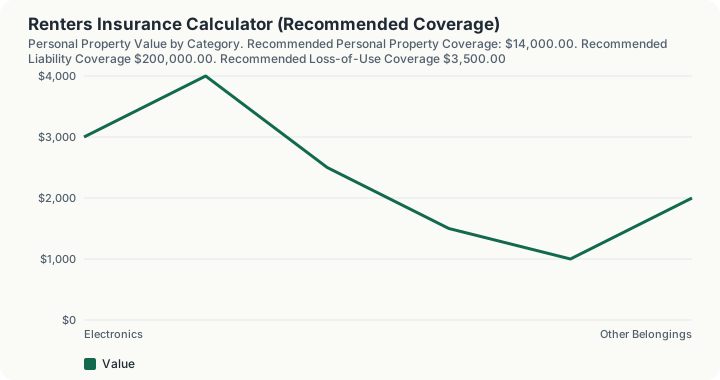
Quick Answer: With a $14,000 itemized personal property inventory, an elevated liability risk profile, and 25% loss-of-use coverage, the recommended policy carries $14,000 in personal property coverage, $200,000 in liability coverage, and $3,500 in loss-of-use coverage, for $17,500 in total recommended property-side coverage.
Overview
Renters insurance protects what a landlord's own property policy does not: your personal belongings, your liability exposure if someone is injured in your home or you damage someone else's property, and your temporary living costs if the rental unit becomes uninhabitable. It is inexpensive relative to the protection it provides, the Insurance Information Institute (III) has long noted that renters insurance premiums run a small fraction of homeowners insurance premiums, yet a large share of renters remain uninsured, often because they underestimate the value of what they own or assume a landlord's policy covers their belongings (it does not; a landlord's policy covers the building, not your possessions).
Recommended coverage breaks into three distinct components, each following different standard industry guidance:
- Personal property coverage replaces your belongings if they are stolen, destroyed by fire, or damaged by another covered peril. It is sized from an itemized inventory of what you actually own.
- Liability coverage pays legal and medical costs if you are found responsible for someone else's injury or property damage. III cites a commonly discussed range of $100,000 to $300,000, with the right point in that range depending on your assets and risk factors.
- Loss-of-use coverage (also called additional living expense coverage) reimburses temporary housing, meals, and related costs if you cannot live in your rental while it is repaired after a covered loss. III commonly cites 20%-30% of your personal property coverage as a planning range for this component.
How This Is Calculated
Personal property coverage is the sum of an itemized inventory across common categories:
Liability coverage is selected from three standard tiers within III's commonly discussed $100,000-$300,000 range, based on a simple risk profile you select (more assets to protect, or risk factors like dog ownership, a home business, or frequently hosting guests, argue for a higher tier):
| Risk Profile | Recommended Liability Coverage |
|---|---|
| Standard | $100,000 |
| Elevated | $200,000 |
| High | $300,000 |
Loss-of-use coverage is a percentage of personal property coverage, clamped to III's commonly cited 20%-30% range:
Liability coverage is a separate policy limit, purchased alongside personal property and loss-of-use coverage rather than combined into a single number, so it is not added into the total above.
Worked Example
Using the calculator's default inputs:
- Electronics: $3,000
- Furniture: $4,000
- Clothing & Personal Items: $2,500
- Appliances: $1,500
- Jewelry & Valuables: $1,000
- Other Belongings: $2,000
- Liability Risk Profile: Elevated
- Loss-of-Use Percentage: 25%
- Personal property coverage: $3,000 + $4,000 + $2,500 + $1,500 + $1,000 + $2,000 = $14,000
- Recommended liability coverage (elevated tier): $200,000
- Loss-of-use range: 20% of $14,000 = $2,800 (floor); 30% of $14,000 = $4,200 (ceiling)
- Recommended loss-of-use at 25%: $14,000 × 0.25 = $3,500
- Total recommended coverage: $14,000 + $3,500 = $17,500 (plus $200,000 in separate liability coverage)
Building an Accurate Inventory
The single biggest driver of an accurate personal property number is an honest, complete inventory, not a guess. A few practices that materially improve accuracy:
- Walk through room by room. Most people underestimate total belongings value by lumping "stuff" into one mental bucket instead of counting closets, kitchen drawers, and storage areas.
- Keep receipts and photos. In an actual claim, insurers want documentation. A phone photo of each room, plus receipts for larger purchases, speeds up claims processing considerably.
- Check single-item sublimits. Standard policies commonly cap categories like jewelry (often around $1,500), so if the jewelry inventory in this calculator materially exceeds a typical sublimit, a scheduled personal property rider is usually the right move rather than assuming the base policy covers full value.
- Update annually. New purchases, gifts, and replaced electronics change the number every year; an inventory done once at move-in goes stale quickly.
What This Does Not Account For
- Replacement cost vs. actual cash value. This calculator estimates the coverage amount you should carry, not which valuation method (replacement cost, which pays to buy new items, or actual cash value, which depreciates for age and wear) your specific policy uses. Replacement cost policies cost more but pay out meaningfully more for older items.
- Category sublimits. As noted above, jewelry, firearms, art, and collectibles are commonly subject to per-category dollar caps regardless of your total personal property coverage; this calculator does not model individual policy sublimit language.
- Named perils vs. open perils. Most renters policies cover a defined list of named perils (fire, theft, certain water damage, etc.) rather than all possible causes of loss; flood and earthquake damage typically require separate policies entirely.
- Deductible selection. This calculator estimates coverage amounts, not the premium impact of choosing a higher or lower deductible.
- State-specific liability norms. The $100,000-$300,000 liability range is general III guidance; some states, HOAs, or landlords set minimum liability requirements in the lease itself that should take priority over this calculator's estimate.
Common Pitfalls
- Assuming the landlord's insurance covers your belongings. A landlord's policy covers the building structure, not a tenant's personal property or liability. Nearly all renters insurance claims are filed against the tenant's own policy, not the landlord's.
- Underinsuring electronics and furniture. These two categories are consistently the most underestimated in self-reported inventories, since people tend to remember big-ticket items but forget the cumulative value of cables, small appliances, and everyday furniture.
- Ignoring the liability side entirely. Renters often focus exclusively on replacing belongings and skip the liability conversation, even though a liability judgment (a dog bite, a guest's slip-and-fall) can exceed the value of everything a renter owns.
- Not scheduling high-value items. Jewelry, musical instruments, and collectibles that exceed standard sublimits need a scheduled rider; without one, a claim on a $5,000 ring may only pay the policy's standard jewelry sublimit.
- Letting the policy go stale. An inventory and coverage amount set at move-in rarely matches what a renter owns two or three years later.
Frequently Asked Questions
Does renters insurance cover roommates?
Why is the liability range so wide ($100,000 to $300,000)?
Is 20%-30% loss-of-use coverage usually enough?
How much does renters insurance typically cost?
Does this calculator replace talking to an insurance agent?
Sources
- National Association of Insurance Commissioners, the standard-setting body of U.S. state insurance regulators. content.naic.org
Also consulted: Insurance Information Institute (III): Renters insurance consumer guidance on personal property, liability, and additional-living-expense coverage; Insurance Information Institute (III): Facts + Statistics on renters insurance ownership and typical premium levels.