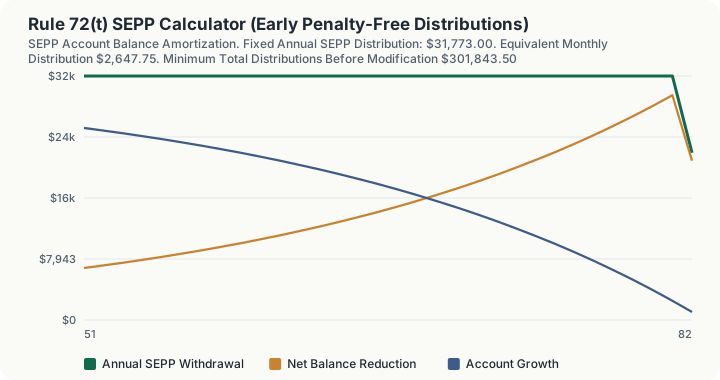
Quick Answer: Rule 72(t) lets you withdraw from an IRA or 401(k) before age 59½ without the 10% early withdrawal penalty by committing to a series of Substantially Equal Periodic Payments (SEPP), and this calculator computes your fixed annual payment under the Fixed Amortization method.
Overview
Withdrawals from a traditional IRA or 401(k) before age 59½ normally trigger a 10% early withdrawal penalty on top of ordinary income tax. Internal Revenue Code Section 72(t)(2)(A)(iv) carves out an exception: if you take a series of Substantially Equal Periodic Payments, calculated under IRS-approved methods and continued without modification for a minimum period, the 10% penalty does not apply. This is commonly called a 72(t) plan or a SEPP plan.
The IRS formalized how to calculate a compliant SEPP in Revenue Ruling 2002-62, later modified by Notice 2022-6 (effective for any SEPP series beginning on or after January 1, 2023). Both documents describe the same three permitted calculation methods:
- Required Minimum Distribution (RMD) method. The account balance is divided by a life expectancy factor each year, and both the balance and the payment are recalculated annually. This produces the smallest and most variable payment of the three methods.
- Fixed Amortization method. The account balance is amortized in level annual payments over a life expectancy factor, using a fixed interest rate chosen at the start of the plan. The payment is calculated once and then stays fixed for the life of the plan. This calculator implements this method.
- Fixed Annuitization method. The annual payment is determined using an annuity factor derived from a mortality table and the chosen interest rate, producing a payment amount similar to the amortization method but calculated differently.
Once you choose the Fixed Amortization or Fixed Annuitization method, the IRS allows a one-time, penalty-free switch to the RMD method later in the plan if the fixed payment becomes larger than desired. There is no other permitted way to change the payment amount without breaking the plan.
How This Is Calculated
The Fixed Amortization method treats your account balance exactly like a loan being paid down: the "loan" is your IRA balance, the "payments" are what you withdraw, and the "interest rate" is a rate the IRS lets you choose within limits. The formula is the standard level-payment annuity equation:
`
Annual Payment = Balance × i / [1 − (1 + i)⁻ⁿ]
`
where i is the chosen interest rate and n is your life expectancy factor in years, drawn from an IRS-published mortality table. This calculator solves that equation using the platform's PMT solver, the same present-value annuity math used for loan payments, run against your account balance instead of a loan principal.
Two inputs the IRS constrains directly:
- The life expectancy factor. The IRS permits the Single Life Table, the Uniform Lifetime Table, or the Joint and Last Survivor Table from Notice 2022-6, depending on your situation. This calculator approximates that factor using Social Security Administration period life table data, which tracks closely with the IRS mortality tables but is not a substitute for the official published tables. Confirm the exact factor for your filing situation with a tax professional or the IRS tables directly before finalizing a real plan.
- The interest rate. Under Notice 2022-6, the maximum permitted rate is the greater of 5% or 120% of the federal mid-term rate (the Applicable Federal Rate, or AFR) published for either of the two months immediately preceding the month your SEPP plan begins. The calculator lets you set a rate up to 6% and flags this constraint in the input's help text; before locking in a real plan, verify the actual permitted maximum for your start month against the IRS's published AFR tables.
The calculator also computes your minimum required plan duration: SEPP payments must continue, without modification, for the longer of five years or until you reach age 59½. Stopping, changing, or otherwise "busting" the plan before that point retroactively disqualifies every distribution you have already taken, triggering the 10% penalty on all of them plus IRS interest charges back to each distribution date.
Worked Example
Consider a 50-year-old with a $500,000 IRA balance, using the unisex life expectancy table and the current interest rate floor of 5.0%.
- Life expectancy factor at age 50: 31.68 years
- Fixed annual SEPP payment: $500,000 × 0.05 / [1 − 1.05⁻³¹·⁶⁸] = $31,773.00
- Equivalent monthly payment (if the custodian pays monthly): $31,773.00 ÷ 12 = $2,647.75
- Minimum required plan duration: 59.5 − 50 = 9.5 years, which exceeds the 5-year floor, so 9.5 years governs
- Minimum total distributions before the plan can be modified: $31,773.00 × 9.5 = $301,843.50
- Effective annual withdrawal rate: $31,773.00 ÷ $500,000 = 6.35%
That $31,773.00 payment is fixed. It does not change from year to year even as the account balance grows or shrinks with market performance, which is the core tradeoff of the Fixed Amortization method compared to the RMD method.
The Balance While the Payment Stands Still
The payment above is the only number in this plan that cannot move. Under the Fixed Amortization method the annual distribution is set once and repeated, so the whole story of the plan is what happens to the balance underneath it.
Step 1 -- Age 51, the first distribution year. Account growth at 5% is $25,000.00, the withdrawal is $31,773.00, so the balance falls to $493,227.00
Step 2 -- Age 52. Growth of $24,661.35 against the same $31,773.00 withdrawal leaves $486,115.35
Step 3 -- Distributions taken after two years. $31,773.00 + $31,773.00 = $63,546.00
Step 4 -- Age 59, the last year before the plan can be modified. Nine distributions have been taken, totalling $285,957.00, and the balance is $425,317.08
Step 5 -- Growth credited over those nine years. Cumulative account growth reaches $211,274.08
Nine years of withdrawals have removed $285,957.00 from a $500,000 account and left $425,317.08 in it, because growth replaced roughly three quarters of what was taken. That is the arithmetic behind the commitment: the plan is not sized to preserve the balance, and it is not sized to exhaust it quickly either, but the payment is identical in year nine and year one whatever the balance has done in between. Reducing it, skipping it, or taking anything extra before age 59.5 busts the exception and pulls the 10% penalty back onto every distribution above.
What This Does Not Account For
- Ordinary income tax. A 72(t) plan only avoids the 10% early withdrawal penalty. Every distribution remains fully taxable as ordinary income in the year received, exactly like any other traditional IRA or 401(k) withdrawal.
- The exact IRS life expectancy table for your situation. This calculator uses SSA period life data as an approximation. The official calculation must use the Single Life, Uniform Lifetime, or Joint and Last Survivor Table specified in Notice 2022-6.
- The exact permitted interest rate for your specific start month. The 120% AFR figure changes monthly. Confirm the actual ceiling before locking in a plan.
- State income tax treatment, which varies and is not modeled here.
- 401(k) plan-specific restrictions. Many employer 401(k) plans do not permit in-service SEPP withdrawals at all; 72(t) plans are most commonly run through IRAs, sometimes after rolling over a 401(k) balance first.
- The one-time switch to the RMD method and its effect on future payment amounts, which this calculator does not model.
Common Pitfalls
- Modifying the plan early. Any change to the payment amount, schedule, or account balance (beyond ordinary investment gains and losses) before satisfying the minimum duration retroactively disqualifies the entire plan, with penalties and interest applied to every prior distribution.
- Taking an extra withdrawal "just this once." Even a single additional distribution outside the SEPP schedule is treated by the IRS as a modification of the entire plan.
- Rolling additional money into the SEPP account after the plan starts, or transferring money out. Both are treated as prohibited modifications.
- Assuming the payment is optional to skip in a bad year. Missing a scheduled payment is also a modification, unlike a true RMD, which has more flexibility in later years.
- Confusing "penalty-free" with "tax-free." SEPP distributions still generate a tax bill; they simply avoid the additional 10% early-withdrawal surtax.
- Using the wrong life expectancy table or an outdated interest rate ceiling, which produces a payment amount the IRS may later deem non-compliant.
Frequently Asked Questions
What happens if I break a 72(t) plan early?
Can I change which of the three methods I use?
Does the payment amount change every year?
How long must a 72(t) plan run?
Where does the interest rate ceiling come from?
Sources
- Internal Revenue Code Section 72(t)(2)(A)(iv), Substantially Equal Periodic Payments exception to the early distribution tax. law.cornell.edu/uscode/text/26/72
- IRS Notice 2022-6, "Substantially Equal Periodic Payments," modifying the interest rate and methodology guidance for SEPP plans beginning on or after January 1, 2023. irs.gov
- Social Security Administration Period Life Table, used as the life expectancy data source in this calculator's approximation. ssa.gov
Also consulted: IRS Revenue Ruling 2002-62, the original guidance establishing the RMD, Fixed Amortization, and Fixed Annuitization methods.