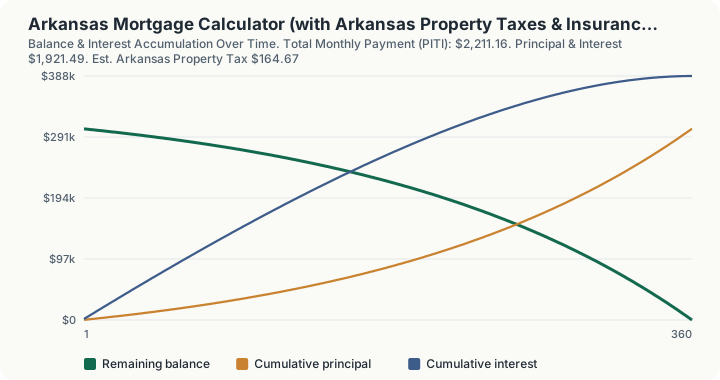
Quick Answer: A $380,000 Arkansas home with 20% down, a 30-year fixed loan at 6.5% APR, this calculator's 0.52% property tax assumption, and a $125/month insurance estimate produces a total monthly payment (PITI) of $2,211.16.
Three Inputs, Three Constants
Only price, down payment percentage and APR are yours. The rest of the model is fixed in code: the amortization runs over exactly 360 periods with no term selector and no extra-payment field, the property tax rate is a hardcoded 0.52% in this calculator's own configuration rather than a figure read from a state rate table, and homeowners insurance is a flat $125 a month at every price and in every county.
On the defaults that produces a $304,000.00 loan principal, $1,921.49 of monthly principal and interest, $164.67 of monthly property tax, $125.00 of insurance, a PITI of $2,211.16, and $387,732.82 of interest across the full 360 payments.
Arkansas's actual tax mechanism is different in kind. Constitutional Amendment 79 assesses property at 20% of appraised value, caps annual homestead assessment growth, and grants a flat-dollar Homestead Property Tax Credit applied after millage. The engine reproduces none of those three steps: it multiplies the purchase price by 0.52% and divides by twelve.
How This Is Calculated
- Down payment and loan principal. Loan Principal = Home Price x (1 - Down Payment %). At the defaults, $380,000 x 80% = $304,000.
- Principal and interest. The principal amortizes over exactly 360 periods at the monthly rate (APR / 12):
The 360 is fixed in the call and the extra-payment parameter is passed as zero.
- Property tax estimate. Monthly Property Tax = Home Price x 0.52% / 12, applied to the purchase price. The 0.52% is a constant in this configuration; no assessed value is derived and no millage is looked up.
- Insurance estimate. A flat $125.00 a month, independent of price and coverage.
- PITI total. Monthly PITI = Principal & Interest + Property Tax + $125.00. No mortgage insurance term is added at any loan-to-value.
Worked Example
Baseline inputs:
- Home Purchase Price: $380,000
- Down Payment: 20% ($76,000)
- Interest Rate (APR): 6.5%
Step by step: - Loan principal: $380,000 x 80% = $304,000.00 - Monthly principal & interest: $1,921.49 - Monthly property tax: $164.67 - Monthly insurance estimate: $125.00 - Total monthly payment (PITI): $2,211.16 - Total interest over 360 payments: $387,732.82
Walking the Down Payment, With the PMI Line Absent
Each run below is a separate calculation at $380,000 and 6.5%.
0% down. Principal $380,000.00, P&I $2,401.86, PITI $2,691.53, lifetime interest $484,667.97.
3.5% down. Principal $366,700.00, P&I $2,317.79, PITI $2,607.46.
5% down. Principal $361,000.00, P&I $2,281.77, PITI $2,571.44, lifetime interest $460,432.24.
10% down. Principal $342,000.00, P&I $2,161.67, PITI $2,451.34.
20% down. Principal $304,000.00, P&I $1,921.49, PITI $2,211.16.
25% down. Principal $285,000.00, P&I $1,801.39, PITI $2,091.06.
The $2,571.44 at 5% down is the number to distrust. A 95% loan-to-value conventional loan carries private mortgage insurance and an FHA loan at 3.5% down carries both an upfront and an annual mortgage insurance premium, and this calculator adds neither: the 5% row contains the identical three components as the 25% row. Within the model, going from 20% down to 5% costs $360.28 a month and going to nothing down costs $480.37 a month, and a real borrower's figures are higher than both by the whole insurance premium.
What an Eighth of a Point Buys
Rate moves in 0.125% steps in this input. At $380,000 with 20% down:
6.375% APR. P&I $1,896.56, PITI $2,186.23, lifetime interest $378,763.14.
6.5% APR. P&I $1,921.49, PITI $2,211.16, lifetime interest $387,732.82.
6.625% APR. P&I $1,946.55, PITI $2,236.22, lifetime interest $396,756.31.
One eighth of a point costs $25.06 a month and $9,021.08 of interest over the 360 payments. A full point from 6.5% to 7.5% takes P&I to $2,125.61 and PITI to $2,415.28, with lifetime interest reaching $461,220.45. In the other direction, 5.5% returns P&I of $1,726.08, PITI of $2,015.75, and $317,388.26 of lifetime interest, which is $70,346.97 less interest than the default run for one point of rate.
Working Backwards From a Payment Ceiling
Holding 20% down and 6.5% APR: a $340,000 purchase returns PITI of $1,991.56 and a $380,000 purchase returns $2,211.16, so a $2,000 monthly ceiling is crossed just above $340,000. $300,000 returns $1,771.96. A buyer with $2,450 of room reaches $420,000, which returns $2,430.75. At $500,000 the figure is $2,869.94 and at $750,000 it is $4,242.41.
Naming the Payment Correctly, and What the Mistake Costs
A lender quoting the loan alone reports $1,921.49. The housing payment this calculator models is $2,211.16. The difference is $289.67 a month, or $3,476.04 a year, and it is entirely the escrow items: the tax component plus the insurance placeholder. Budgeting against the smaller figure understates a year of housing cost by more than a month's payment.
The gap widens with price, because the tax component scales while P&I depends only on the financed amount. At $750,000 the P&I is $3,792.41 against PITI of $4,242.41.
The Insurance Constant, Verified
Running the calculator at two prices confirms the flat treatment. At $300,000 the modelled tax is $130.00 a month and insurance is $125.00. At $750,000 the tax is $325.00 and insurance is still $125.00. Arkansas carries real tornado, hail and flood exposure, and $125 a month is not a plausible premium on a $750,000 home, so the $4,242.41 PITI at that price is understated by whatever the true premium exceeds the placeholder.
What This Does Not Account For
- Private mortgage insurance and FHA premiums. Not modelled at any loan-to-value, so the 0%, 3.5% and 5% down figures above are all understated.
- The flat $125 insurance placeholder. Identical at $300,000 and at $750,000, as shown above.
- The fixed 360-month term. No 15-year, 20-year or adjustable option, and the extra-payment parameter is passed as zero, so prepayment cannot be modelled.
- Amendment 79's 20% assessment ratio and 5% homestead growth cap. Neither is performed; 0.52% is applied to the purchase price directly.
- The Homestead Property Tax Credit. A flat annual credit against the finished bill in Arkansas practice. This engine has no credit step, so owner-occupant bills are often lower than modelled.
- County and school district millage. Arkansas has 75 counties and hundreds of districts; none is looked up.
- HOA dues, closing costs, points and escrow reserves. None is part of the PITI figure.
Common Pitfalls
- Budgeting the $1,921.49 P&I figure. The modelled payment is $2,211.16, $289.67 a month higher.
- Trusting the low-down-payment rows. $2,571.44 at 5% down contains no mortgage insurance.
- Expecting insurance to scale. It stays at $125.00 from $300,000 to $750,000.
- Reading 0.52% as a millage rate. It is a hardcoded configuration constant applied to the purchase price, not an assessed-value calculation.
- Comparing this to a 15-year quote. Every figure here is 360 payments; no shorter term exists in the code.
Frequently Asked Questions
Why does this calculator use 0.52% instead of my county's millage rate?
Is the Homestead Property Tax Credit reflected?
Is PMI included?
What does an eighth of a point cost?
Can I model extra payments or a 15-year term?
Sources
- Consumer Financial Protection Bureau (CFPB): mortgage disclosure and PMI requirements under Regulation Z. ecfr.gov/current/title-12/chapter-X/part-1026
- Arkansas Department of Finance and Administration, the official state tax authority for Arkansas rates, rules and forms. dfa.arkansas.gov
Also consulted: Arkansas Assessment Coordination Division: Amendment 79 assessed value and Homestead Tax Credit guidance, cited as background only; Arkansas county assessor offices: parcel-level assessed value and millage lookups; Arkansas Insurance Department: homeowners insurance market data.