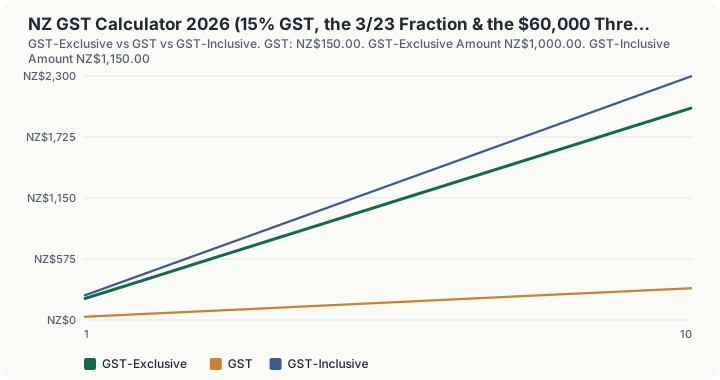
Quick Answer: On a GST-inclusive amount of $1,150, the GST content is $150.00, leaving a GST-exclusive amount of $1,000.00. GST is 15% of the exclusive figure but only 13.04% of the inclusive figure, because the extraction fraction is 15/115 = 3/23. Subtracting 15% from $1,150 instead would give $977.50, understating the exclusive amount by $22.50.
What does this calculator do?
New Zealand's Goods and Services Tax is a broad-based consumption tax charged at a single rate of 15%. There are almost no reduced rates and very few exemptions, which makes the rate itself easy. What is not easy is direction. Every GST question is really the question of which way you are travelling: are you starting from a figure that already contains GST, or from one that does not?
That distinction is where most New Zealand GST errors are made. A supplier quotes $1,000 plus GST and issues an invoice for $1,150. A bookkeeper looking only at the $1,150 needs to split it back into $1,000 of income and $150 of GST payable to Inland Revenue. Taking 15% off $1,150 does not do this. It gives $977.50, which is wrong by $22.50, and it is wrong in the same direction on every single transaction, so the error compounds silently across a return period.
This calculator does two separate jobs. It converts in either direction between GST-exclusive and GST-inclusive amounts, and it quantifies exactly how far the naive 15% deduction is wrong on your own figure. Alongside that, it applies the compulsory registration test: a rolling 12-month test, looking both backwards and forwards, against a $60,000 threshold.
How is this calculated?
The engine holds one GST rate, 15%, and derives the extraction fraction from it rather than hard-coding 3/23:
GST fraction = r/(1 + r) = 0.15/1.15 = 3/23 ≈ 13.04%
When the direction is add, the amount you entered is treated as GST-exclusive:
GST = net × r; gross = net + GST
When the direction is remove (the default), the amount you entered is treated as GST-inclusive:
GST = gross × r/(1 + r); net = gross − GST
With the defaults, direction is "remove" and the amount is $1,150.
Step 1: Take the GST-inclusive amount you entered. Gross = $1,150.00
Step 2: Apply the GST fraction to it. $1,150.00 x 0.15 / 1.15 = $150.00
Step 3: Subtract the GST to get the GST-exclusive amount. $1,150.00 - $150.00 = $1,000.00
Step 4: Express the GST as a percentage of the GST-inclusive figure. 0.15 / 1.15 x 100 = 13.04%
Step 5: Compute the wrong answer, the one you get by deducting 15% of the gross. $1,150.00 - ($1,150.00 x 0.15) = $977.50
Step 6: Measure the size of that error against the correct GST-exclusive figure. $1,000.00 - $977.50 = $22.50
Steps 5 and 6 run in both directions, so the error is quantified rather than merely described, even when you are adding GST rather than removing it.
The registration test is separate arithmetic on separate inputs. The engine compares each of your two turnover figures against the threshold independently, and either one reaching it is enough:
Step 7: Test the backward-looking limb. $45,000 turnover in the last 12 months, against a $60,000 threshold: not met
Step 8: Test the forward-looking limb. $62,000 expected in the next 12 months, against a $60,000 threshold: met
Step 9: Combine the limbs. Either limb alone triggers liability, so the status is Registration is compulsory
Step 10: Compute headroom from the higher of the two turnover figures. $60,000 - max($45,000, $62,000) = negative, floored at $0
The results table then walks a ladder of GST-exclusive amounts running from one fifth of your own figure up to twice it, in fifths, adding GST to each, so the 15% and 13.04% relationship can be read off at several transaction sizes at once.
Worked Example
A contractor issues an invoice for $2,300 including GST and needs to know what to book as income.
Step 1: Identify the direction. The $2,300 already includes GST, so this is a remove calculation.
Step 2: Apply the GST fraction. $2,300.00 x 3 / 23 = $300.00
Step 3: Derive the GST-exclusive income. $2,300.00 - $300.00 = $2,000.00
Step 4: Check the arithmetic the other way. $2,000.00 x 0.15 = $300.00, confirming the split.
Step 5: See what the naive deduction would have produced. $2,300.00 x 0.15 = $345.00 of supposed GST
Step 6: Measure the overstatement. $345.00 - $300.00 = $45.00 of GST that was never charged
That $45 would have been paid to Inland Revenue out of the contractor's own pocket, and the recorded income would have been understated by the same $45 on this invoice alone.
What does this calculator not account for?
- The GST rate is fixed at 15% in the engine's default. Zero-rated supplies (exports, going-concern sales of a business, certain land transactions between registered persons) and exempt supplies (residential rent, most financial services, donated goods sold by non-profits) carry no GST at all. This page will happily apply 15% to an amount that should have carried none; deciding whether a supply is standard-rated, zero-rated or exempt is a judgement this calculator does not make.
- Registration status is not the same as a GST return. The registration test here uses only the two turnover figures you supply. It does not compute GST payable or refundable for a period, which requires output tax on sales less input tax on purchases, and depends on your accounting basis (payments, invoice or hybrid) and your filing frequency.
- The turnover figures are yours, not verified. The forward-looking limb bites on expectation, and the engine takes your expectation at face value. In practice Inland Revenue tests whether the expectation was reasonable at the time.
- Turnover is not the same as taxable activity turnover. The threshold is measured on the value of supplies from a taxable activity, which excludes some receipts (for example the sale of a capital asset in some circumstances). The engine does not filter what you enter.
- The 3/23 fraction is exact only at 15%. If the rate ever changed, the fraction would change with it. The engine derives the fraction from the rate, so it stays internally consistent, but the 3/23 shorthand quoted throughout this page is specific to a 15% rate.
- No de-registration, special supply or apportionment rules are applied. Mixed private and business use, second-hand goods input credits, and the rules on ceasing to be registered are all outside this calculation.
What mistakes do people make with this?
Deducting 15% instead of applying the fraction. This is the error the calculator is built around. On $1,150 it costs $22.50; on $115,000 it costs $2,250. It is always in the same direction, so it never averages out.
Treating the threshold as a financial-year test. It is a rolling 12-month test. A quiet April and a busy November can put you over the line in a month that has nothing to do with your balance date.
Waiting until you have actually earned $60,000. The forward-looking limb is triggered by expectation. If you sign a contract in July that you expect will take you to $60,000 within 12 months, the liability arises then, not when the money lands.
Assuming that being under the threshold means you cannot register. Voluntary registration is available below $60,000, and for a business with heavy GST-bearing costs and zero-rated or business-to-business sales it can be worth doing.
Quoting "plus GST" and invoicing the same number. If your quote is $1,000 plus GST, your invoice is $1,150. Issuing it as $1,000 including GST costs you $130.43 of income, not $150.
Frequently Asked Questions
Why is GST 13.04% of an invoice total rather than 15%?
How do I take GST off a price in New Zealand?
When do I have to register for GST in New Zealand?
Can I register for GST voluntarily below $60,000?
What is the difference between $1,000 plus GST and $1,000 including GST?
Does the 15% rate apply to everything?
Sources
- Inland Revenue, GST (goods and services tax): ird.govt.nz/gst, "GST is charged at a rate of 15%."
- Inland Revenue, Registering for GST: ird.govt.nz/gst/registering-for-gst, registration is compulsory where "your turnover was at least $60,000 in the last 12 months, or you expect it will be at least $60,000 in the next 12 months".
Also consulted: Inland Revenue guide IR409, Fringe benefit tax guide (April 2026 edition), page 55, states the GST fraction verbatim as "Value x 3 / 23 = GST payable"; Goods and Services Tax Act 1985, section 51 (compulsory registration).
All figures read from Inland Revenue on 2026-08-30 and current for the 2026-27 New Zealand tax year (1 April 2026 to 31 March 2027).