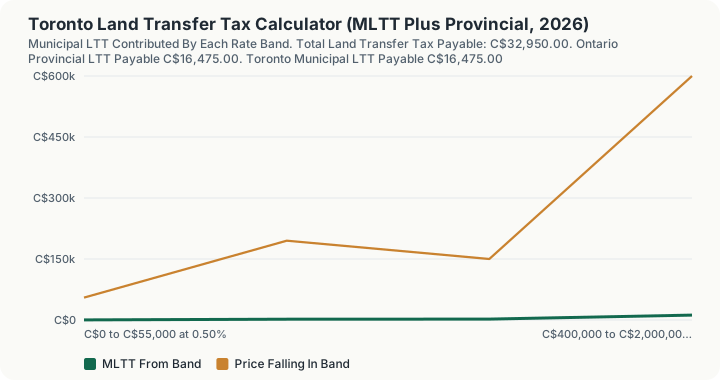
Quick Answer: A C$1,000,000 house in Toronto attracts C$32,950.00 of land transfer tax: C$16,475.00 to Ontario and another C$16,475.00 to the City. A qualifying first-time purchaser claims two separate reliefs, C$4,000 and C$4,475, bringing it to C$24,475.00. From 1 April 2026 the City's rates above C$3,000,000 rose to 4.40%, 5.45%, 6.50%, 7.55% and 8.60%, which adds C$18,500 to a C$5,000,000 purchase.
What does this calculator do?
Toronto is the only municipality in Ontario that levies its own land transfer tax. A purchase inside the city is taxed twice on the same price: once by the province under the Land Transfer Tax Act, and once by the City under Chapter 760 of the Toronto Municipal Code. The two bills are calculated separately, claimed separately and both due in cash on closing.
Below C$2,000,000 the two schedules are identical, so the simplest way to think about an ordinary Toronto purchase is that the provincial figure is doubled.
Above C$3,000,000 they diverge sharply. The province stays at a flat 2.5% marginal rate no matter how expensive the property. The City runs a graduated ladder that reaches 8.60%. Those graduated tiers were introduced on 1 January 2024 at 3.5% through 7.5%, and City Council raised them on 17 December 2025, with the higher rates taking effect for transactions on or after 1 April 2026.
As with the provincial tax there are two schedules, and only land containing one or two single family residences reaches the graduated tiers. Commercial, industrial, multi-residential and vacant land stops at 2.0% in both taxes.
How is this calculated?
- Compute the Ontario provincial tax first. It is the marginal tier calculation described on the Ontario page: 0.5%, 1.0%, 1.5%, 2.0% and, on the single family schedule only, 2.5% above C$2,000,000.
- Compute the municipal tax on the same price, using the City's own schedule. Below C$3,000,000 it matches the provincial single family schedule exactly. Above it, the graduated tiers in force from 1 April 2026 apply.
4.40% over 3M, 5.45% over 4M, 6.50% over 5M, 7.55% over 10M, 8.60% over 20M
Every tier is marginal. Chapter 760 is explicit about this, charging each rate on "the value of the consideration which exceeds" one figure "up to and including" the next.
MLTT_gross = ∑_i rateᵢ × (min(Price, ceilingᵢ) − floorᵢ)⁺
- Apply each relief to its own tax. The provincial refund is capped at C$4,000, the City's rebate at C$4,475. Neither can exceed the tax it is claimed against, and a qualifying first-time purchaser can therefore recover up to C$8,475 in total. Neither is offered on the other-land schedule.
Relief_total = min(LTT, 4000) + min(MLTT, 4475)
- Apply the City's minimum tax rule to the municipal tax. Chapter 760 provides that no municipal tax is payable where the amount payable after refunds and rebates is less than C$72. The test is applied after the rebate, so it can zero out a small residual municipal bill entirely.
MLTT_payable = 0, if 0 < MLTT_net < 72; MLTT_net, otherwise
- Add the two payable amounts, and price the April 2026 change. The calculator also runs the municipal tax a second time through the 1 January 2024 tiers and reports the difference, so the effect of the amendment is visible rather than assumed.
Total = LTT_net + MLTT_payable
Worked Example
A repeat buyer purchases a house in Toronto for C$1,000,000.
Step 1 - The shared bands up to C$400,000. C$55,000 x 0.5% = C$275.00, plus C$195,000 x 1.0% = C$1,950.00, plus C$150,000 x 1.5% = C$2,250.00, giving C$4,475.00
Step 2 - The 2.0% band. C$1,000,000 - C$400,000 = C$600,000, at 2.0% = C$12,000.00
Step 3 - The provincial tax. C$4,475.00 + C$12,000.00 = C$16,475.00
Step 4 - The municipal tax. The City's schedule is identical at this price, so it is C$16,475.00 again
Step 5 - The total. C$16,475.00 + C$16,475.00 = C$32,950.00, an effective 3.295% of the purchase price
Now make the buyer a qualifying first-time purchaser.
Step 6 - The provincial refund. C$16,475.00 - C$4,000.00 = C$12,475.00
Step 7 - The municipal rebate. C$16,475.00 - C$4,475.00 = C$12,000.00
Step 8 - Total relief and total payable. C$4,000.00 + C$4,475.00 = C$8,475.00 of relief, leaving C$24,475.00 payable
Now the graduated tiers, on a C$5,000,000 house.
Step 9 - The stack up to C$3,000,000. C$4,475.00 through C$400,000, plus C$1,600,000 at 2.0% = C$32,000.00, plus C$1,000,000 at 2.5% = C$25,000.00, giving C$61,475.00
Step 10 - The 4.40% tier. C$1,000,000 x 4.40% = C$44,000.00
Step 11 - The 5.45% tier. C$1,000,000 x 5.45% = C$54,500.00
Step 12 - The municipal tax. C$61,475.00 + C$44,000.00 + C$54,500.00 = C$159,975.00
Step 13 - The provincial tax on the same house. C$36,475.00 through C$2,000,000, plus C$3,000,000 at 2.5% = C$75,000.00, giving C$111,475.00
Step 14 - The combined bill. C$159,975.00 + C$111,475.00 = C$271,450.00, an effective 5.429%
Step 15 - What the 1 April 2026 amendment cost. Under the old 3.5% and 4.5% tiers the municipal tax would have been C$61,475.00 + C$35,000.00 + C$45,000.00 = C$141,475.00. The increase is C$18,500.00
Where The Two Taxes Diverge, Priced
Below C$2,000,000 the municipal tax simply doubles the provincial one. At C$650,000 each is C$9,475.00 and the total is C$18,950.00. At C$1,500,000 each is C$26,475.00 and the total is C$52,950.00. The combined effective rate creeps from 2.915% to 3.530% across that range.
The graduated tiers are marginal, and the difference is large. If the 4.40% rate applied to the whole of a C$3,500,000 price the municipal tax would be C$154,000. Marginally it is C$61,475.00 plus C$500,000 at 4.40%, which is C$83,475.00. Reading the table as a flat rate overstates the tax by C$70,525 on one purchase.
Crossing C$3,000,000 costs 4.4 cents, not a re-rating. At exactly C$3,000,000 the municipal tax is C$61,475.00. At C$3,000,001 it is C$61,475.04. There is no cliff at the threshold, only a steeper slope above it.
Each additional C$100,000 above C$3,000,000 adds C$4,400 of municipal tax, then C$5,450 above C$4,000,000, then C$6,500 above C$5,000,000, against a flat C$2,500 provincially at every one of those prices.
The minimum tax rule is real and it does fire. On a C$401,250 purchase by a first-time purchaser the municipal tax is C$4,500.00, the C$4,475 rebate leaves C$25.00, and because that is under C$72 no municipal tax is payable at all. The provincial side still collects C$500.00, so the total bill is C$500.00 rather than C$525.00.
The two reliefs run out at different prices. The provincial C$4,000 is exhausted at about C$368,333 of price and the City's C$4,475 at about C$400,000. Above C$400,000 a first-time purchaser is simply C$8,475 better off than a repeat buyer, at every price.
What does this calculator not account for?
- The Municipal Non-Resident Speculation Tax, an additional 10% municipal tax on residential purchases by foreign buyers, and the separate 25% provincial Non-Resident Speculation Tax. Either dwarfs the taxes modelled here.
- The MLTT administration fee, charged per transaction on top of the tax.
- HST on new construction, and the new housing rebate against it.
- The apportionment rules in Chapter 760 where only part of the land conveyed is used in connection with a single family residence.
- Exemptions, deferrals and the detailed first-time purchaser eligibility tests: age, occupancy within nine months, never having owned a home anywhere in the world, a spouse's ownership during the marriage, and Canadian citizenship or permanent residence within 18 months of transfer.
- Whether the property is inside the City of Toronto at all. Mississauga, Markham, Vaughan and the rest of the GTA pay the provincial tax only.
- The exact enacted text of the 1 April 2026 rates. The consolidation of Chapter 760 published by the City is dated 6 September 2023 and predates the amendment, so while the band boundaries and the marginal structure come from the bylaw, the five replacement rates come from the City's published rates page. Both are City of Toronto publications, but the rates were not read from the enacting bylaw.
What mistakes do people make with this?
- Budgeting only the provincial tax. Inside Toronto that understates the bill by roughly half.
- Applying a single rate to the whole price. On a C$3,500,000 house that overstates the municipal tax by C$70,525.
- Using the pre-April 2026 tiers. The 3.5% through 7.5% ladder was replaced on 1 April 2026 and understates a C$5,000,000 purchase by C$18,500.
- Assuming one first-time buyer claim covers both taxes. They are two separate claims, C$4,000 and C$4,475.
- Expecting the graduated tiers on a commercial purchase. The other-land schedule stops at 2.0% in both taxes.
- Forgetting both taxes are due in cash on closing and cannot be rolled into the mortgage.
Frequently Asked Questions
Do I really pay two land transfer taxes in Toronto?
What changed on 1 April 2026?
Are the high-value rates charged on the whole price?
How much can a first-time purchaser recover?
What is the C$72 minimum tax?
Do the graduated tiers apply to a condominium?
Sources
- Internal Revenue Service, the official authority for the tax rules this calculator relates to. irs.gov
Also consulted: City of Toronto, "Municipal Land Transfer Tax and Municipal Non-Resident Speculation Tax Rates and Fees". The schedule in force from 1 April 2026, following the amendment City Council passed on 17 December 2025. Read 31 August 2026; City of Toronto, "Municipal Land Transfer Tax Historical Rates". The 1 January 2024 to 31 March 2026 tiers of 3.5% through 7.5%. Read 31 August 2026; Toronto Municipal Code Chapter 760, Taxation, Municipal Land Transfer Tax, consolidation of 6 September 2023. Section 760-9.2, added by By-law 824-2023, for the marginal structure and the band boundaries; section 760-10 for the C$72 minimum tax. Read 31 August 2026; City of Toronto, "Municipal Land Transfer Tax and MNRST Rebate Opportunities". First-time purchaser rebate of up to C$4,475 and its conditions. Read 31 August 2026; Ontario, "Calculating Land Transfer Tax" and "Land Transfer Tax Refunds for First-Time Homebuyers", for the provincial layer and its C$4,000 refund. Read 31 August 2026.