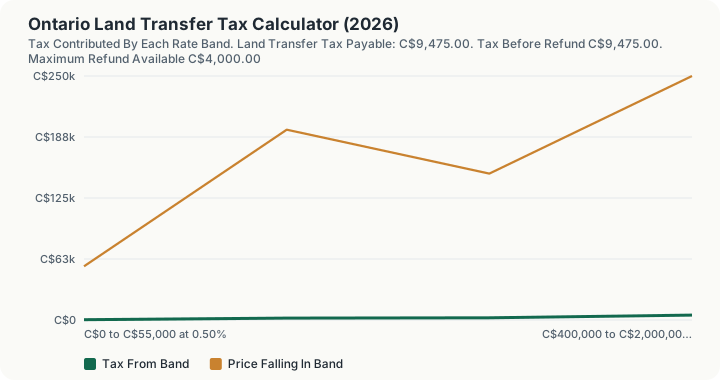
Quick Answer: A C$650,000 purchase of a house in Ontario attracts C$9,475.00 of provincial land transfer tax. A qualifying first-time homebuyer claims a refund of up to C$4,000, bringing it to C$5,475.00. The tax is charged in marginal tiers on the whole price with nothing deducted first, and there are two different rate schedules: only land containing one or two single family residences ever reaches the 2.5% top tier.
What does this calculator do?
Ontario's land transfer tax is payable by the buyer on registration, in cash, on top of the purchase price. It is not financed, it is not part of the mortgage, and for most buyers it is the largest single closing cost after the down payment.
Two things about it are routinely got wrong.
The first is that the rate is marginal. A C$650,000 house is not taxed at 2%. It is taxed at 0.5% on the first slice, 1.0% on the next, 1.5% on the next and 2.0% only on what is left over C$400,000. The effective rate on that purchase is 1.458%, not 2%.
The second is that Ontario publishes two schedules, not one. Land containing one or two single family residences runs up through a 2.5% tier above C$2,000,000. All other land, which includes commercial, industrial, multi-residential and vacant land, stops at 2.0% and has no higher tier at all. On a C$2.5 million purchase the difference between those two schedules is C$2,500.
A purchase inside the City of Toronto pays a second, municipal land transfer tax on top of everything below. That is a separate calculation with its own rebate and its own high-value tiers.
How is this calculated?
- Select the rate schedule. The calculator uses the single family schedule by default and the other-land schedule when you change the property type. The two schedules are identical up to C$400,000 and diverge above it.
Single family:0.5%, 1.0%, 1.5%, 2.0%, 2.5%
Other land:0.5%, 1.0%, 1.5%, 2.0%
- Apply each rate to the slice of price that falls inside its band. No allowance or exemption is subtracted from the price beforehand; the whole value of the consideration is run through the tiers.
Tax_gross = ∑_i rateᵢ × (min(Price, ceilingᵢ) − floorᵢ)⁺
- Apply the first-time homebuyer refund as a cap on the tax. The refund is the smaller of C$4,000 and the tax itself, so it can reduce the bill to zero but never below it. It is not applied on the other-land schedule, because the refund is available on an eligible home.
Refund = min(Tax_gross, C$4,000)
Tax_net = Tax_gross − Refund
- Report the marginal rate and the effective rate. The marginal rate is the rate of the highest band the price reaches. The effective rate is the tax you actually pay, after any refund, divided by the whole purchase price.
Rate_effective = Tax_net/Price
Worked Example
A repeat buyer purchases a house for C$650,000.
Step 1 - The first band. C$55,000 x 0.5% = C$275.00
Step 2 - The second band. C$250,000 - C$55,000 = C$195,000, at 1.0% = C$1,950.00
Step 3 - The third band. C$400,000 - C$250,000 = C$150,000, at 1.5% = C$2,250.00
Step 4 - The fourth band. C$650,000 - C$400,000 = C$250,000, at 2.0% = C$5,000.00
Step 5 - The total. C$275.00 + C$1,950.00 + C$2,250.00 + C$5,000.00 = C$9,475.00
Step 6 - The rate that is not 2%. C$9,475.00 / C$650,000 = 1.458% effective, against a 2.00% marginal rate
Now make the same buyer a qualifying first-time homebuyer.
Step 7 - The refund. The smaller of C$9,475.00 and C$4,000.00 = C$4,000.00
Step 8 - The tax payable. C$9,475.00 - C$4,000.00 = C$5,475.00
The ministry describes the refund as meaning no tax is payable on the first C$368,000 of consideration. That is worth testing.
Step 9 - A C$368,000 purchase. C$275.00 + C$1,950.00 = C$2,225.00 through C$250,000, plus C$118,000 at 1.5% = C$1,770.00, giving C$3,995.00
Step 10 - Fully refunded. C$3,995.00 is under the C$4,000 cap, so the refund covers all of it and the tax payable is C$0.00
Step 11 - The true break-even. Tax reaches exactly C$4,000 when C$2,225 + 1.5% x (Price - C$250,000) = C$4,000, i.e. at a price of C$368,333.33. The ministry's C$368,000 headline is rounded down, so a purchase between those two figures is also fully refunded.
Finally the property-type toggle, which is the input most often left wrong.
Step 12 - C$2.5 million, single family schedule. C$4,475.00 through C$400,000, plus C$1,600,000 at 2.0% = C$32,000.00, plus C$500,000 at 2.5% = C$12,500.00, giving C$48,975.00
Step 13 - C$2.5 million, other land. C$4,475.00 through C$400,000, plus C$2,100,000 at 2.0% = C$42,000.00, giving C$46,475.00
Step 14 - The difference the toggle makes. C$48,975.00 - C$46,475.00 = C$2,500.00, which is the 0.5 point gap applied to the C$500,000 above C$2 million
What The Bands And The Refund Cap Actually Do
The refund is a cap, not a rate. At C$650,000 it removes C$4,000 from a C$9,475 bill, which is 42% of the tax. At C$2,000,000 the tax is C$36,475 and the same C$4,000 removes 11% of it. The relief is worth the same dollars to every buyer who qualifies and is therefore worth progressively less as a share of the purchase.
The cliff at C$368,333.33 is the only one in the schedule. Below it a qualifying first-time buyer pays nothing at all. Above it they pay the excess and only the excess: at C$369,000 the tax is C$4,010.00 and the refund covers C$4,000 of it, leaving C$10.00. There is no sudden jump, because the refund is capped rather than withdrawn.
Each additional C$100,000 of price above C$400,000 adds C$2,000 of tax, and keeps adding exactly that until the price passes C$2,000,000, at which point every further C$100,000 adds C$2,500 on the single family schedule and stays at C$2,000 on the other-land schedule.
The effective rate climbs slowly and never reaches the marginal rate. At C$400,000 it is 1.119%. At C$650,000 it is 1.458%. At C$2,000,000 it is 1.824%. Even at C$5,000,000, where the top band has been running for C$3 million, the effective rate is 2.230% against a 2.5% marginal rate. The lower bands never stop dragging the average down.
The first band is small enough to be invisible. The whole 0.5% tier covers only the first C$55,000 and contributes C$275 to every single purchase in the province, no matter how large.
What does this calculator not account for?
- Toronto's Municipal Land Transfer Tax, which roughly doubles the bill inside the city. Use the dedicated Toronto calculator for that.
- The Non-Resident Speculation Tax, a 25% provincial tax on residential purchases by foreign buyers in Ontario, which is far larger than the tax modelled here.
- HST on a newly built home, which is a separate tax with its own new housing rebate.
- The apportionment rules that apply where only part of the land conveyed is used in connection with a single family residence, so that the two schedules apply to different parts of one purchase.
- Exemptions and deferrals, including certain transfers between spouses, transfers to family business corporations and conveyances of farmed land.
- The 18 month deadline for claiming the first-time homebuyer refund, and the detailed eligibility tests behind it: age, occupancy within nine months, never having owned an eligible home anywhere in the world, a spouse's ownership during the marriage, and Canadian citizenship or permanent residence.
- Whether the property type you selected is the one the ministry would agree with. The calculator applies whichever schedule you choose; it cannot inspect the land.
- Legal fees, title insurance, adjustments and registration costs, none of which are land transfer tax.
What mistakes do people make with this?
- Multiplying the price by the top rate. C$650,000 at 2% is C$13,000. The correct figure is C$9,475. The tiers are marginal.
- Treating the refund as a rate or a percentage. It is a fixed maximum of C$4,000 and it is capped at the tax payable, so a cheap enough home is simply untaxed.
- Assuming the 2.5% tier applies to every property. It exists only on the single family schedule. A commercial purchase at C$3 million never leaves the 2.0% band.
- Budgeting the provincial tax alone on a Toronto purchase. The municipal tax is a second bill of roughly the same size.
- Forgetting that the tax is due in cash on closing. It cannot be added to the mortgage.
- Assuming a first-time buyer pays nothing. The refund runs out at about C$368,333 of price, which is well below the median Ontario house.
Frequently Asked Questions
Is the tax charged on the whole price at one rate?
How much is the first-time homebuyer refund?
Why are there two rate schedules?
Do I pay this on top of Toronto's tax?
When is the tax paid?
Does the refund get paid to me later?
Sources
- Internal Revenue Service, the official authority for the tax rules this calculator relates to. irs.gov
Also consulted: Ontario, "Calculating Land Transfer Tax", ontario.ca/document/land-transfer-tax/calculating-land-transfer-tax. Both rate schedules, for agreements entered into after 14 November 2016 and registrations on or after 1 January 2017. Read 31 August 2026; Ontario, "Land Transfer Tax Refunds for First-Time Homebuyers", ontario.ca/document/land-transfer-tax/land-transfer-tax-refunds-first-time-homebuyers. Maximum refund of C$4,000, the C$368,000 description, the eligibility conditions and the 18 month claim deadline. Read 31 August 2026; Ontario Land Transfer Tax Act, which imposes the tax and authorises the schedules above.