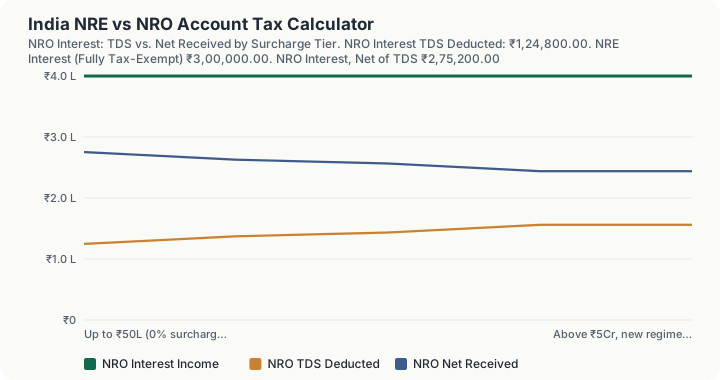
Quick Answer: ₹3,00,000 sitting in an NRE account earns interest that is fully tax-exempt in India (Section 10(4)(ii)) -- zero TDS. The identical ₹4,00,000 sitting in an NRO account instead faces a flat 30% TDS plus 4% cess, for ₹1,24,800 withheld at source, leaving only ₹2,75,200 net -- an effective 31.2% bite out of NRO interest that simply doesn't exist for NRE.
Overview
Every NRI needs both an NRE and an NRO account, because they serve fundamentally different purposes -- and the tax treatment between them is not a small difference, it's the difference between 0% and roughly 31-43%.
- NRE (Non-Resident External) account: holds money you remit into India from your foreign earnings. Because the underlying funds are foreign-sourced, interest on an NRE account is fully exempt from Indian income tax under Section 10(4)(ii) -- no tax, no TDS, full stop (as long as you remain a "person resident outside India" under FEMA and the account is maintained per RBI rules).
- NRO (Non-Resident Ordinary) account: holds India-sourced income -- rent, dividends, pension, sale proceeds of Indian assets, or interest you've already earned in India. Because this money originates in India, interest on an NRO account is fully taxable, with the bank deducting TDS at a flat 30% under Section 195, before surcharge and 4% cess are added on top.
The practical implication: if you have discretion over where to park genuinely foreign-sourced money (say, savings you're transferring from your country of residence), keeping it in NRE rather than NRO can be the difference between an exempt return and one taxed at over 30% at the withholding stage alone.
This matters most at the point money first enters India. Foreign remittances, foreign salary savings, and foreign investment proceeds should generally land in an NRE account to preserve the exemption. Anything that originates inside India -- rent from a property you still own, dividends on Indian shares, a pension from a former Indian employer, or maturing fixed deposits opened while you were still a resident -- belongs in NRO, and stays taxable there regardless of which account you eventually move it to.
How This Is Calculated
NRE interest:
NRO interest:
The surcharge rate is determined by your total income (not just the NRO interest), on the ordinary uncapped ladder: 0% up to ₹50 lakh, 10% from ₹50L-₹1Cr, 15% from ₹1Cr-₹2Cr, 25% from ₹2Cr-₹5Cr, and 25% (new regime) or 37% (old regime) above ₹5 crore.
Two commonly-cited reference points this calculator reproduces exactly: at income up to ₹50 lakh, the effective NRO TDS rate is a flat 31.2% (30% × 1.04, no surcharge); in the ₹50L-₹1Cr tier, it rises to 34.32% (30% × 1.10 × 1.04).
Important: TDS is a withholding mechanism, not your final liability. NRO interest is ultimately taxed at your actual applicable slab rate when you file your Indian return -- the flat 30% TDS commonly over-withholds relative to a lower actual liability (especially for NRIs whose only India income is modest bank interest), meaning a refund is often due at filing. Alternatively, a Form 13 lower-deduction certificate (see the companion Property TDS Calculator's discussion of Form 13, which applies to interest too) can reduce the withholding upfront.
Worked Example
Using the calculator's default inputs: ₹3,00,000 NRE interest, ₹4,00,000 NRO interest, total income up to ₹50 lakh (no surcharge).
- NRE interest: fully exempt, zero tax, zero TDS.
- NRO interest TDS: ₹4,00,000 × 30% = ₹1,20,000 base tax.
- No surcharge (total income under ₹50 lakh).
- Cess: 4% × ₹1,20,000 = ₹4,800.
- Total NRO TDS: ₹1,24,800 -- an effective 31.2% rate.
- Net NRO interest received: ₹4,00,000 − ₹1,24,800 = ₹2,75,200.
- Combined gross interest across both accounts: ₹7,00,000; only the ₹4,00,000 NRO portion is taxed at all.
Had that same ₹3,00,000 been sitting in an NRO account instead of NRE, it would have faced the identical 31.2% TDS, costing an additional ₹93,600 in tax that the NRE exemption avoids entirely.
What This Does Not Account For
- FCNR (Foreign Currency Non-Resident) accounts, which are also exempt like NRE but held in foreign currency rather than INR -- not modeled separately here, though the tax treatment is analogous to NRE.
- The point at which returning to India changes this. Once you become a Resident and Ordinarily Resident, NRE-equivalent exemptions taper off (an RFC -- Resident Foreign Currency -- account has its own separate rules), which this NRI-focused calculator does not model.
- Marginal relief on surcharge, consistent with the other calculators in this series.
- The actual slab-rate reconciliation at filing. This calculator shows the TDS withheld, not your true final liability, which could be lower (triggering a refund) if NRO interest is your only India income and falls under the basic exemption threshold.
- FEMA repatriation of NRO interest already net of TDS -- see the companion NRI Capital Gains Repatriation Calculator for the USD 1 million per-financial-year ceiling that applies specifically to NRO-sourced funds (NRE/FCNR funds are freely repatriable and outside that ceiling).
- DTAA relief on NRO interest, which can reduce the 30% domestic rate for residents of certain treaty countries -- see the companion DTAA Relief Calculator.
Common Pitfalls
- Depositing foreign-sourced savings into an NRO account by default, out of convenience or because that's the account that was already open, and paying 30%+ TDS on interest that could have been fully exempt in an NRE account instead.
- Assuming NRO's 30% TDS is your final tax bill. It's a withholding rate; your actual liability is computed at slab rates when you file, and a refund is common if NRO interest is modest.
- Not realizing FEMA repatriation rules differ sharply between the two. NRE (and FCNR) balances are freely and fully repatriable; NRO balances are capped at USD 1 million per financial year and require Form 15CA/15CB documentation.
- Mixing genuinely India-sourced income into an NRE account. Only foreign-remitted funds belong in NRE; depositing Indian rental income or dividends into an NRE account can jeopardize its tax-exempt status and invite scrutiny.
- Forgetting cess applies to NRO TDS with no exemption threshold. Even at the lowest surcharge tier, the 4% cess still applies on top of the 30% base rate.
Frequently Asked Questions
Is NRE account interest really 100% tax-free in India?
Why is NRO interest taxed at 30% instead of my regular slab rate?
Can I move money from NRO to NRE to avoid the tax?
What's the difference between NRE, NRO, and FCNR accounts?
Do joint account holders change the tax treatment?
Sources
- Section 10(4)(ii), Income-tax Act, 1961 (NRE account interest exemption). incometax.gov.in/iec/foportal
Also consulted: Section 195, Income-tax Act, 1961 (TDS on NRO interest paid to non-residents); RBI Master Direction on Deposits and Accounts (NRE/NRO/FCNR account rules under FEMA).
Verification note: the Section 10(4)(ii) NRE exemption and the 30%-plus-surcharge-plus-cess NRO TDS convention were corroborated across multiple professional tax-advisory sources, and this calculator's computed effective NRO TDS rates (31.2% and 34.32% at the two lowest surcharge tiers) independently match the figures commonly cited across those sources -- a strong cross-check on the underlying surcharge/cess math, though the specific 30% figure for the general run of NRO deposit interest (as opposed to the separate, lower rates that apply to specific Section 115A categories like infrastructure bonds) was not independently confirmed against a Gazette notification within this session.