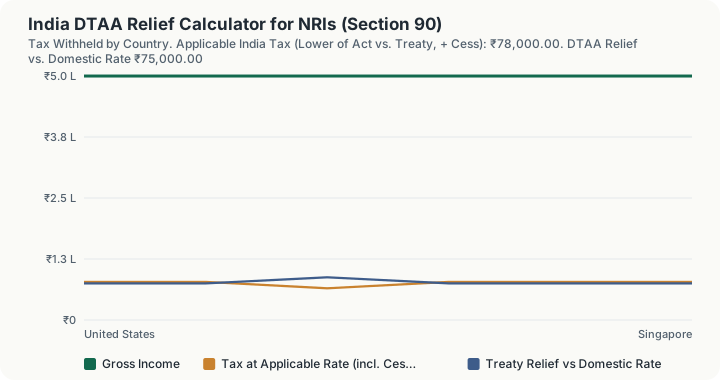
Quick Answer: An NRI resident of the USA receiving ₹5,00,000 in interest from an Indian NRO account faces a domestic 30% Section 195 withholding rate -- but the India-US tax treaty caps interest at 15%. Since the treaty rate is lower, Section 90(2) lets the treaty rate apply instead: tax of ₹75,000 plus 4% cess of ₹3,000, for a total of ₹78,000 -- a ₹75,000 saving in withholding compared to the plain domestic rate.
Overview
India has Double Taxation Avoidance Agreements (DTAAs) with more than 90 countries. When an NRI earns India-sourced income (typically bank interest or dividends) and is a tax resident of a treaty country, Section 90(2) of the Income-tax Act, 1961 lets the taxpayer be governed by whichever is more beneficial: the plain domestic Act rate, or the treaty-capped rate -- never the higher of the two.
This calculator covers exactly 6 of India's 90+ treaty countries: the United States, United Kingdom, UAE, Canada, Australia, and Singapore. These were chosen because they host large NRI populations, not because they're the only treaties that matter -- if your country of residence isn't one of these six, this calculator does not apply to you, and you should look up your specific treaty's Article 11 (interest) and Article 10 (dividends) directly.
Important framing correction: Section 90 (bilateral relief, where a DTAA exists) and Section 91 (unilateral relief, only for countries with NO DTAA) are often mentioned together, but they are not interchangeable. All 6 countries covered here have a DTAA with India, so Section 90 governs, not Section 91 -- Section 91 is not modeled in this calculator because it would never actually apply to these six. What Section 91 covers instead: relief for double taxation with a country India has no treaty with at all, which is not the scenario most NRIs from these six countries face.
Separately, this calculator only addresses India's withholding rate on India-sourced income. Whether your country of residence then grants you credit for the India tax you paid (avoiding a second layer of tax back home) depends on that country's own domestic tax law and its own DTAA position -- which this calculator, being India-tax-focused, does not model.
How This Is Calculated
1. Determine the domestic (no-treaty) Section 195 rate. - Interest: 30% (the standard rate applied to ordinary NRO deposit/bank interest, absent a specific Section 115A concessional category such as infrastructure bonds or ECBs, which this calculator does not separately model). - Dividend: 20%.
2. Determine the treaty-capped rate for your selected country and income type (see the coverage table below).
3. Apply the lower of the two (Section 90(2)):
4. Add 4% Health & Education Cess on the applicable-rate tax (cess is a domestic administrative addition; whether it should apply on top of a treaty-capped rate is itself a debated question in Indian tax practice -- this calculator applies it consistently for a conservative, comparable figure across countries).
Covered Treaty Rates (Interest / Dividend)
| Country | Interest Cap | Dividend Cap (Portfolio) | Dividend Cap (Substantial Holding) |
|---|---|---|---|
| USA | 15% | 25% | 15% (10%+ voting stock) |
| UK | 15% | 10% | -- (single rate; 15% if property-derived) |
| UAE | 12.5% | 10% | -- (single rate) |
| Canada | 15% | 25% | 15% (10%+ voting stock) |
| Australia | 15% | 15% | -- (single flat rate, unusual among treaties) |
| Singapore | 15% (10% to a bank/financial institution) | 15% | 10% (25%+ equity holding) |
Notice something counterintuitive? For US and Canadian dividends, the general "portfolio" treaty rate (25%) is actually worse than the 20% domestic rate -- the treaty only helps a dividend recipient who holds 10%+ of the paying company's voting stock (rare for an individual retail investor). Section 90(2) means the domestic 20% rate wins in that case, and this calculator will show "No" for whether the treaty was beneficial.
Worked Example
Section 90(2) is a comparison, not a discount, so the useful thing to watch is the point at which the comparison flips. Start with the case where the treaty clearly wins, then move to the one where it does not.
Case one: NRO interest, resident of the USA
Step 1 -- The domestic Section 195 rate on ordinary NRO interest. 30%
Step 2 -- Tax at the domestic rate, before cess. ₹5,00,000 × 30% = ₹1,50,000
Step 3 -- The India-US treaty cap on interest (Article 11). 15%
Step 4 -- Tax at the treaty rate, before cess. ₹5,00,000 × 15% = ₹75,000
Step 5 -- Apply Section 90(2), the lower of the two. min(30%, 15%) = 15%, so the treaty governs
Step 6 -- Relief against the domestic rate. ₹1,50,000 - ₹75,000 = ₹75,000
Step 7 -- Add 4% Health and Education Cess. ₹75,000 × 4% = ₹3,000 ₹75,000 + ₹3,000 = ₹78,000 payable
Case two: the same NRI, on an Indian dividend
Step 8 -- The domestic Section 195 rate on dividends. 20%, so ₹5,00,000 × 20% = ₹1,00,000 before cess
Step 9 -- The India-US treaty cap on a portfolio dividend. 25%, so ₹5,00,000 × 25% = ₹1,25,000 before cess
Step 10 -- Apply Section 90(2) again. min(20%, 25%) = 20%, so the domestic rate governs and the treaty does nothing Relief: ₹0 Payable with cess: ₹1,00,000 × 1.04 = ₹1,04,000
The same taxpayer, the same treaty, the same country, and the treaty is worth ₹75,000 on one income stream and nothing at all on the other. A DTAA sets a ceiling on what India may charge; it never sets a floor below the domestic rate, and there is no rule that a treaty must be an improvement.
Step 11 -- The shareholding threshold that flips case two. Cross 10% of the paying company's voting stock and the US treaty's dividend cap drops from 25% to 15% Tax: ₹5,00,000 × 15% = ₹75,000, plus cess = ₹78,000 Relief against the domestic rate: ₹25,000
Step 11 is the discontinuity worth searching for. Below 10% of voting stock the answer is ₹1,04,000; at 10% and above it is ₹78,000 on identical income. Canada's treaty is built the same way. Almost no individual retail investor is on the right side of that line, which is why the honest answer for most NRI dividend recipients is that the treaty changes nothing.
Step 12 -- The same ₹5,00,000 of interest across the other covered treaties. UAE at a 12.5% cap: ₹65,000 payable, relief ₹87,500 UK, Canada, Australia and Singapore at 15%: ₹78,000 payable, relief ₹75,000 each
The UAE line is the outlier among the covered treaties, and it is the reason UAE residency comes up so often in NRI planning discussions. None of this reaches the payer automatically: a bank will withhold at the domestic rate unless it holds a valid Tax Residency Certificate, Form 10F and a no-permanent-establishment declaration, leaving the difference to be reclaimed at filing.
What This Does Not Account For
- The other 84+ DTAA countries. If your country of residence is not USA, UK, UAE, Canada, Australia, or Singapore, none of these rates apply to you -- consult your specific treaty.
- Royalties, fees for technical services, capital gains, and business income, which have their own (often different) treaty articles -- this calculator covers interest and dividend income only.
- TRC and Form 10F documentation requirements. The reduced rate is not automatic; it requires furnishing valid documentation to the payer before or at the time of payment.
- Foreign tax credit in your country of residence. This calculator only computes the India-side withholding; whether your home country then credits or further taxes this income is a separate question governed by that country's law.
- Most-Favoured-Nation (MFN) clause disputes. Some of India's older European treaties carry MFN clauses that have been the subject of Supreme Court litigation (the Nestle SA case) over whether they self-execute without a separate notification -- not relevant to the 6 countries covered here, but a reminder that treaty interpretation can be contested.
- Marginal relief and surcharge on the withheld amount at higher income levels -- this calculator applies a flat cess only, consistent with how DTAA-rate withholding is typically administered by payers.
Common Pitfalls
- Assuming the treaty rate is always better. As the USA/Canada portfolio-dividend example shows, the "general" treaty rate can be higher than the plain domestic rate. Section 90(2) protects you either way -- you always get the lower of the two -- but only if you correctly compute both.
- Not furnishing a TRC and Form 10F. Banks and other payers will often apply the higher domestic rate by default and require you to prove treaty eligibility; without the paperwork in hand before payment, you'll need to claim the difference back when filing your Indian return.
- Confusing India's withholding relief with double-taxation relief in your home country. Getting a lower India withholding rate does not, by itself, tell you what your country of residence will do with that income -- check your home country's foreign tax credit or exemption rules separately.
- Applying the substantial-shareholding dividend rate without actually qualifying. The 15% USA/Canada rate requires holding 10%+ of the paying company's voting stock -- essentially never true for an individual buying listed shares or mutual funds.
- Treating this calculator as covering all 90+ treaties. It explicitly does not; using rates from this tool for a country not in the list would be a fabricated result.
Frequently Asked Questions
What's the DTAA benefit for an NRI in the USA?
Do I need any paperwork to get the lower DTAA rate, or does it apply automatically?
My country isn't in this calculator's list of 6 -- where do I find my treaty rate?
Is DTAA relief the same as a foreign tax credit?
Sources
- Section 90, Income-tax Act, 1961 (agreement with foreign countries; "whichever is more beneficial" rule). incometax.gov.in/iec/foportal
Also consulted: India's Double Taxation Avoidance Agreements with the United States, United Kingdom, United Arab Emirates, Canada, Australia, and Singapore (treaty texts as published/summarized via incometax.gov.in and cross-referenced professional tax-advisory summaries); Section 195, Income-tax Act, 1961 (domestic withholding rates on non-resident payments, absent treaty relief).
Verification note -- please read before relying on these rates: the treaty rates in this calculator are corroborated across multiple professional secondary sources (tax-advisory portals cross-checked against each other), but this session's attempt to fetch the official incometaxindia.gov.in comparative DTAA-vs-Act chart directly returned an HTTP 403 (access denied) error, so these figures could NOT be independently verified against the primary treaty text or the official chart within this build. Singapore's general/portfolio rate is 15% for both interest and dividends -- the lower 10% rate applies only to interest paid to a bank/financial institution, or to dividends where the Singapore recipient holds 25%+ of the Indian company's equity, neither of which applies to an individual retail NRI. Before relying on any of these rates for an actual TDS position or tax filing, confirm the exact applicable article, sub-clause, and any Protocol amendments with a chartered accountant or the primary treaty text.