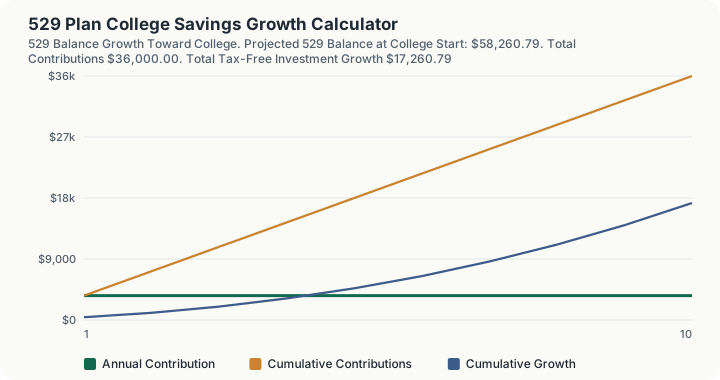
Quick Answer: Starting with $5,000 saved, contributing $300 a month, and earning an assumed 6% average annual return over 10 years, a 529 plan grows to $58,260.79, of which $36,000.00 came from your own pocket and $17,260.79 came from investment growth that is federal-tax-free when spent on qualified education expenses.
Overview
A 529 plan is a state-sponsored investment account built for one purpose: paying for education without paying tax on the growth. You contribute after-tax dollars (no federal deduction for the contribution itself, though many states offer one), the money is invested in a menu of age-based or static portfolios, and every dollar of investment growth comes out federal-income-tax-free as long as it's spent on qualified education expenses. There is no federal contribution limit on a 529 the way there is on a Coverdell ESA or a retirement account; individual states set their own aggregate lifetime caps, typically between $235,000 and $575,000 per beneficiary, well beyond what most families ever accumulate.
The tradeoff for that flexibility is that a 529 doesn't give you an upfront tax deduction the way a 401(k) or Traditional IRA does. It gives you exactly one tax benefit: tax-free growth and tax-free qualified withdrawals. That's still a meaningful benefit, especially over a decade or more, because it means every dollar the market adds to your balance is a dollar that would otherwise have been taxed as capital gains or dividends in an ordinary brokerage account.
This calculator projects that growth month by month, using the same time-value-of-money engine the rest of this platform uses for compound growth, and layers on the real 2026 federal gift tax rules that determine how much you can contribute before you need to think about IRS paperwork.
How This Is Calculated
The projection compounds monthly. Each year, your starting balance for that year plus twelve monthly contributions (made at the end of each month) grow at your assumed annual return divided by 12, using the platform's shared future-value solver rather than a bespoke formula written into this page. The ending balance of each year becomes the starting balance of the next, chained forward across your full savings horizon.
Separately, the calculator checks your annualized contribution ($300/month here becomes $3,600/year) against the 2026 federal gift tax annual exclusion, which is $19,000 per donor per beneficiary for an individual contributor, or $38,000 for a married couple electing to split gifts. Contributing within that exclusion means no IRS filing is required at all; contributing above it means the excess counts against your lifetime gift and estate tax exemption and requires filing Form 709, unless you use the 5-year superfunding election described below.
Because a 529 has no federal contribution limit, this calculator never caps your monthly contribution the way the Coverdell ESA calculator does. It only flags whether your contribution rate has gift tax paperwork implications, which is a completely separate question from how much you're allowed to save.
Worked Example
A married couple opens a 529 for a child ten years from college with $5,000 already set aside, commits to $300 a month, and assumes a 6% return. Two questions follow: what does it grow to, and does the gifting attract IRS attention.
Step 1 -- The monthly compounding rate. 6% / 12 = 0.5% a month
Step 2 -- Annualised contribution. $300 x 12 = $3,600 a year
Step 3 -- Balance at the end of year one. $5,000 grown for twelve months plus twelve $300 deposits = $9,009.06
Step 4 -- Growth earned in year one. $9,009.06 - $5,000 - $3,600 = $409.06
Year Two, and the Running Total
Step 5 -- Balance at the end of year two. $9,009.06 carried forward, plus another twelve $300 deposits and a year of growth = $13,265.39
Step 6 -- Cumulative contributions after two years. $3,600 x 2 = $7,200
Step 7 -- Cumulative growth after two years. $13,265.39 - $5,000 - $7,200 = $1,065.39
Step 8 -- Growth earned in year two alone. $1,065.39 - $409.06 = $656.33
Year two earned 60% more than year one on identical deposits. That gap is the entire case for opening the account early rather than well.
Where It Lands at Ten Years
Step 9 -- Total contributed over the horizon. $3,600 x 10 = $36,000
Step 10 -- Balance at the end of year ten. = $58,260.79
Step 11 -- Total investment growth. $58,260.79 - $5,000 - $36,000 = $17,260.79
That $17,260.79 is the number the account exists to protect: in a taxable brokerage it would be taxed on the way out, and in a 529 spent on qualified education it is not taxed at all.
The Gift Tax Check
Step 12 -- Against the married annual exclusion. $3,600 contributed against the $38,000 exclusion, so no Form 709 filing is triggered
Step 13 -- The superfunding ceiling if they front-loaded instead. $38,000 x 5 years = $190,000
A couple wanting to move a lump sum in immediately can elect to treat up to $190,000 as if it were gifted evenly across five years, keeping the whole thing inside the annual exclusion and out of their lifetime exemption.
The 2026 Gift Tax Rules That Actually Matter Here
Most families never bump into 529 contribution limits, because the limits that matter aren't about the plan itself, they're about federal gift tax law:
- Annual exclusion: $19,000 per donor per beneficiary in 2026 (unchanged from 2025), or $38,000 for a married couple electing to split gifts on a joint return. Grandparents, aunts, uncles, and family friends each get their own separate exclusion per beneficiary, so a child can receive contributions from several different $19,000-or-$38,000 buckets in the same year without anyone filing paperwork.
- 5-year superfunding election: Under IRC Sec. 529(c)(2)(B), a single contributor can front-load up to 5 years of the annual exclusion in one lump sum ($95,000 individual, $190,000 married for 2026) and elect on Form 709 to treat it as if spread evenly across 5 years for gift tax purposes. This is one of the few ways to move a large sum out of a taxable estate instantly while still using the annual exclusion rather than the lifetime exemption.
- Exceeding the exclusion without superfunding: A contribution above the annual exclusion (and not covered by the 5-year election) requires filing Form 709, but it usually still doesn't trigger any actual gift tax owed, since it simply reduces the donor's lifetime gift and estate tax exemption (a very large number for most families) rather than being taxed immediately.
What This Does Not Account For
- State tax treatment. More than 30 states offer a state income tax deduction or credit for 529 contributions, on top of the federal tax-free growth this calculator models. Those benefits vary widely by state and aren't included here.
- Investment fees and expense ratios. 529 plans charge program management fees and underlying fund expense ratios that reduce your actual return below the gross rate you assume in this calculator.
- Contribution changes over time. This model assumes a level monthly contribution for the entire horizon. Real family budgets fluctuate; a raise, a second child, or a job change will change what you can actually contribute year to year.
- Financial aid impact. A parent-owned 529 is counted as a parental asset on the FAFSA, assessed at a maximum of 5.64%, which is much more favorable than a student-owned asset but still a real factor in aid calculations this tool doesn't model.
- Non-qualified withdrawal penalties. Earnings withdrawn for non-qualified expenses are taxed as ordinary income plus a 10% federal penalty. This calculator assumes every dollar is eventually used for qualified expenses.
Common Pitfalls
- Assuming there's a federal 529 contribution limit. There isn't one. The only limits that apply are the state's aggregate lifetime cap (rarely a real constraint) and the gift tax annual exclusion (a paperwork threshold, not a savings cap).
- Forgetting the K-12 and student loan uses. As of 2026, 529 funds can cover up to $20,000 per year in K-12 tuition and a broadened list of K-12 expenses (tutoring, curricular materials, standardized test fees) under the One Big Beautiful Bill Act, and up to $10,000 lifetime toward the beneficiary's or a sibling's qualified student loan repayment. Many families still think of a 529 as strictly a "college fund."
- Overlooking the 529-to-Roth IRA rollover option. Since SECURE 2.0 Act Sec. 126, up to $35,000 of unused 529 funds can be rolled into the beneficiary's own Roth IRA over their lifetime, as long as the 529 has been open at least 15 years, the rolled funds have been in the account at least 5 years, and the rollover doesn't exceed that year's Roth IRA contribution limit. This meaningfully reduces the old "what if my kid doesn't go to college" worry.
- Changing the beneficiary without checking the new beneficiary's relationship. 529 funds can be reassigned to another family member (siblings, cousins, even the account owner) without tax consequences, but the definition of "family member" is specific and worth checking before assuming a transfer is penalty-free.
Frequently Asked Questions
What happens to unused 529 funds if my child doesn't need them?
Can I roll a 529 into a Roth IRA?
Do I get a federal tax deduction for 529 contributions?
Is there a downside to the 5-year superfunding election?
How much of my 529 contribution can I use for K-12 expenses?
Sources
- Internal Revenue Code Sec. 529, "Qualified Tuition Programs." sec.gov
- IRS Rev. Proc. 2025-32, 2026 federal gift tax annual exclusion ($19,000 individual / $38,000 married gift-splitting). irs.gov
- IRS Publication 970, "Tax Benefits for Education.". irs.gov/publications/p970
- U.S. Securities and Exchange Commission, Investor.gov, "An Introduction to 529 Plans." investor.gov
Also consulted: One Big Beautiful Bill Act (H.R. 1), signed July 4, 2025: expanded K-12 qualified expenses and raised the annual K-12 withdrawal limit to $20,000, effective 2026; SECURE 2.0 Act of 2022, Section 126: 529-to-Roth IRA rollover provision, effective January 1, 2024.