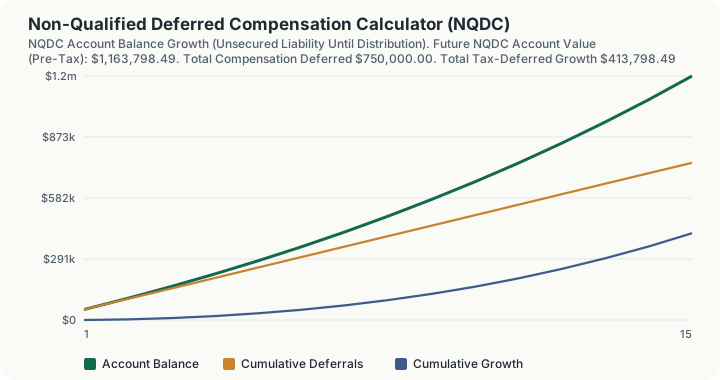
Quick Answer: A non-qualified deferred compensation (NQDC) plan lets high earners defer salary or bonus into a tax-deferred account that grows until a future distribution, and this calculator projects the future account value and estimates how much the strategy saves (or costs) based on the gap between your current and future tax brackets.
Overview
Non-qualified deferred compensation plans are employer-sponsored arrangements, common at large companies and for senior executives, that let an employee elect to defer a portion of salary, bonus, or other compensation to a future date, typically retirement or a fixed number of years out. The deferred amount is not taxed when earned. Instead, it grows based on a notional rate of return (often tracking a menu of mutual-fund-like investment options, or a fixed crediting rate) and is taxed as ordinary income only when it is actually distributed.
The word "non-qualified" is doing important legal work in that name. Qualified plans, like 401(k)s, are governed by ERISA and must hold participant assets in a segregated trust, protected from the employer's creditors. NQDC plans are explicitly not qualified plans and are not protected this way. The deferred compensation legally remains a general asset of the employer, and your right to eventually receive it is nothing more than an unsecured promise, an IOU, that sits behind every other creditor if the employer goes bankrupt. This is the single most important risk to understand before using an NQDC plan, and it is discussed in detail below.
The primary appeal of NQDC plans is tax arbitrage: if you expect to be in a meaningfully lower tax bracket when the money is eventually distributed (commonly true for someone deferring during high-earning working years and receiving distributions after retiring, or spreading distributions over lower-income years), deferring taxation of that income can save real money. This calculator quantifies exactly that trade.
How This Is Calculated
Account growth. Each year's deferral compounds at your assumed notional growth rate, with new deferrals added at the end of each year, exactly mirroring how the platform's time-value-of-money engine computes the future value of a series of level, end-of-period contributions:
`
Future Value = Annual Deferral × [(1 + r)ⁿ − 1] / r
`
where r is the annual growth rate and n is the number of years you defer. This is the same closed-form ordinary-annuity future-value formula used across the platform, cross-checked here against a year-by-year compounding loop that also produces the full schedule shown in the results table.
Tax comparison. The calculator then estimates the tax owed if the entire future account value were distributed and taxed as ordinary income at your expected future marginal rate, giving you a net after-tax distribution figure. Separately, it calculates a tax-deferral benefit: the value of having this same pool of dollars taxed at your (presumably lower) future rate instead of your current rate.
`
Tax-Deferral Benefit = Future Account Value × (Current Marginal Rate − Future Marginal Rate)
`
If your expected future bracket is lower than your current bracket, this benefit is positive: you saved money by deferring. If your future bracket turns out higher than your current bracket, the benefit is negative: deferral cost you money in hindsight, because you paid a higher tax rate on the same dollars than you would have paid taking them as current compensation.
Worked Example
An executive at the top of the federal bracket defers $50,000 of salary a year for fifteen years. The plan credits 6%, and they expect to be in the 24% bracket when the money is finally paid out.
Step 1 -- Total compensation deferred. $50,000 x 15 years = $750,000
Step 2 -- The annuity accumulation factor. (1.06^15 - 1) / 0.06 = 23.2760
Step 3 -- Future account value. $50,000 x 23.2760 = $1,163,798.49
Step 4 -- Tax-deferred growth. $1,163,798.49 - $750,000 = $413,798.49
Step 5 -- Tax due on distribution at the 24% future rate. $1,163,798.49 x 24% = $279,311.64
Step 6 -- Net after-tax distribution. $1,163,798.49 - $279,311.64 = $884,486.85
Step 7 -- The bracket gap. 37% - 24% = 13 points
Step 8 -- The tax-deferral benefit. $1,163,798.49 x 13% = $151,293.80
Watching the Balance Build Over the First Two Years
Step 9 -- Balance at the end of year one. $50,000 deferred, credited at the end of the period = $50,000 with no growth yet
Step 10 -- Growth credited in year two. 6% x $50,000 = $3,000
Step 11 -- Balance at the end of year two. $50,000 + $3,000 + $50,000 = $103,000
Step 12 -- Cumulative growth after two years. $103,000 - $100,000 deferred = $3,000
Fifteen years later that same mechanism has turned $750,000 of deferrals into $413,798.49 of growth, which is step 4.
Step 8 is where the argument for deferring actually lives, and it is a bet rather than a certainty. The $151,293.80 assumes the executive's marginal rate really is 13 points lower at distribution. Reverse the assumption -- retire into a higher bracket, or have statutory rates rise -- and step 8 turns negative, at which point the deferral has cost money rather than saved it. And it is a bet made against a balance the executive does not own: unlike a 401(k), this $1,163,798.49 is an unsecured promise from the employer, sitting behind every other general creditor if the company fails.
What This Does Not Account For
- The unsecured general creditor risk. This is the defining risk of NQDC plans and is not, and cannot be, captured in a compound-growth calculation. If your employer becomes insolvent before your deferred compensation is distributed, you stand in line with the company's other general unsecured creditors, with no special protection, and could lose some or all of the deferred balance regardless of how well it performed on paper.
- IRC Section 409A distribution timing rules. Unlike a 401(k), NQDC distribution timing elections must generally be locked in either at the time of deferral or under narrow, strictly limited re-election windows. Violating Section 409A's timing rules can trigger immediate taxation of the entire deferred balance plus a 20% additional federal tax and interest penalties, none of which is modeled here.
- FICA (Social Security and Medicare) tax timing. FICA tax on NQDC deferrals is generally due when the compensation is deferred (or when it vests, if later), not when it is eventually distributed, which is a separate and often overlooked tax event not captured in this calculator.
- Distribution in installments versus a lump sum. This calculator assumes the full balance is taxed in a single distribution year at your future marginal rate. Spreading distributions over several years, a common strategy to avoid pushing all the income into your top bracket at once, would change the effective blended tax rate.
- State income tax, which varies and can shift meaningfully between the state you work in during deferral and the state you may reside in during distribution (for example, retiring to a no-income-tax state).
- Forfeiture risk unrelated to bankruptcy, such as plan-specific vesting schedules or non-compete clawback provisions some NQDC plans include.
Common Pitfalls
- Treating an NQDC plan like a 401(k). A 401(k) balance is legally protected in a trust, separate from the employer's own assets. An NQDC balance is not. This is a fundamentally different risk profile, and the two should never be evaluated as equivalent options based purely on projected growth.
- Overestimating the future bracket gap. Many people assume they will automatically drop into a much lower tax bracket in retirement, but a large, concentrated NQDC distribution can itself push you into a high bracket in the very years you receive it, partially or fully erasing the anticipated benefit.
- Ignoring employer financial health. Deferring a meaningful share of compensation into an unsecured promise from a financially struggling or highly leveraged employer concentrates career risk and balance-sheet risk in the same place.
- Missing the Section 409A election window. Deferral elections and, in many cases, distribution timing elections must be made before the compensation is earned, subject to strict IRS timing rules. Missing the window can mean losing the ability to defer that year's compensation at all.
- Not diversifying notional investment choices within the plan. Because the plan is unsecured regardless of how the notional balance performs, concentrating the notional investment choice entirely in employer stock compounds the same-employer risk on top of the credit risk already inherent in the plan.
Frequently Asked Questions
What happens to my deferred compensation if my employer goes bankrupt?
Is there a 10% early withdrawal penalty like a 401(k) or IRA?
Can I change my mind about the deferral or distribution schedule?
Why would I ever choose an NQDC plan over just investing after-tax income myself?
Does the growth rate I choose matter for the tax-deferral benefit?
Sources
- Internal Revenue Code Section 409A, Inclusion in Gross Income of Deferred Compensation Under Nonqualified Deferred Compensation Plans. law.cornell.edu/uscode/text/26/409A
- Internal Revenue Service Publication 15-A, Employer's Supplemental Tax Guide, for FICA timing treatment of nonqualified deferred compensation. irs.gov/publications/p15
- U.S. Securities and Exchange Commission, Investor.gov guidance on nonqualified deferred compensation plans and their unsecured creditor status relative to ERISA-qualified plans. investor.gov