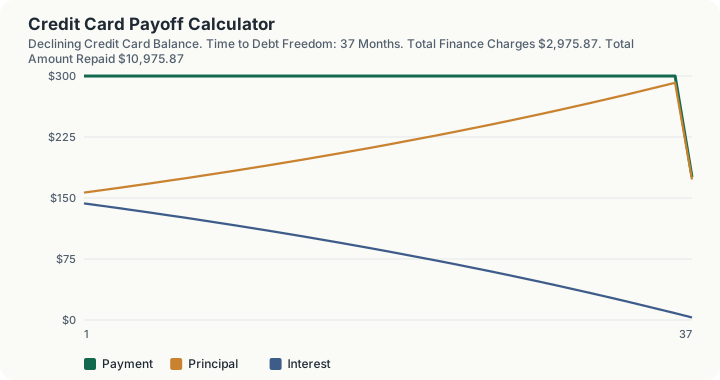
Quick Answer: An $8,000 balance at 21.5% APR paid at a fixed $300 a month takes about 37 months to clear and costs roughly $2,976 in interest, nearly 37% of the original balance, which is what makes credit card debt uniquely expensive compared to installment loans.
Overview
Credit card debt behaves differently from a car loan or mortgage because it is revolving, not fixed-term. There is no built-in schedule that guarantees payoff by a certain date; the balance simply shrinks or grows based on whatever is paid each month against a rate that, unlike most installment debt, regularly exceeds 20% APR. This calculator models a single card balance paid down at a fixed monthly payment, showing exactly how long it takes to reach zero and how much of that fixed payment goes to interest versus principal in each period, month by month, so the true cost of carrying a balance is visible rather than hidden inside a minimum-payment line on a statement.
The core danger this calculator is built to expose is the gap between a card issuer's minimum payment and the payment actually required to make meaningful progress. Minimum payments are typically calculated as a small percentage of the balance plus accrued interest, which on a high-APR card can mean a monthly payment that barely covers the interest charged that same month. This tool uses a fixed dollar payment instead, so a user can see directly how raising that payment amount compresses both the payoff timeline and the total interest paid.
How This Is Calculated
The calculator simulates the balance month by month rather than using a closed-form formula, because it needs to cap each monthly payment at whatever balance remains (avoiding overpayment on the final month):
- Monthly rate conversion. The entered APR is divided by 12 to produce a monthly periodic rate.
- Monthly interest accrual. Each month, interest is calculated as the current balance multiplied by the monthly rate.
- Payment application. The fixed monthly payment is applied first to that month's accrued interest, with the remainder reducing principal. If the fixed payment exceeds the remaining balance plus interest, only the amount needed to zero the balance is applied.
- Iteration to zero. This process repeats month by month, tracking cumulative interest paid, until the balance reaches zero or 360 months elapse, whichever comes first.
- Special case for 0% APR. When the interest rate is zero, such as during a promotional balance transfer period, the calculator simply divides the balance by the payment amount to determine the number of months, since no interest accrues.
Worked Example
Using the calculator's baseline inputs: an $8,000 balance, a 21.5% APR, and a fixed $300 monthly payment.
- Month 1 interest: $8,000 × (21.5% ÷ 12) = $143.33
- Month 1 principal paid: $300 − $143.33 = $156.67
- Month 1 ending balance: $8,000 − $156.67 = $7,843.33
- This process repeats, with the interest portion shrinking and the principal portion growing each month as the balance declines.
- Total time to payoff: approximately 37 months
- Total interest paid: approximately $2,975.87, on top of the original $8,000 principal, for total repayment near $10,975.87
For comparison, an aggressive $500 monthly payment on a smaller $5,000 balance at 24% APR clears in just 12 months with about $635 in total interest, illustrating how much faster payoff accelerates once the payment meaningfully exceeds the interest accruing each month.
A Year of $300 Payments
The six points above give the endpoint. The first twelve months are where most people abandon the plan, so it is worth seeing them separately.
Step 1 -- Month 1. Interest $143.33, principal $156.67, balance $7,843.33
Step 2 -- Month 2. Interest $140.53, principal $159.47, balance $7,683.86
Step 3 -- Interest charged in the first two months. $143.33 + $140.53 = $283.86
Step 4 -- After twelve payments. Interest paid to date $1,523.22, principal cleared $2,076.78, balance $5,923.22
Step 5 -- Month 37, payoff. Total interest $2,975.87, balance $0.00
Twelve months of $300 payments come to $3,600.00, and the balance falls by $2,076.78. Put differently, 42% of the first year's payments went to the card issuer as interest, and by the end of the year the borrower still owes 74% of what they started with. That ratio improves sharply later: the last twelve payments clear far more principal than the first twelve, because the interest charge shrinks with the balance. Anyone judging progress by the balance alone at month twelve will conclude the payment is not working, when in fact it is simply working slowest at the beginning.
What This Does Not Account For
- Variable APR changes. Many credit cards carry a variable rate tied to the prime rate, which can rise or fall over the payoff period; this calculator assumes a constant APR for the full term.
- New purchases added to the balance. This model assumes no new spending occurs on the card during payoff. Continuing to use the card while paying it down extends the actual timeline well beyond what this calculator shows.
- Daily periodic rate compounding. Most card issuers compound interest daily rather than monthly, which produces a slightly higher effective rate than the monthly-compounding approximation used here, typically a small difference but one that grows on higher balances and longer timelines.
- Promotional balance transfer fees. A 0% APR balance transfer typically carries an upfront transfer fee (often 3% to 5% of the balance), which is not included in this calculator's payoff math.
- Credit utilization and score effects. Paying down a balance affects credit utilization ratio and credit score, factors entirely outside the scope of a payoff timeline calculation.
Common Pitfalls
- Paying only the minimum payment shown on a statement. Minimum payments on high-APR cards are often set low enough that payoff can take a decade or more; this calculator's fixed-payment model shows how much faster a modestly higher payment clears the balance.
- Underestimating how much of an early payment goes to interest. On a 21.5% APR card, more than half of the first month's $300 payment in this example goes to interest, not principal, a ratio that only improves as the balance shrinks.
- Ignoring the compounding effect of continued spending. Making payments while continuing to charge new purchases to the same card can keep the balance flat or growing even while the payoff calculator shows a declining trajectory based on payments alone.
- Comparing 0% APR promotional periods without accounting for what happens after they expire. A balance not fully paid off before a promotional rate ends can revert to a standard APR often above 20%, resetting the payoff math entirely.
- Assuming all credit card debt behaves the same as installment debt. Unlike a car loan with a fixed term, a credit card balance has no natural end date without a deliberate fixed payment strategy like the one this calculator models.
Frequently Asked Questions
Why does the interest portion of my payment start so high?
How is this different from a debt consolidation or multi-debt payoff calculator?
What happens if I only enter a payment close to the minimum required?
Does a 0% promotional APR mean I pay nothing extra?
Why does raising my monthly payment shrink the payoff time by more than it seems it should?
Sources
- Consumer Financial Protection Bureau, Credit CARD Act minimum payment disclosure requirements. consumerfinance.gov
- Federal Reserve Board, G.19 Consumer Credit statistical release on revolving credit rates. federalreserve.gov
- Truth in Lending Act (Regulation Z), APR disclosure and periodic statement requirements. ecfr.gov/current/title-12/chapter-X/part-1026
- Federal Trade Commission, consumer guidance on credit card balance transfers and promotional APR terms. consumer.ftc.gov